 Movie
Movie Controller


+ Open data

- Basic information
| Entry | Database: PDB / ID: 9ugo | ||||||||||||||||||||||||||||||
|---|---|---|---|---|---|---|---|---|---|---|---|---|---|---|---|---|---|---|---|---|---|---|---|---|---|---|---|---|---|---|---|
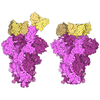
| Title | Cryo-EM structure of the HBsAg dimer and Complex with Fab | ||||||||||||||||||||||||||||||
 Components Components |
| ||||||||||||||||||||||||||||||
 Keywords Keywords | VIRAL PROTEIN/IMMUNE SYSTEM / HBV antigen / dimer / Fab / complex / VIRAL PROTEIN-IMMUNE SYSTEM complex | ||||||||||||||||||||||||||||||
| Function / homology | Large envelope protein S / Major surface antigen from hepadnavirus / membrane fusion involved in viral entry into host cell / symbiont entry into host cell / virion attachment to host cell / virion membrane / Middle S protein Function and homology information Function and homology information | ||||||||||||||||||||||||||||||
| Biological species |  Homo sapiens (human) Homo sapiens (human) hepatitis B virus genotype A hepatitis B virus genotype A | ||||||||||||||||||||||||||||||
| Method | ELECTRON MICROSCOPY / single particle reconstruction / cryo EM / Resolution: 4 Å | ||||||||||||||||||||||||||||||
 Authors Authors | Liu, Y. / Liao, M. / Liu, Z. / Ju, B. / Zhang, Z. | ||||||||||||||||||||||||||||||
| Funding support | 1items
| ||||||||||||||||||||||||||||||
 Citation Citation | Journal: Gut / Year: 2026 Title: Characterisation of plasmablast-derived HBsAg-specific antibody and its structural basis for binding to native HBsAg dimer. Authors: Bin Ju / Zhouqing Liu / Hu Yan / Yong Liu / Lu Zhang / Xiangyang Ge / Xin Wang / Zhu Si / Bing Zhou / Qing Fan / Miao Wang / Yuxiao Li / Wenlong Lai / Jianhui Gan / Haiyan Wang / Juanjuan ...Authors: Bin Ju / Zhouqing Liu / Hu Yan / Yong Liu / Lu Zhang / Xiangyang Ge / Xin Wang / Zhu Si / Bing Zhou / Qing Fan / Miao Wang / Yuxiao Li / Wenlong Lai / Jianhui Gan / Haiyan Wang / Juanjuan Zhao / Yuchen Xia / Maofu Liao / Zheng Zhang /  Abstract: BACKGROUND: Plasmablast-derived HBV surface antigen (HBsAg)-specific monoclonal antibody (mAb) and structural basis for binding to native HBsAg are poorly known. OBJECTIVE: We aimed to identify plasmablast-derived HBsAg-specific mAbs, evaluate their antiviral activities and resolve their structure for binding to native HBsAg. DESIGN: A previously vaccinated volunteer was enrolled in this study, who was boosted with a dose of recombinant hepatitis B vaccine and donated the blood sample. Activated plasmablasts were sorted ...DESIGN: A previously vaccinated volunteer was enrolled in this study, who was boosted with a dose of recombinant hepatitis B vaccine and donated the blood sample. Activated plasmablasts were sorted from fresh peripheral blood mononuclear cells and mAbs were expressed. Their gene features, cross-genotypic binding activities and antiviral functions in vitro and in vivo were comprehensively analysed. The cryo-electron microscopy (cryo-EM) was used to determine the structure of representative mAb bound to the native HBsAg. RESULTS: In this study, we cloned a series of HBsAg-specific mAbs directly from clonally expanded plasmablasts from a vaccinated individual. Most of the mAbs displayed cross-reactivities of binding ...RESULTS: In this study, we cloned a series of HBsAg-specific mAbs directly from clonally expanded plasmablasts from a vaccinated individual. Most of the mAbs displayed cross-reactivities of binding to different genotype HBsAg proteins and antiviral functions such as neutralisation and antibody-dependent cellular phagocytosis. These human anti-HBsAg mAbs, especially SY-4-class and SY-23-class, could be good candidates for antibody drugs. The cryo-EM structure of SY-23 bound to the dimeric HBsAg was determined, revealing its binding mechanism and unprecedented structural detail of the major antigenic loop (AGL) of HBsAg. CONCLUSION: Overall, our work has uncovered the diverse gene features and varied anti-HBV activities of plasmablast-derived mAbs, providing a series of antibody drug candidates and the long-sought- ...CONCLUSION: Overall, our work has uncovered the diverse gene features and varied anti-HBV activities of plasmablast-derived mAbs, providing a series of antibody drug candidates and the long-sought-after atomic model of AGL has paved the way for a wholistic characterisation of the AGL's dynamic conformation during HBV infection and immune response. | ||||||||||||||||||||||||||||||
| History |
|
- Structure visualization
| Structure viewer | Molecule: MolmilJmol/JSmol |
|---|
- Downloads & links
-Download
| PDBx/mmCIF format | 9ugo.cif.gz | 184.9 KB | Display | PDBx/mmCIF format |
|---|---|---|---|---|
| PDB format | pdb9ugo.ent.gz | 147.9 KB | Display | PDB format |
| PDBx/mmJSON format | 9ugo.json.gz | Tree view | PDBx/mmJSON format | |
| Others |  Other downloads Other downloads |
-Validation report
| Arichive directory | https://data.pdbj.org/pub/pdb/validation_reports/ug/9ugoftp://data.pdbj.org/pub/pdb/validation_reports/ug/9ugo | HTTPS FTP |
|---|
-Related structure data
| Related structure data |  64142MC M: map data used to model this data C: citing same article ( |
|---|---|
| Similar structure data |
-Links
 PDBj
PDBj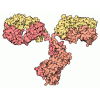
- Assembly
| Deposited unit | 
|
|---|---|
| 1 |
|
-Components
| #1: Antibody | Mass: 23425.979 Da / Num. of mol.: 2 Source method: isolated from a genetically manipulated source Source: (gene. exp.) Homo sapiens (human) / Production host: Homo sapiens (human)#2: Antibody | Mass: 24121.160 Da / Num. of mol.: 2 Source method: isolated from a genetically manipulated source Source: (gene. exp.) Homo sapiens (human) / Production host: Homo sapiens (human)#3: Protein | Mass: 11008.200 Da / Num. of mol.: 2 Source method: isolated from a genetically manipulated source Details: The sequence of organism hepatitis B virus genotype A is not available during the biocuration, replaced by B8QJB4 temporarily. Source: (gene. exp.) hepatitis B virus genotype AProduction host: Yeast centromeric expression vector p416CYC (others) References: UniProt: B8QJB4 Has protein modification | Y | |
|---|
-Experimental details
-Experiment
| Experiment | Method: ELECTRON MICROSCOPY |
|---|---|
| EM experiment | Aggregation state: PARTICLE / 3D reconstruction method: single particle reconstruction |
- Sample preparation
| Component | Name: complex of HBsAg dimer with Fab / Type: COMPLEX / Entity ID: all / Source: RECOMBINANT | ||||||||||||
|---|---|---|---|---|---|---|---|---|---|---|---|---|---|
| Source (natural) |
| ||||||||||||
| Source (recombinant) |
| ||||||||||||
| Buffer solution | pH: 7.5 | ||||||||||||
| Specimen | Embedding applied: NO / Shadowing applied: NO / Staining applied: NO / Vitrification applied: YES | ||||||||||||
| Vitrification | Cryogen name: ETHANE |
- Electron microscopy imaging
| Experimental equipment |  Model: Titan Krios / Image courtesy: FEI Company |
|---|---|
| Microscopy | Model: TFS KRIOS |
| Electron gun | Electron source:  FIELD EMISSION GUN / Accelerating voltage: 300 kV / Illumination mode: FLOOD BEAM FIELD EMISSION GUN / Accelerating voltage: 300 kV / Illumination mode: FLOOD BEAM |
| Electron lens | Mode: BRIGHT FIELD / Nominal defocus max: 2000 nm / Nominal defocus min: 1000 nm |
| Image recording | Electron dose: 50 e/Å2 / Film or detector model: GATAN K3 (6k x 4k) |
- Processing
| EM software | Name: PHENIX / Version: 1.18.2_3874: / Category: model refinement | ||||||||||||||||||||||||
|---|---|---|---|---|---|---|---|---|---|---|---|---|---|---|---|---|---|---|---|---|---|---|---|---|---|
| CTF correction | Type: PHASE FLIPPING AND AMPLITUDE CORRECTION | ||||||||||||||||||||||||
| 3D reconstruction | Resolution: 4 Å / Resolution method: FSC 0.143 CUT-OFF / Num. of particles: 53213 / Symmetry type: POINT | ||||||||||||||||||||||||
| Refine LS restraints |
|
