Journal: Protein Cell / Year: 2026 Title: DNA-triggered AIM2 condensation orchestrates immune activation and regulation. Authors: Quanjin Li / Xiaohan Geng / Huiwen Yan / Zhaolong Li / Miao Shi / Ziqi Zhu / Tongxin Niu / Chunqiu Zhao / Kaile Shu / Yina Gao / Han Feng / Songqing Liu / Qiuyao Jiang / Pengcheng Bu / Dong Li / Pu Gao / Abstract: The innate immune sensor AIM2 detects cytosolic DNA and initiates inflammatory responses, yet its activation mechanism remains incompletely understood. Here, we show that AIM2 undergoes liquid-liquid ...The innate immune sensor AIM2 detects cytosolic DNA and initiates inflammatory responses, yet its activation mechanism remains incompletely understood. Here, we show that AIM2 undergoes liquid-liquid phase separation upon DNA binding, forming dynamic condensates both in vitro and in cells. These condensates serve as platforms for inflammasome and PANoptosome assembly, promoting immune activation across multiple pathways. Direct structural determination from condensates reveals the assembly of active-form ASC filaments. Mechanistically, liquid-phase condensation is governed by multivalent interactions involving different AIM2 domains, including previously uncharacterized regions and species-specific elements. In vitro and in vivo assays show that mutants specifically disrupting condensation impair immune complex assembly, cell death initiation, antimicrobial defense, and intestinal homeostasis. Moreover, AIM2-DNA condensates function as regulatory hubs targeted by host- and pathogen-derived factors to balance immune homeostasis or facilitate immune evasion. These findings establish liquid-phase condensation as a fundamental mechanism of AIM2 activation and a potential therapeutic target.
History
Deposition
Mar 26, 2025
Deposition site: PDBJ / Processing site: PDBC
Revision 1.0
Apr 15, 2026
Provider: repository / Type: Initial release
Revision 1.0
Apr 15, 2026
Data content type: EM metadata / Data content type: EM metadata / Provider: repository / Type: Initial release
Revision 1.0
Apr 15, 2026
Data content type: FSC / Data content type: FSC / Provider: repository / Type: Initial release
Revision 1.0
Apr 15, 2026
Data content type: Half map / Part number: 1 / Data content type: Half map / Provider: repository / Type: Initial release
Revision 1.0
Apr 15, 2026
Data content type: Half map / Part number: 2 / Data content type: Half map / Provider: repository / Type: Initial release
Revision 1.0
Apr 15, 2026
Data content type: Image / Data content type: Image / Provider: repository / Type: Initial release
Revision 1.0
Apr 15, 2026
Data content type: Primary map / Data content type: Primary map / Provider: repository / Type: Initial release
Data content type: EM metadata / Data content type: EM metadata / EM metadata / Group: Database references / Experimental summary / Data content type: EM metadata / EM metadata / Category: citation / em_admin Data content type: EM metadata / EM metadata ...EM metadata / EM metadata / EM metadata / EM metadata Item: _citation.journal_volume / _citation.page_first ..._citation.journal_volume / _citation.page_first / _citation.page_last / _em_admin.last_update
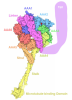
A: Apoptosis-associated speck-like protein containing a CARD B: Apoptosis-associated speck-like protein containing a CARD C: Apoptosis-associated speck-like protein containing a CARD D: Apoptosis-associated speck-like protein containing a CARD E: Apoptosis-associated speck-like protein containing a CARD F: Apoptosis-associated speck-like protein containing a CARD G: Apoptosis-associated speck-like protein containing a CARD H: Apoptosis-associated speck-like protein containing a CARD I: Apoptosis-associated speck-like protein containing a CARD J: Apoptosis-associated speck-like protein containing a CARD K: Apoptosis-associated speck-like protein containing a CARD L: Apoptosis-associated speck-like protein containing a CARD M: Apoptosis-associated speck-like protein containing a CARD N: Apoptosis-associated speck-like protein containing a CARD O: Apoptosis-associated speck-like protein containing a CARD P: Apoptosis-associated speck-like protein containing a CARD Q: Apoptosis-associated speck-like protein containing a CARD R: Apoptosis-associated speck-like protein containing a CARD S: Apoptosis-associated speck-like protein containing a CARD T: Apoptosis-associated speck-like protein containing a CARD U: Apoptosis-associated speck-like protein containing a CARD V: Apoptosis-associated speck-like protein containing a CARD W: Apoptosis-associated speck-like protein containing a CARD X: Apoptosis-associated speck-like protein containing a CARD Y: Apoptosis-associated speck-like protein containing a CARD Z: Apoptosis-associated speck-like protein containing a CARD a1: Apoptosis-associated speck-like protein containing a CARD b1: Apoptosis-associated speck-like protein containing a CARD c1: Apoptosis-associated speck-like protein containing a CARD d1: Apoptosis-associated speck-like protein containing a CARD e1: Apoptosis-associated speck-like protein containing a CARD f1: Apoptosis-associated speck-like protein containing a CARD g1: Apoptosis-associated speck-like protein containing a CARD h1: Apoptosis-associated speck-like protein containing a CARD i1: Apoptosis-associated speck-like protein containing a CARD j1: Apoptosis-associated speck-like protein containing a CARD k1: Apoptosis-associated speck-like protein containing a CARD l1: Apoptosis-associated speck-like protein containing a CARD m1: Apoptosis-associated speck-like protein containing a CARD
... Apoptosis-associatedspeck-likeproteincontainingaCARD / mASC / PYD and CARD domain-containing protein
Mass: 11547.250 Da / Num. of mol.: 39 Source method: isolated from a genetically manipulated source Source: (gene. exp.) human gammaherpesvirus 4 (Epstein-Barr virus) Production host: Escherichia coli (E. coli) / References: UniProt: Q9EPB4
Has protein modification
N
-
Experimental details
-
Experiment
Experiment
Method: ELECTRON MICROSCOPY
EM experiment
Aggregation state: PARTICLE / 3D reconstruction method: single particle reconstruction
-
Sample preparation
Component
Name: ASC-PYD filament from condensates / Type: COMPLEX / Entity ID: all / Source: RECOMBINANT
In the structure databanks used in Yorodumi, some data are registered as the other names, "COVID-19 virus" and "2019-nCoV". Here are the details of the virus and the list of structure data.
Jan 31, 2019. EMDB accession codes are about to change! (news from PDBe EMDB page)
EMDB accession codes are about to change! (news from PDBe EMDB page)
The allocation of 4 digits for EMDB accession codes will soon come to an end. Whilst these codes will remain in use, new EMDB accession codes will include an additional digit and will expand incrementally as the available range of codes is exhausted. The current 4-digit format prefixed with “EMD-” (i.e. EMD-XXXX) will advance to a 5-digit format (i.e. EMD-XXXXX), and so on. It is currently estimated that the 4-digit codes will be depleted around Spring 2019, at which point the 5-digit format will come into force.
The EM Navigator/Yorodumi systems omit the EMD- prefix.
Related info.:Q: What is EMD? / ID/Accession-code notation in Yorodumi/EM Navigator
Yorodumi is a browser for structure data from EMDB, PDB, SASBDB, etc.
This page is also the successor to EM Navigator detail page, and also detail information page/front-end page for Omokage search.
The word "yorodu" (or yorozu) is an old Japanese word meaning "ten thousand". "mi" (miru) is to see.
Related info.:EMDB / PDB / SASBDB / Comparison of 3 databanks / Yorodumi Search / Aug 31, 2016. New EM Navigator & Yorodumi / Yorodumi Papers / Jmol/JSmol / Function and homology information / Changes in new EM Navigator and Yorodumi
 Movie
Movie Controller


 Open data
 Basic information
 Components
 Keywords
 Function and homology information
 human gammaherpesvirus 4 (Epstein-Barr virus)
 Authors
 Citation
 Structure visualization
 Downloads & links
 Other downloads
 PDBj
PDBj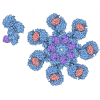
 Assembly

 Escherichia coli (E. coli) / References: UniProt: Q9EPB4
 Sample preparation
 Electron microscopy imaging
 FIELD EMISSION GUN / Accelerating voltage: 300 kV / Illumination mode: FLOOD BEAM
 Processing