[English] 日本語
Yorodumi
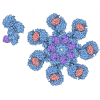
- EMDB-63955: Structure of ASC-PYD filament from condensates -

+
Open data


ID or keywords:

Loading...

-
Basic information

Entry
Database: EMDB / ID: EMD-63955
TitleStructure of ASC-PYD filament from condensates
Map data
Sample
  • Complex: ASC-PYD filament from condensates
    • Protein or peptide: Apoptosis-associated speck-like protein containing a CARD
KeywordsASC-PYD / filament / condensates / IMMUNE SYSTEM
Function / homology
Function and homology information


CLEC7A/inflammasome pathway / The NLRP3 inflammasome / peptidase activator activity involved in apoptotic process / NLRP6 inflammasome complex / myosin I binding / Pyrin domain binding / myeloid dendritic cell activation involved in immune response / positive regulation of antigen processing and presentation of peptide antigen via MHC class II / regulation of intrinsic apoptotic signaling pathway / myeloid dendritic cell activation ...CLEC7A/inflammasome pathway / The NLRP3 inflammasome / peptidase activator activity involved in apoptotic process / NLRP6 inflammasome complex / myosin I binding / Pyrin domain binding / myeloid dendritic cell activation involved in immune response / positive regulation of antigen processing and presentation of peptide antigen via MHC class II / regulation of intrinsic apoptotic signaling pathway / myeloid dendritic cell activation / IkappaB kinase complex / AIM2 inflammasome complex / NLRP1 inflammasome complex / macropinocytosis / canonical inflammasome complex / interleukin-6 receptor binding / BMP receptor binding / NLRP3 inflammasome complex / NLRP3 inflammasome complex assembly / positive regulation of adaptive immune response / cysteine-type endopeptidase activator activity / negative regulation of interferon-beta production / regulation of tumor necrosis factor-mediated signaling pathway / regulation of GTPase activity / osmosensory signaling pathway / positive regulation of activated T cell proliferation / positive regulation of extrinsic apoptotic signaling pathway / pattern recognition receptor signaling pathway / pattern recognition receptor activity / tropomyosin binding / positive regulation of actin filament polymerization / positive regulation of release of cytochrome c from mitochondria / intrinsic apoptotic signaling pathway by p53 class mediator / positive regulation of interleukin-10 production / intrinsic apoptotic signaling pathway in response to DNA damage by p53 class mediator / pyroptotic inflammatory response / cellular response to interleukin-1 / positive regulation of T cell migration / positive regulation of defense response to virus by host / positive regulation of chemokine production / Neutrophil degranulation / negative regulation of cytokine production involved in inflammatory response / activation of innate immune response / intrinsic apoptotic signaling pathway / positive regulation of phagocytosis / tumor necrosis factor-mediated signaling pathway / positive regulation of interleukin-1 beta production / regulation of autophagy / positive regulation of interleukin-8 production / negative regulation of canonical NF-kappaB signal transduction / response to bacterium / apoptotic signaling pathway / regulation of protein stability / positive regulation of non-canonical NF-kappaB signal transduction / protein homooligomerization / positive regulation of interleukin-6 production / positive regulation of JNK cascade / cellular response to tumor necrosis factor / positive regulation of type II interferon production / positive regulation of T cell activation / positive regulation of tumor necrosis factor production / positive regulation of inflammatory response / cellular response to lipopolysaccharide / regulation of inflammatory response / protease binding / regulation of apoptotic process / defense response to virus / defense response to Gram-negative bacterium / microtubule / transmembrane transporter binding / positive regulation of canonical NF-kappaB signal transduction / positive regulation of ERK1 and ERK2 cascade / protein dimerization activity / defense response to Gram-positive bacterium / positive regulation of apoptotic process / inflammatory response / Golgi membrane / innate immune response / neuronal cell body / apoptotic process / nucleolus / enzyme binding / endoplasmic reticulum / protein homodimerization activity / protein-containing complex / mitochondrion / extracellular region / nucleoplasm / identical protein binding / nucleus / cytoplasm / cytosol
Similarity search - Function
CARD8/ASC/NALP1, CARD domain / : / DAPIN domain profile. / DAPIN domain / PAAD/DAPIN/Pyrin domain / PAAD/DAPIN/Pyrin domain / CARD domain / CARD caspase recruitment domain profile. / Caspase recruitment domain / Death-like domain superfamily
Similarity search - Domain/homology
Apoptosis-associated speck-like protein containing a CARD
Similarity search - Component
Biological speciesEpstein-Barr virus (strain GD1) (Epstein-Barr virus) / human gammaherpesvirus 4 (Epstein-Barr virus)
Methodsingle particle reconstruction / cryo EM / Resolution: 2.7 Å
AuthorsGao P / Li QJ / Li ZL
Funding support1 items
OrganizationGrant numberCountry
Not funded
CitationJournal: Protein Cell / Year: 2026
Title: DNA-triggered AIM2 condensation orchestrates immune activation and regulation.
Authors: Quanjin Li / Xiaohan Geng / Huiwen Yan / Zhaolong Li / Miao Shi / Ziqi Zhu / Tongxin Niu / Chunqiu Zhao / Kaile Shu / Yina Gao / Han Feng / Songqing Liu / Qiuyao Jiang / Pengcheng Bu / Dong Li / Pu Gao /
Abstract: The innate immune sensor AIM2 detects cytosolic DNA and initiates inflammatory responses, yet its activation mechanism remains incompletely understood. Here, we show that AIM2 undergoes liquid-liquid ...The innate immune sensor AIM2 detects cytosolic DNA and initiates inflammatory responses, yet its activation mechanism remains incompletely understood. Here, we show that AIM2 undergoes liquid-liquid phase separation upon DNA binding, forming dynamic condensates both in vitro and in cells. These condensates serve as platforms for inflammasome and PANoptosome assembly, promoting immune activation across multiple pathways. Direct structural determination from condensates reveals the assembly of active-form ASC filaments. Mechanistically, liquid-phase condensation is governed by multivalent interactions involving different AIM2 domains, including previously uncharacterized regions and species-specific elements. In vitro and in vivo assays show that mutants specifically disrupting condensation impair immune complex assembly, cell death initiation, antimicrobial defense, and intestinal homeostasis. Moreover, AIM2-DNA condensates function as regulatory hubs targeted by host- and pathogen-derived factors to balance immune homeostasis or facilitate immune evasion. These findings establish liquid-phase condensation as a fundamental mechanism of AIM2 activation and a potential therapeutic target.
History
DepositionMar 26, 2025-
Header (metadata) releaseApr 15, 2026-
Map releaseApr 15, 2026-
UpdateApr 15, 2026-
Current statusApr 15, 2026Processing site: PDBc / Status: Released

-
Structure visualization

Supplemental images

Downloads & links

-
Map

FileDownload / File: emd_63955.map.gz / Format: CCP4 / Size: 512 MB / Type: IMAGE STORED AS FLOATING POINT NUMBER (4 BYTES)
Projections & slices

Image control

Size
Brightness
Contrast
Others
AxesZ (Sec.)Y (Row.)X (Col.)
0.52 Å/pix.
x 512 pix.
= 266.24 Å
0.52 Å/pix.
x 512 pix.
= 266.24 Å
0.52 Å/pix.
x 512 pix.
= 266.24 Å

Surface

Projections

Slices (1/3)

Slices (1/2)

Slices (2/3)

Images are generated by Spider.

Voxel sizeX=Y=Z: 0.52 Å
Density
Contour LevelBy AUTHOR: 0.05
Minimum - Maximum-0.17016016 - 0.29335555
Average (Standard dev.)0.0007475207 (±0.01125249)
SymmetrySpace group: 1
Details

EMDB XML:

Map geometry
Axis orderXYZ
Origin000
Dimensions512512512
Spacing512512512
CellA=B=C: 266.24 Å
α=β=γ: 90.0 °

-
Supplemental data

-
Half map: #1

Fileemd_63955_half_map_1.map
Projections & Slices
AxesZYX

Projections

Slices (1/2)
Density Histograms

-
Half map: #2

Fileemd_63955_half_map_2.map
Projections & Slices
AxesZYX

Projections

Slices (1/2)
Density Histograms

-
Sample components

-
Entire : ASC-PYD filament from condensates

EntireName: ASC-PYD filament from condensates
Components
  • Complex: ASC-PYD filament from condensates
    • Protein or peptide: Apoptosis-associated speck-like protein containing a CARD

-
Supramolecule #1: ASC-PYD filament from condensates

SupramoleculeName: ASC-PYD filament from condensates / type: complex / ID: 1 / Parent: 0 / Macromolecule list: all
Source (natural)Organism: Epstein-Barr virus (strain GD1) (Epstein-Barr virus)

-
Macromolecule #1: Apoptosis-associated speck-like protein containing a CARD

MacromoleculeName: Apoptosis-associated speck-like protein containing a CARD
type: protein_or_peptide / ID: 1 / Number of copies: 39 / Enantiomer: LEVO
Source (natural)Organism: human gammaherpesvirus 4 (Epstein-Barr virus)
Molecular weightTheoretical: 11.54725 KDa
Recombinant expressionOrganism: Escherichia coli (E. coli)
SequenceString:
MGRARDAILD ALENLSGDEL KKFKMKLLTV QLREGYGRIP RGALLQMDAI DLTDKLVSYY LESYGLELTM TVLRDMGLQE LAEQLQTTK EESGAVAAAA SVPAQS

UniProtKB: Apoptosis-associated speck-like protein containing a CARD

-
Experimental details

-
Structure determination

Methodcryo EM
Processingsingle particle reconstruction
Aggregation stateparticle

-
Sample preparation

BufferpH: 7.5
VitrificationCryogen name: ETHANE

-
Electron microscopy

MicroscopeTFS TITAN THEMIS
Image recordingFilm or detector model: GATAN K2 SUMMIT (4k x 4k) / Average electron dose: 60.0 e/Å2
Electron beamAcceleration voltage: 300 kV / Electron source: FIELD EMISSION GUN
Electron opticsIllumination mode: FLOOD BEAM / Imaging mode: BRIGHT FIELD / Nominal defocus max: 1.8 µm / Nominal defocus min: 1.2 µm

+
Image processing

CTF correctionType: PHASE FLIPPING AND AMPLITUDE CORRECTION
Startup modelType of model: NONE
Final reconstructionResolution.type: BY AUTHOR / Resolution: 2.7 Å / Resolution method: FSC 0.143 CUT-OFF / Software - Name: cryoSPARC (ver. 4.7) / Number images used: 45400
Initial angle assignmentType: PROJECTION MATCHING
Final angle assignmentType: PROJECTION MATCHING
FSC plot (resolution estimation)

+
About Yorodumi

-
News

-
Feb 9, 2022. New format data for meta-information of EMDB entries

New format data for meta-information of EMDB entries

  • Version 3 of the EMDB header file is now the official format.
  • The previous official version 1.9 will be removed from the archive.

Related info.:EMDB header

External links:wwPDB to switch to version 3 of the EMDB data model

-
Aug 12, 2020. Covid-19 info

Covid-19 info

URL: https://pdbj.org/emnavi/covid19.php

New page: Covid-19 featured information page in EM Navigator.

Related info.:Covid-19 info / Mar 5, 2020. Novel coronavirus structure data

+
Mar 5, 2020. Novel coronavirus structure data

Novel coronavirus structure data

Related info.:Yorodumi Speices / Aug 12, 2020. Covid-19 info

External links:COVID-19 featured content - PDBj / Molecule of the Month (242):Coronavirus Proteases

+
Jan 31, 2019. EMDB accession codes are about to change! (news from PDBe EMDB page)

EMDB accession codes are about to change! (news from PDBe EMDB page)

  • The allocation of 4 digits for EMDB accession codes will soon come to an end. Whilst these codes will remain in use, new EMDB accession codes will include an additional digit and will expand incrementally as the available range of codes is exhausted. The current 4-digit format prefixed with “EMD-” (i.e. EMD-XXXX) will advance to a 5-digit format (i.e. EMD-XXXXX), and so on. It is currently estimated that the 4-digit codes will be depleted around Spring 2019, at which point the 5-digit format will come into force.
  • The EM Navigator/Yorodumi systems omit the EMD- prefix.

Related info.:Q: What is EMD? / ID/Accession-code notation in Yorodumi/EM Navigator

External links:EMDB Accession Codes are Changing Soon! / Contact to PDBj

+
Jul 12, 2017. Major update of PDB

Major update of PDB

  • wwPDB released updated PDB data conforming to the new PDBx/mmCIF dictionary.
  • This is a major update changing the version number from 4 to 5, and with Remediation, in which all the entries are updated.
  • In this update, many items about electron microscopy experimental information are reorganized (e.g. em_software).
  • Now, EM Navigator and Yorodumi are based on the updated data.

External links:wwPDB Remediation / Enriched Model Files Conforming to OneDep Data Standards Now Available in the PDB FTP Archive

-
Yorodumi

Thousand views of thousand structures

  • Yorodumi is a browser for structure data from EMDB, PDB, SASBDB, etc.
  • This page is also the successor to EM Navigator detail page, and also detail information page/front-end page for Omokage search.
  • The word "yorodu" (or yorozu) is an old Japanese word meaning "ten thousand". "mi" (miru) is to see.

Related info.:EMDB / PDB / SASBDB / Comparison of 3 databanks / Yorodumi Search / Aug 31, 2016. New EM Navigator & Yorodumi / Yorodumi Papers / Jmol/JSmol / Function and homology information / Changes in new EM Navigator and Yorodumi

Read more