 Movie
Movie Controller


+ Open data

- Basic information
| Entry | Database: PDB / ID: 9tzw | |||||||||||||||||||||||||||
|---|---|---|---|---|---|---|---|---|---|---|---|---|---|---|---|---|---|---|---|---|---|---|---|---|---|---|---|---|
| Title | SARM1 TIR with BEXi adduct 6 | |||||||||||||||||||||||||||
 Components Components | NAD(+) hydrolase SARM1 | |||||||||||||||||||||||||||
 Keywords Keywords | HYDROLASE / NAD(+) / SARM1 / TIR | |||||||||||||||||||||||||||
| Function / homology |  Function and homology information Function and homology informationnegative regulation of MyD88-independent toll-like receptor signaling pathway / extrinsic component of synaptic membrane / MyD88-independent TLR4 cascade / NADP+ nucleosidase activity / Toll Like Receptor 3 (TLR3) Cascade / NAD+ nucleosidase activity / regulation of synapse pruning / modification of postsynaptic structure / NAD+ catabolic process / ADP-ribosyl cyclase/cyclic ADP-ribose hydrolase ...negative regulation of MyD88-independent toll-like receptor signaling pathway / extrinsic component of synaptic membrane / MyD88-independent TLR4 cascade / NADP+ nucleosidase activity / Toll Like Receptor 3 (TLR3) Cascade / NAD+ nucleosidase activity / regulation of synapse pruning / modification of postsynaptic structure / NAD+ catabolic process / ADP-ribosyl cyclase/cyclic ADP-ribose hydrolase / NAD+ nucleosidase activity, cyclic ADP-ribose generating / nervous system process / positive regulation of programmed cell death / regulation of dendrite morphogenesis / response to axon injury / protein localization to mitochondrion / signaling adaptor activity / TRAF6-mediated induction of TAK1 complex within TLR4 complex / Activation of IRF3, IRF7 mediated by TBK1, IKKε (IKBKE) / IKK complex recruitment mediated by RIP1 / neuromuscular junction / microtubule / double-stranded DNA binding / Hydrolases; Glycosylases; Hydrolysing N-glycosyl compounds / mitochondrial outer membrane / axon / dendrite / synapse / glutamatergic synapse / signal transduction / cell surface / mitochondrion / identical protein binding / cytosol / cytoplasm Similarity search - Function | |||||||||||||||||||||||||||
| Biological species |  Homo sapiens (human) Homo sapiens (human) | |||||||||||||||||||||||||||
| Method | ELECTRON MICROSCOPY / single particle reconstruction / cryo EM / Resolution: 3.3 Å | |||||||||||||||||||||||||||
 Authors Authors | Sader, K.S. / Oliveria, T.M. | |||||||||||||||||||||||||||
| Funding support | 1items
| |||||||||||||||||||||||||||
 Citation Citation | Journal: Commun Chem / Year: 2026 Title: The rise and fall of SARM1 base-exchange inhibitors. Authors: Thomas Lundbäck / Vijay Chandrasekar / Chendi Gu / Hyoungseok Ju / Robyn McAdam / Maria Palomero / Kasim Sader / Bradley Peter / Lisa Wissler / Philip Nevin / Edmund Foster / Tanguy Jamier ...Authors: Thomas Lundbäck / Vijay Chandrasekar / Chendi Gu / Hyoungseok Ju / Robyn McAdam / Maria Palomero / Kasim Sader / Bradley Peter / Lisa Wissler / Philip Nevin / Edmund Foster / Tanguy Jamier / Pravallika Manjappa / Carina Johansson / Jenny Sandmark / Mei Ding / Anette Persson-Kry / Sanhita Mitra / Tugce Munise Satir / Bilada Bilican / Mirko Messa / Graham Fraser / John Linley / Helen Plant / Rachel Moore / Tina Seifert / Michael Lerche / Carina Raynochek / Ewa Nilsson / Nour Majbour / Richard Lucey / Taiana Maia de Oliveira / Qi Wang / Iain Chessell / Perla Breccia / Rebecca Jarvis /    Abstract: The sterile alpha and TIR motif containing 1 (SARM1) enzyme is a key driver of axonal degeneration in response to injury, making it an attractive target for treating chemotherapy-induced peripheral ...The sterile alpha and TIR motif containing 1 (SARM1) enzyme is a key driver of axonal degeneration in response to injury, making it an attractive target for treating chemotherapy-induced peripheral neuropathy (CIPN) and other nervous system diseases. In this study, we identified and optimised a class of base-exchange inhibitors (BEXi) targeting human SARM1 and explored their molecular interactions and conformational effects using cryo-EM, HDX-MS and SAXS. Although BEXi produced robust inhibition across all biochemical and cellular assay formats, application at sub-inhibitory concentrations consistently led to paradoxical SARM1 activation, and in neuronal assays, accelerated neurite degeneration. Further analysis showed that BEXi only delayed, rather than prevented, neurite degeneration when applied to primary neuronal cells, even at exceedingly high inhibitor concentrations. These results prompted us to discontinue BEXi development in favour of alternative strategies, underscoring the complexity of SARM1 as a therapeutic target and the need for comprehensive, mechanistically informed screening cascades. | |||||||||||||||||||||||||||
| History |
|
- Structure visualization
| Structure viewer | Molecule: MolmilJmol/JSmol |
|---|
- Downloads & links
-Download
| PDBx/mmCIF format | 9tzw.cif.gz | 221.6 KB | Display | PDBx/mmCIF format |
|---|---|---|---|---|
| PDB format | pdb9tzw.ent.gz | Display | PDB format | |
| PDBx/mmJSON format | 9tzw.json.gz | Tree view | PDBx/mmJSON format | |
| Others |  Other downloads Other downloads |
-Validation report
| Arichive directory | https://data.pdbj.org/pub/pdb/validation_reports/tz/9tzwftp://data.pdbj.org/pub/pdb/validation_reports/tz/9tzw | HTTPS FTP |
|---|
-Related structure data
| Related structure data |  56477MC  9tzyC M: map data used to model this data C: citing same article ( |
|---|---|
| Similar structure data |

-Links
 PDBj
PDBj

- Assembly
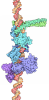
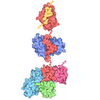
| Deposited unit | 
|
|---|---|
| 1 |
|
-Components
| #1: Protein | Mass: 16148.522 Da / Num. of mol.: 4 Source method: isolated from a genetically manipulated source Source: (gene. exp.) Homo sapiens (human) / Gene: SARM1, KIAA0524, SAMD2, SARM / Production host:   Escherichia coli (E. coli) Escherichia coli (E. coli)References: UniProt: Q6SZW1, ADP-ribosyl cyclase/cyclic ADP-ribose hydrolase, Hydrolases; Glycosylases; Hydrolysing N-glycosyl compounds #2: Chemical | ChemComp-A1JZX / [[( Mass: 846.654 Da / Num. of mol.: 4 / Source method: obtained synthetically / Formula: C33H38N9O14P2 / Feature type: SUBJECT OF INVESTIGATION Has ligand of interest | Y | Has protein modification | N | |
|---|
-Experimental details
-Experiment
| Experiment | Method: ELECTRON MICROSCOPY |
|---|---|
| EM experiment | Aggregation state: PARTICLE / 3D reconstruction method: single particle reconstruction |
- Sample preparation
| Component | Name: SARM1 / Type: COMPLEX / Details: TIR assembly / Entity ID: #1 / Source: RECOMBINANT | |||||||||||||||
|---|---|---|---|---|---|---|---|---|---|---|---|---|---|---|---|---|
| Molecular weight | Experimental value: NO | |||||||||||||||
| Source (natural) | Organism: Homo sapiens (human) | |||||||||||||||
| Source (recombinant) | Organism: Escherichia coli (E. coli) | |||||||||||||||
| Buffer solution | pH: 7.5 | |||||||||||||||
| Buffer component |
| |||||||||||||||
| Specimen | Conc.: 6.83 mg/ml / Embedding applied: NO / Shadowing applied: NO / Staining applied: NO / Vitrification applied: YES / Details: Sample flash-frozen and stored at -80C. | |||||||||||||||
| Specimen support | Grid material: COPPER / Grid mesh size: 200 divisions/in. / Grid type: Quantifoil R1.2/1.3 | |||||||||||||||
| Vitrification | Instrument: FEI VITROBOT MARK IV / Cryogen name: ETHANE / Humidity: 100 % / Chamber temperature: 277 K / Details: 2.5ul |
- Electron microscopy imaging
| Experimental equipment |  Model: Titan Krios / Image courtesy: FEI Company |
|---|---|
| Microscopy | Model: TFS KRIOS |
| Electron gun | Electron source:  FIELD EMISSION GUN / Accelerating voltage: 300 kV / Illumination mode: FLOOD BEAM FIELD EMISSION GUN / Accelerating voltage: 300 kV / Illumination mode: FLOOD BEAM |
| Electron lens | Mode: BRIGHT FIELD / Nominal magnification: 120000 X / Calibrated magnification: 213000 X / Nominal defocus max: 2000 nm / Nominal defocus min: 1000 nm / Calibrated defocus min: 500 nm / Calibrated defocus max: 3700 nm / Cs: 2.7 mm / C2 aperture diameter: 50 µm / Alignment procedure: COMA FREE |
| Specimen holder | Cryogen: NITROGEN / Specimen holder model: FEI TITAN KRIOS AUTOGRID HOLDER / Temperature (max): 77 K / Temperature (min): 77 K / Residual tilt: 0.02 mradians |
| Image recording | Average exposure time: 4.38 sec. / Electron dose: 43 e/Å2 / Film or detector model: FEI FALCON IV (4k x 4k) / Num. of grids imaged: 1 / Num. of real images: 3758 / Details: Movies were collected in EER mode. |
| Image scans | Sampling size: 14 µm / Width: 4096 / Height: 4096 |
- Processing
| EM software |
| ||||||||||||||||||||||||||||||||||||||||
|---|---|---|---|---|---|---|---|---|---|---|---|---|---|---|---|---|---|---|---|---|---|---|---|---|---|---|---|---|---|---|---|---|---|---|---|---|---|---|---|---|---|
| CTF correction | Type: PHASE FLIPPING AND AMPLITUDE CORRECTION | ||||||||||||||||||||||||||||||||||||||||
| Particle selection | Num. of particles selected: 2535468 | ||||||||||||||||||||||||||||||||||||||||
| Symmetry | Point symmetry: C1 (asymmetric) | ||||||||||||||||||||||||||||||||||||||||
| 3D reconstruction | Resolution: 3.3 Å / Resolution method: FSC 0.143 CUT-OFF / Num. of particles: 110926 / Algorithm: FOURIER SPACE / Details: Non-uniform refinement / Num. of class averages: 1 / Symmetry type: POINT | ||||||||||||||||||||||||||||||||||||||||
| Atomic model building | B value: 62.3 / Protocol: RIGID BODY FIT / Space: RECIPROCAL / Target criteria: Cross-correlation Details: Rigid body fitting of TIR monomers was done in Chimera, followed by realspace refinement in Coot, and finally refinement in Phenix. | ||||||||||||||||||||||||||||||||||||||||
| Atomic model building | PDB-ID: 7NAK Accession code: 7NAK / Source name: PDB / Type: experimental model |

