 Movie
Movie Controller


+ Open data

- Basic information
| Entry | Database: PDB / ID: 9tkg | |||||||||||||||||||||||||||
|---|---|---|---|---|---|---|---|---|---|---|---|---|---|---|---|---|---|---|---|---|---|---|---|---|---|---|---|---|
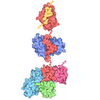
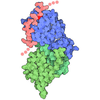
| Title | TAF15 amyloid filament fold F | |||||||||||||||||||||||||||
 Components Components | TATA-binding protein-associated factor 2N | |||||||||||||||||||||||||||
 Keywords Keywords | PROTEIN FIBRIL / Amyloid Neurodegeneration Frontotemporal lobar degeneration | |||||||||||||||||||||||||||
| Function / homology |  Function and homology information Function and homology informationmRNA stabilization / HIV Transcription Initiation / RNA Polymerase II HIV Promoter Escape / Transcription of the HIV genome / RNA Polymerase II Promoter Escape / RNA Polymerase II Transcription Pre-Initiation And Promoter Opening / RNA Polymerase II Transcription Initiation / RNA Polymerase II Transcription Initiation And Promoter Clearance / RNA Polymerase II Pre-transcription Events / mRNA 3'-UTR binding ...mRNA stabilization / HIV Transcription Initiation / RNA Polymerase II HIV Promoter Escape / Transcription of the HIV genome / RNA Polymerase II Promoter Escape / RNA Polymerase II Transcription Pre-Initiation And Promoter Opening / RNA Polymerase II Transcription Initiation / RNA Polymerase II Transcription Initiation And Promoter Clearance / RNA Polymerase II Pre-transcription Events / mRNA 3'-UTR binding / transcription coregulator activity / Regulation of TP53 Activity through Phosphorylation / positive regulation of DNA-templated transcription / DNA binding / RNA binding / nucleoplasm / zinc ion binding / nucleus / cytoplasm Similarity search - Function | |||||||||||||||||||||||||||
| Biological species |  Homo sapiens (human) Homo sapiens (human) | |||||||||||||||||||||||||||
| Method | ELECTRON MICROSCOPY / helical reconstruction / cryo EM / Resolution: 2.08 Å | |||||||||||||||||||||||||||
 Authors Authors | Tetter, S. / Varghese, N.R. / Ryskeldi-Falcon, B. | |||||||||||||||||||||||||||
| Funding support |  United Kingdom, 1items United Kingdom, 1items
| |||||||||||||||||||||||||||
 Citation Citation | Journal: bioRxiv / Year: 2026 Title: Distinct TAF15 amyloid filament folds define multiple subtypes of FTLD-TAF15. Authors: Stephan Tetter / Nikhil R Varghese / Alexey G Murzin / Wouter De Coster / Marleen Van den Broeck / Sigrun Roeber / Jeffrey T Joseph / Kathy Newell / Rudolf Castellani / Sumit Das / Lee-Cyn ...Authors: Stephan Tetter / Nikhil R Varghese / Alexey G Murzin / Wouter De Coster / Marleen Van den Broeck / Sigrun Roeber / Jeffrey T Joseph / Kathy Newell / Rudolf Castellani / Sumit Das / Lee-Cyn Ang / Matthis Synofzik / Jochen Herms / Rosa Rademakers / Bernardino Ghetti / Tammaryn Lashley / Ian R A Mackenzie / Manuela Neumann / Benjamin Ryskeldi-Falcon /     Abstract: Neurodegenerative diseases are characterised by the assembly of a limited number of disease-specific proteins into amyloid filaments, which form intracellular inclusions or extracellular deposits in ...Neurodegenerative diseases are characterised by the assembly of a limited number of disease-specific proteins into amyloid filaments, which form intracellular inclusions or extracellular deposits in the central nervous system (CNS). We previously found that amyloid filaments of TATA-binding protein-associated factor 15 (TAF15) characterise a subtype of frontotemporal lobar degeneration with FET protein-immunoreactive inclusions (FTLD-FET), termed atypical FTLD with ubiquitin-positive inclusions (aFTLD-U), which causes early-onset, rapidly progressive behavioural variant frontotemporal dementia (FTD). However, it was not clear if TAF15 proteinopathy was more widespread in neurodegenerative diseases. Two additional FTLD-FET subtypes have been proposed, neuronal intermediate filament inclusion body disease (NIFID) and basophilic inclusion body disease (BIBD), which have more heterogenous clinical presentations including FTD, motor neuron diseases (MND) and movement disorders. Here, we used electron cryo-microscopy (cryo-EM) to determine a total of 32 amyloid filament structures from the brains of 17 individuals encompassing all three proposed subtypes of FTLD-FET and their diverse clinical presentations. All cases were characterised by TAF15 filaments, in the absence of filaments of the other FET proteins, fused in sarcoma (FUS) and Ewing's sarcoma (EWS). All three aFTLD-U cases had the previously-reported TAF15 fold. Unexpectedly, we found four distinct TAF15 folds among 11 NIFID cases. Eight of these cases shared a common fold, while the remaining three were each distinct. Furthermore, we found distinct TAF15 folds for each of the three BIBD cases. Neuropathological reassessment of the neocortical TAF15 inclusion pathology of these cases distinguished the NIFID cases with the common fold from the others. Thus, TAF15 filament structures form the basis of a new, expanded classification of FTLD-FET subtypes. Moreover, we discovered a TAF15 Y38C variant in the filament fold of one of the individuals with BIBD. The structure is unable to incorporate wild-type TAF15, despite the individual being heterozygous, suggesting that this variant drives TAF15 filament assembly. This study provides structural and genetic evidence that TAF15 amyloid filaments underlie the diverse group of neurodegenerative diseases currently termed FTLD-FET, which we therefore rename FTLD-TAF15. | |||||||||||||||||||||||||||
| History |
|
- Structure visualization
| Structure viewer | Molecule: MolmilJmol/JSmol |
|---|
- Downloads & links
-Download
| PDBx/mmCIF format | 9tkg.cif.gz | 135.7 KB | Display | PDBx/mmCIF format |
|---|---|---|---|---|
| PDB format | pdb9tkg.ent.gz | 75.2 KB | Display | PDB format |
| PDBx/mmJSON format | 9tkg.json.gz | Tree view | PDBx/mmJSON format | |
| Others |  Other downloads Other downloads |
-Validation report
| Arichive directory | https://data.pdbj.org/pub/pdb/validation_reports/tk/9tkgftp://data.pdbj.org/pub/pdb/validation_reports/tk/9tkg | HTTPS FTP |
|---|
-Related structure data
| Related structure data |  56027MC  9thmC  9thnC  9thpC  9tkeC  9tkfC  9tkhC  9tkiC  9tkjC  9tkkC  9tklC  9tkzC  9tl2C M: map data used to model this data C: citing same article ( |
|---|---|
| Similar structure data |


-Links
 PDBj
PDBj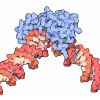
- Assembly
| Deposited unit | 
| ||||||||||||||||||||||||
|---|---|---|---|---|---|---|---|---|---|---|---|---|---|---|---|---|---|---|---|---|---|---|---|---|---|
| 1 |
| ||||||||||||||||||||||||
| Noncrystallographic symmetry (NCS) | NCS oper:
|
-Components
| #1: Protein | Mass: 61909.000 Da / Num. of mol.: 5 / Source method: isolated from a natural source Details: Amyloid filament formed by TAF15. Each chain is comprised of TAF15 residues 14-95 Source: (natural) Homo sapiens (human) / References: UniProt: Q92804Has protein modification | N | |
|---|
-Experimental details
-Experiment
| Experiment | Method: ELECTRON MICROSCOPY |
|---|---|
| EM experiment | Aggregation state: FILAMENT / 3D reconstruction method: helical reconstruction |
- Sample preparation
| Component | Name: TATA-binding protein-associated factor 2N / Type: TISSUE / Details: TAF15 amyloid filament fold F / Entity ID: all / Source: NATURAL |
|---|---|
| Molecular weight | Experimental value: NO |
| Source (natural) | Organism: Homo sapiens (human) / Organ: Brain / Tissue: Prefrontal cortex |
| Buffer solution | pH: 7.4 |
| Specimen | Embedding applied: NO / Shadowing applied: NO / Staining applied: NO / Vitrification applied: YES |
| Specimen support | Grid material: GOLD / Grid mesh size: 200 divisions/in. / Grid type: Quantifoil R1.2/1.3 |
| Vitrification | Instrument: FEI VITROBOT MARK IV / Cryogen name: ETHANE |
- Electron microscopy imaging
| Experimental equipment |  Model: Titan Krios / Image courtesy: FEI Company |
|---|---|
| Microscopy | Model: TFS KRIOS |
| Electron gun | Electron source:  FIELD EMISSION GUN / Accelerating voltage: 300 kV / Illumination mode: FLOOD BEAM FIELD EMISSION GUN / Accelerating voltage: 300 kV / Illumination mode: FLOOD BEAM |
| Electron lens | Mode: BRIGHT FIELD / Nominal defocus max: 2000 nm / Nominal defocus min: 1000 nm |
| Image recording | Electron dose: 40 e/Å2 / Film or detector model: GATAN K3 (6k x 4k) / Num. of grids imaged: 1 / Num. of real images: 39715 |
| EM imaging optics | Energyfilter name: GIF Bioquantum / Energyfilter slit width: 10 eV |
- Processing
| EM software |
| |||||||||||||||||||||||||||||||||||||||||||||||||||||||||||||||||||||||||||||||||||||||||||||||||||||||||||
|---|---|---|---|---|---|---|---|---|---|---|---|---|---|---|---|---|---|---|---|---|---|---|---|---|---|---|---|---|---|---|---|---|---|---|---|---|---|---|---|---|---|---|---|---|---|---|---|---|---|---|---|---|---|---|---|---|---|---|---|---|---|---|---|---|---|---|---|---|---|---|---|---|---|---|---|---|---|---|---|---|---|---|---|---|---|---|---|---|---|---|---|---|---|---|---|---|---|---|---|---|---|---|---|---|---|---|---|---|
| CTF correction | Type: PHASE FLIPPING AND AMPLITUDE CORRECTION | |||||||||||||||||||||||||||||||||||||||||||||||||||||||||||||||||||||||||||||||||||||||||||||||||||||||||||
| Helical symmerty | Angular rotation/subunit: -1.45 ° / Axial rise/subunit: 4.8 Å / Axial symmetry: C1 | |||||||||||||||||||||||||||||||||||||||||||||||||||||||||||||||||||||||||||||||||||||||||||||||||||||||||||
| Particle selection | Num. of particles selected: 159941 | |||||||||||||||||||||||||||||||||||||||||||||||||||||||||||||||||||||||||||||||||||||||||||||||||||||||||||
| 3D reconstruction | Resolution: 2.08 Å / Resolution method: FSC 0.143 CUT-OFF / Num. of particles: 40188 / Symmetry type: HELICAL | |||||||||||||||||||||||||||||||||||||||||||||||||||||||||||||||||||||||||||||||||||||||||||||||||||||||||||
| Refinement | Resolution: 2.08→2.08 Å / Cor.coef. Fo:Fc: 0.751 / WRfactor Rwork: 0.371 / SU B: 3.934 / SU ML: 0.097 / Average fsc free: 0 / Average fsc overall: 0.827 / Average fsc work: 0.827 / ESU R: 0.068 Details: Hydrogens have been added in their riding positions
| |||||||||||||||||||||||||||||||||||||||||||||||||||||||||||||||||||||||||||||||||||||||||||||||||||||||||||
| Solvent computation | Solvent model: NONE | |||||||||||||||||||||||||||||||||||||||||||||||||||||||||||||||||||||||||||||||||||||||||||||||||||||||||||
| Displacement parameters | Biso mean: 35.794 Å2 | |||||||||||||||||||||||||||||||||||||||||||||||||||||||||||||||||||||||||||||||||||||||||||||||||||||||||||
| Refine LS restraints |
|