 Movie
Movie Controller

[English] 日本語
 Yorodumi
- PDB-9tbe: Cryo-EM structure of the light-driven sodium pump ErNaR in the mo... -
+ Open data

- Basic information
| Entry | Database: PDB / ID: 9tbe | ||||||||||||||||||||||||
|---|---|---|---|---|---|---|---|---|---|---|---|---|---|---|---|---|---|---|---|---|---|---|---|---|---|
| Title | Cryo-EM structure of the light-driven sodium pump ErNaR in the monomeric form in the K2 state | ||||||||||||||||||||||||
 Components Components | Bacteriorhodopsin-like protein | ||||||||||||||||||||||||
 Keywords Keywords | MEMBRANE PROTEIN / rhodopsin / ErNaR / sodium pump / phototransduction | ||||||||||||||||||||||||
| Function / homology | EICOSANE / RETINAL Function and homology information Function and homology information | ||||||||||||||||||||||||
| Biological species |  Erythrobacter (bacteria) Erythrobacter (bacteria) | ||||||||||||||||||||||||
| Method | ELECTRON MICROSCOPY / single particle reconstruction / cryo EM / Resolution: 2.8 Å | ||||||||||||||||||||||||
 Authors Authors | Haubner, M. / Williams, H.M. / Hruby, J. / Straub, M.S. / Guskov, A. / Kovalev, K. / Drabbels, M. / Lorenz, U.J. | ||||||||||||||||||||||||
| Funding support |  Switzerland, 1items Switzerland, 1items
| ||||||||||||||||||||||||
 Citation Citation | Journal: bioRxiv / Year: 2025 Title: Microsecond Time-Resolved Cryo-EM Based on Jet Vitrification. Authors: Michal Haubner / Harry M Williams / Jakub Hruby / Monique S Straub / Albert Guskov / Kirill Kovalev / Marcel Drabbels / Ulrich J Lorenz /   Abstract: Understanding and ultimately predicting the function of proteins is one of the frontiers in structural biology. This will only be possible if it becomes feasible to routinely observe proteins on the ...Understanding and ultimately predicting the function of proteins is one of the frontiers in structural biology. This will only be possible if it becomes feasible to routinely observe proteins on the fast timescales on which they perform their tasks. Recently, laser flash melting and revitrification experiments have improved the time resolution of cryo-electron microscopy (cryo-EM) to microseconds, rendering it fast enough to observe the domain motions of proteins that are frequently linked to function. However, observations have been limited to a time window of just a few hundred microseconds. Here, we introduce time-resolved cryo-EM experiments based on jet vitrification that combine microsecond resolution with an observation window of up to seconds. We use a short laser pulse to initiate protein dynamics, and as they unfold, vitrify the sample with a jet of a liquid cryogen to arrest the dynamics at that point in time. We demonstrate that our approach affords near-atomic spatial resolution and a time resolution of 21 µs. This allows us to observe the photoinduced dynamics of the light-driven sodium pump NaR on the microsecond to millisecond timescale. Our experiments significantly expand the ability of cryo-EM to observe protein dynamics across multiple timescales. | ||||||||||||||||||||||||
| History |
|
- Structure visualization
| Structure viewer | Molecule: MolmilJmol/JSmol |
|---|
- Downloads & links
-Download
| PDBx/mmCIF format | 9tbe.cif.gz | 74.5 KB | Display | PDBx/mmCIF format |
|---|---|---|---|---|
| PDB format | pdb9tbe.ent.gz | 51.8 KB | Display | PDB format |
| PDBx/mmJSON format | 9tbe.json.gz | Tree view | PDBx/mmJSON format | |
| Others |  Other downloads Other downloads |
-Validation report
| Arichive directory | https://data.pdbj.org/pub/pdb/validation_reports/tb/9tbeftp://data.pdbj.org/pub/pdb/validation_reports/tb/9tbe | HTTPS FTP |
|---|
-Related structure data
| Related structure data |  55766MC  9tbdC  9tbfC C: citing same article ( M: map data used to model this data |
|---|---|
| Similar structure data | |
| Experimental dataset #1 | Data reference: 10.6019/EMPIAR-13126 / Data set type: EMPIAR / Metadata reference: 10.6019/EMPIAR-13126 |


-Links
 PDBj
PDBj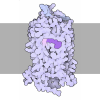
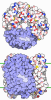
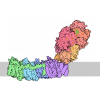
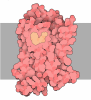
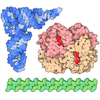
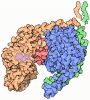
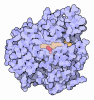
- Assembly
| Deposited unit | 
|
|---|---|
| 1 |
|
-Components
| #1: Protein | Mass: 30532.338 Da / Num. of mol.: 1 Source method: isolated from a genetically manipulated source Source: (gene. exp.) Erythrobacter (bacteria) / Production host:  Escherichia coli (E. coli) Escherichia coli (E. coli) | ||||||||||
|---|---|---|---|---|---|---|---|---|---|---|---|
| #2: Chemical | ChemComp-LFA / 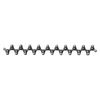  Mass: 282.547 Da / Num. of mol.: 11 / Source method: obtained synthetically / Formula: C20H42 Mass: 282.547 Da / Num. of mol.: 11 / Source method: obtained synthetically / Formula: C20H42#3: Sugar | 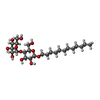 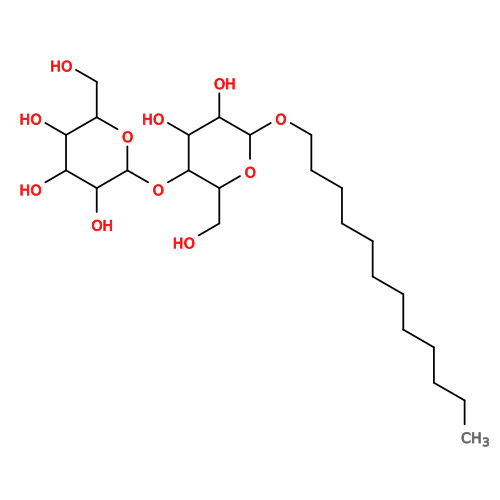 Type: D-saccharide / Mass: 510.615 Da / Num. of mol.: 2 / Source method: obtained synthetically / Formula: C24H46O11 / Comment: detergent*YM Type: D-saccharide / Mass: 510.615 Da / Num. of mol.: 2 / Source method: obtained synthetically / Formula: C24H46O11 / Comment: detergent*YM#4: Chemical | ChemComp-RET / | 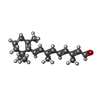 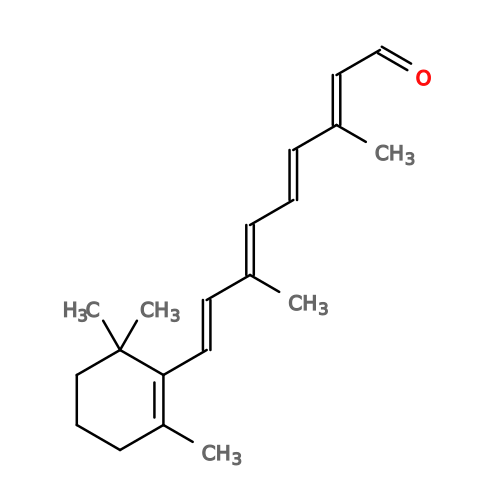 Mass: 284.436 Da / Num. of mol.: 1 / Source method: obtained synthetically / Formula: C20H28O / Feature type: SUBJECT OF INVESTIGATION Mass: 284.436 Da / Num. of mol.: 1 / Source method: obtained synthetically / Formula: C20H28O / Feature type: SUBJECT OF INVESTIGATION#5: Water | ChemComp-HOH / |  Mass: 18.015 Da / Num. of mol.: 20 / Source method: isolated from a natural source / Formula: H2O Mass: 18.015 Da / Num. of mol.: 20 / Source method: isolated from a natural source / Formula: H2OHas ligand of interest | Y | Has protein modification | Y | |
-Experimental details
-Experiment
| Experiment | Method: ELECTRON MICROSCOPY |
|---|---|
| EM experiment | Aggregation state: PARTICLE / 3D reconstruction method: single particle reconstruction |
- Sample preparation
| Component | Name: ErNaR light-driven sodium pump / Type: ORGANELLE OR CELLULAR COMPONENT / Entity ID: #1 / Source: RECOMBINANT | ||||||||||||||||||||
|---|---|---|---|---|---|---|---|---|---|---|---|---|---|---|---|---|---|---|---|---|---|
| Molecular weight | Experimental value: NO | ||||||||||||||||||||
| Source (natural) | Organism: Erythrobacter (bacteria) | ||||||||||||||||||||
| Source (recombinant) | Organism: Escherichia coli (E. coli) | ||||||||||||||||||||
| Buffer solution | pH: 8 / Details: 10 mM HEPES pH 7.5, 150 mM NaCl | ||||||||||||||||||||
| Buffer component |
| ||||||||||||||||||||
| Specimen | Conc.: 4.5 mg/ml / Embedding applied: NO / Shadowing applied: NO / Staining applied: NO / Vitrification applied: YES / Details: This sample was monodisperse. | ||||||||||||||||||||
| Specimen support | Details: Grid was sputter coated with 40 nm thick layer of silver beforehand using a Quorum Q300T device. Grid material: GOLD / Grid mesh size: 200 divisions/in. / Grid type: Quantifoil R1.2/1.3 | ||||||||||||||||||||
| Vitrification | Instrument: FEI VITROBOT MARK IV / Cryogen name: ETHANE / Humidity: 95 % / Chamber temperature: 277 K Details: Vitrification carried out using a modified Vitrobot Mark IV, as outlined in the paper reporting this entry. |
- Electron microscopy imaging
| Experimental equipment |  Model: Titan Krios / Image courtesy: FEI Company |
|---|---|
| Microscopy | Model: TFS KRIOS |
| Electron gun | Electron source:  FIELD EMISSION GUN / Accelerating voltage: 300 kV / Illumination mode: FLOOD BEAM FIELD EMISSION GUN / Accelerating voltage: 300 kV / Illumination mode: FLOOD BEAM |
| Electron lens | Mode: BRIGHT FIELD / Nominal magnification: 165000 X / Nominal defocus max: 2400 nm / Nominal defocus min: 800 nm / Cs: 2.7 mm |
| Specimen holder | Cryogen: NITROGEN / Specimen holder model: FEI TITAN KRIOS AUTOGRID HOLDER |
| Image recording | Electron dose: 40 e/Å2 / Film or detector model: FEI FALCON IV (4k x 4k) |
- Processing
| EM software |
| ||||||||||||||||||||||||
|---|---|---|---|---|---|---|---|---|---|---|---|---|---|---|---|---|---|---|---|---|---|---|---|---|---|
| CTF correction | Type: PHASE FLIPPING AND AMPLITUDE CORRECTION | ||||||||||||||||||||||||
| Symmetry | Point symmetry: C1 (asymmetric) | ||||||||||||||||||||||||
| 3D reconstruction | Resolution: 2.8 Å / Resolution method: FSC 0.143 CUT-OFF / Num. of particles: 44989 Details: Reconstruction conducted in C1 following symmetry expansion of particle stack in C5. Symmetry type: POINT | ||||||||||||||||||||||||
| Refinement | Highest resolution: 2.8 Å Stereochemistry target values: REAL-SPACE (WEIGHTED MAP SUM AT ATOM CENTERS) | ||||||||||||||||||||||||
| Refine LS restraints |
|
