 Movie
Movie Controller

[English] 日本語
 Yorodumi
- PDB-9t9p: Adenosine receptor A2a (A2AR)-beta-lactamase fusion bound to beta... -
+ Open data

- Basic information
| Entry | Database: PDB / ID: 9t9p | ||||||||||||||||||||||||
|---|---|---|---|---|---|---|---|---|---|---|---|---|---|---|---|---|---|---|---|---|---|---|---|---|---|
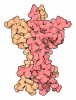
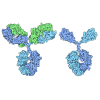
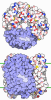
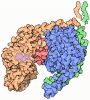
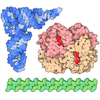
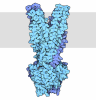
| Title | Adenosine receptor A2a (A2AR)-beta-lactamase fusion bound to beta-lactamase inhibitory protein II (BLIPII) and ZM241385 | ||||||||||||||||||||||||
 Components Components |
| ||||||||||||||||||||||||
 Keywords Keywords | MEMBRANE PROTEIN / G-protein coupled receptor / GPCR / fusion tag | ||||||||||||||||||||||||
| Function / homology |  Function and homology information Function and homology informationregulation of norepinephrine secretion / positive regulation of circadian sleep/wake cycle, sleep / Adenosine P1 receptors / positive regulation of acetylcholine secretion, neurotransmission / G protein-coupled adenosine receptor activity / response to purine-containing compound / G protein-coupled adenosine receptor signaling pathway / NGF-independant TRKA activation / Surfactant metabolism / type 5 metabotropic glutamate receptor binding ...regulation of norepinephrine secretion / positive regulation of circadian sleep/wake cycle, sleep / Adenosine P1 receptors / positive regulation of acetylcholine secretion, neurotransmission / G protein-coupled adenosine receptor activity / response to purine-containing compound / G protein-coupled adenosine receptor signaling pathway / NGF-independant TRKA activation / Surfactant metabolism / type 5 metabotropic glutamate receptor binding / negative regulation of vascular permeability / response to caffeine / positive regulation of urine volume / blood circulation / presynaptic active zone / intermediate filament / sensory perception / eating behavior / positive regulation of glutamate secretion / synaptic transmission, cholinergic / regulation of calcium ion transport / alpha-actinin binding / beta-lactam antibiotic catabolic process / phagocytosis / synaptic transmission, dopaminergic / membrane depolarization / asymmetric synapse / prepulse inhibition / cellular defense response / axolemma / positive regulation of synaptic transmission, glutamatergic / neuron projection morphogenesis / astrocyte activation / presynaptic modulation of chemical synaptic transmission / regulation of mitochondrial membrane potential / locomotory behavior / bioluminescence / excitatory postsynaptic potential / positive regulation of protein secretion / central nervous system development / positive regulation of long-term synaptic potentiation / generation of precursor metabolites and energy / synaptic transmission, glutamatergic / blood coagulation / vasodilation / beta-lactamase / beta-lactamase activity / adenylate cyclase-modulating G protein-coupled receptor signaling pathway / phospholipase C-activating G protein-coupled receptor signaling pathway / ubiquitin protein ligase activity / cell-cell signaling / negative regulation of neuron apoptotic process / adenylate cyclase-activating G protein-coupled receptor signaling pathway / calmodulin binding / presynaptic membrane / G alpha (s) signalling events / response to antibiotic / apoptotic process / positive regulation of ERK1 and ERK2 cascade / inflammatory response / postsynaptic membrane / response to xenobiotic stimulus / negative regulation of cell population proliferation / lipid binding / neuronal cell body / regulation of DNA-templated transcription / dendrite / glutamatergic synapse / protein-containing complex binding / enzyme binding / membrane / identical protein binding / plasma membrane Similarity search - Function | ||||||||||||||||||||||||
| Biological species |  Streptomyces exfoliatus (bacteria) Streptomyces exfoliatus (bacteria) Homo sapiens (human) Homo sapiens (human) Bacillus licheniformis (bacteria) Bacillus licheniformis (bacteria) 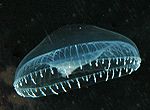 Aequorea victoria (jellyfish) Aequorea victoria (jellyfish) | ||||||||||||||||||||||||
| Method | ELECTRON MICROSCOPY / single particle reconstruction / cryo EM / Resolution: 3 Å | ||||||||||||||||||||||||
 Authors Authors | Shah, N.R. / Bisson, C. / Hutchin, A. / McFarlane, C.R. / Oosterlaken, M. / Pavic, A. / Zebisch, M. | ||||||||||||||||||||||||
| Funding support | 1items
| ||||||||||||||||||||||||
 Citation Citation | Journal: Acta Crystallogr D Struct Biol / Year: 2026 Title: A novel fusion tool to enable G protein-coupled receptor structure determination. Authors: Nita R Shah / Mathieu Oosterlaken / Claudine Bisson / Mattia Bertinelli / Alicia M Churchill-Angus / Andrew Hutchin / Jola Kopec / Vadim Kotov / Ciaran R McFarlane / Erika Griss Pascualli / ...Authors: Nita R Shah / Mathieu Oosterlaken / Claudine Bisson / Mattia Bertinelli / Alicia M Churchill-Angus / Andrew Hutchin / Jola Kopec / Vadim Kotov / Ciaran R McFarlane / Erika Griss Pascualli / Ana Pavic / Matthias Zebisch / Cédric Fiez-Vandal / Edoardo Fabini / Stéphanie Duclos /   Abstract: Structure determination of G protein-coupled receptors (GPCRs) plays an important role in accelerating drug development against this medically important protein family. This study outlines the ...Structure determination of G protein-coupled receptors (GPCRs) plays an important role in accelerating drug development against this medically important protein family. This study outlines the development of a new fusion tool to enable structure determination of GPCRs in inactive conformations by cryo-EM. Initially, a PDB mining approach was applied to select eight naturally occurring proteins with the intention of fusing them into the intracellular loop 3 (ICL3) of GPCRs to create a suitable fiducial marker for cryo-EM workflows. During the selection process, candidates with known high-affinity protein binders were prioritized to enable a further increase in the protein mass of the fiducial marker. Fusion constructs were generated with adenosine receptor A (AR) and were assessed for expression and aggregation levels. For the two best-performing new fusion constructs, ligand binding was characterized to ensure that the fusion tag did not significantly affect protein behaviour. AR with a β-lactamase fusion in ICL3 and binding partner β-lactamase inhibitory protein II (BLIPII) was then selected to solve an antagonist-bound structure. The overall map was resolved to an average of 3.2 Å resolution with continuous helices connecting the β-lactamase to helices 5 and 6 of AR. Focused refinement of the AR region improved the local resolution and map detail in the orthosteric site, thereby allowing confident modelling of the antagonist ligand, ZM241385, which matches previously described X-ray crystallographic structures. This new fusion provides an alternative option for GPCR structure determination, with several potential benefits compared with existing tools, such as a more favourable position relative to the GPCR to reduce potential clashes. | ||||||||||||||||||||||||
| History |
|
- Structure visualization
| Structure viewer | Molecule: MolmilJmol/JSmol |
|---|
- Downloads & links
-Download
| PDBx/mmCIF format | 9t9p.cif.gz | 173.8 KB | Display | PDBx/mmCIF format |
|---|---|---|---|---|
| PDB format | pdb9t9p.ent.gz | 127.9 KB | Display | PDB format |
| PDBx/mmJSON format | 9t9p.json.gz | Tree view | PDBx/mmJSON format | |
| Others |  Other downloads Other downloads |
-Validation report
| Arichive directory | https://data.pdbj.org/pub/pdb/validation_reports/t9/9t9pftp://data.pdbj.org/pub/pdb/validation_reports/t9/9t9p | HTTPS FTP |
|---|
-Related structure data
| Related structure data |  55723MC M: map data used to model this data C: citing same article ( |
|---|---|
| Similar structure data |


-Links
 PDBj
PDBj
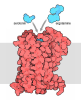
- Assembly
| Deposited unit | 
|
|---|---|
| 1 |
|
-Components
| #1: Protein | Mass: 29044.723 Da / Num. of mol.: 1 Source method: isolated from a genetically manipulated source Source: (gene. exp.) Streptomyces exfoliatus (bacteria) / Gene: bliB / Production host:  Escherichia coli BL21(DE3) (bacteria) / References: UniProt: O87916 Escherichia coli BL21(DE3) (bacteria) / References: UniProt: O87916 |
|---|---|
| #2: Protein | Mass: 94983.242 Da / Num. of mol.: 1 Source method: isolated from a genetically manipulated source Source: (gene. exp.) Homo sapiens (human), (gene. exp.) Bacillus licheniformis (bacteria), (gene. exp.) Aequorea victoria (jellyfish)Gene: ADORA2A, ADORA2, penP, blaP, GFP / Cell line (production host): Sf21 / Production host:   Spodoptera frugiperda (fall armyworm) Spodoptera frugiperda (fall armyworm)References: UniProt: P29274, UniProt: P00808, UniProt: P42212 |
| #3: Chemical | ChemComp-ZMA / 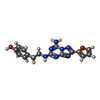 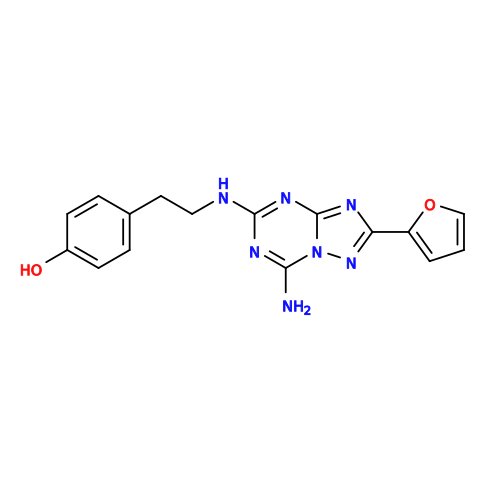 Mass: 337.336 Da / Num. of mol.: 1 / Source method: obtained synthetically / Formula: C16H15N7O2 / Feature type: SUBJECT OF INVESTIGATION / Comment: antagonist*YM Mass: 337.336 Da / Num. of mol.: 1 / Source method: obtained synthetically / Formula: C16H15N7O2 / Feature type: SUBJECT OF INVESTIGATION / Comment: antagonist*YM |
| Has ligand of interest | Y |
| Has protein modification | Y |
-Experimental details
-Experiment
| Experiment | Method: ELECTRON MICROSCOPY |
|---|---|
| EM experiment | Aggregation state: PARTICLE / 3D reconstruction method: single particle reconstruction |
- Sample preparation
| Component |
| ||||||||||||||||||||||||||||||||||||||||||
|---|---|---|---|---|---|---|---|---|---|---|---|---|---|---|---|---|---|---|---|---|---|---|---|---|---|---|---|---|---|---|---|---|---|---|---|---|---|---|---|---|---|---|---|
| Molecular weight |
| ||||||||||||||||||||||||||||||||||||||||||
| Source (natural) |
| ||||||||||||||||||||||||||||||||||||||||||
| Source (recombinant) |
| ||||||||||||||||||||||||||||||||||||||||||
| Buffer solution | pH: 7.5 | ||||||||||||||||||||||||||||||||||||||||||
| Buffer component |
| ||||||||||||||||||||||||||||||||||||||||||
| Specimen | Conc.: 0.38 mg/ml / Embedding applied: NO / Shadowing applied: NO / Staining applied: NO / Vitrification applied: YES Details: Complex was formed and isolated by size exclusion chromatography | ||||||||||||||||||||||||||||||||||||||||||
| Specimen support | Grid material: GOLD / Grid mesh size: 300 divisions/in. / Grid type: UltrAuFoil R1.2/1.3 | ||||||||||||||||||||||||||||||||||||||||||
| Vitrification | Instrument: FEI VITROBOT MARK IV / Cryogen name: ETHANE / Humidity: 95 % / Chamber temperature: 277.15 K |
- Electron microscopy imaging
| Experimental equipment |  Model: Titan Krios / Image courtesy: FEI Company |
|---|---|
| Microscopy | Model: TFS KRIOS |
| Electron gun | Electron source:  FIELD EMISSION GUN / Accelerating voltage: 300 kV / Illumination mode: FLOOD BEAM FIELD EMISSION GUN / Accelerating voltage: 300 kV / Illumination mode: FLOOD BEAM |
| Electron lens | Mode: BRIGHT FIELD / Nominal magnification: 105000 X / Nominal defocus max: 2300 nm / Nominal defocus min: 1100 nm / Cs: 2.7 mm / C2 aperture diameter: 50 µm |
| Specimen holder | Specimen holder model: FEI TITAN KRIOS AUTOGRID HOLDER |
| Image recording | Average exposure time: 2.1 sec. / Electron dose: 49.71 e/Å2 / Film or detector model: GATAN K3 (6k x 4k) |
- Processing
| EM software |
| ||||||||||||||||||||||||||||||||
|---|---|---|---|---|---|---|---|---|---|---|---|---|---|---|---|---|---|---|---|---|---|---|---|---|---|---|---|---|---|---|---|---|---|
| CTF correction | Type: PHASE FLIPPING AND AMPLITUDE CORRECTION | ||||||||||||||||||||||||||||||||
| Symmetry | Point symmetry: C1 (asymmetric) | ||||||||||||||||||||||||||||||||
| 3D reconstruction | Resolution: 3 Å / Resolution method: FSC 0.143 CUT-OFF / Num. of particles: 597000 / Symmetry type: POINT | ||||||||||||||||||||||||||||||||
| Atomic model building | Protocol: FLEXIBLE FIT / Space: REAL / Target criteria: cross-correlation coefficient | ||||||||||||||||||||||||||||||||
| Atomic model building |
| ||||||||||||||||||||||||||||||||
| Refinement | Highest resolution: 3 Å Stereochemistry target values: REAL-SPACE (WEIGHTED MAP SUM AT ATOM CENTERS) | ||||||||||||||||||||||||||||||||
| Refine LS restraints |
|


