[English] 日本語
Yorodumi
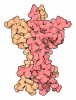
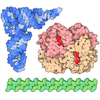
- EMDB-55723: Adenosine receptor A2a (A2AR)-beta-lactamase fusion bound to beta... -

+
Open data


ID or keywords:

Loading...

-
Basic information

Entry
Database: EMDB / ID: EMD-55723
TitleAdenosine receptor A2a (A2AR)-beta-lactamase fusion bound to beta-lactamase inhibitory protein II (BLIPII) and ZM241385
Map datacomposite map generated from 2 focused maps
Sample
  • Complex: A2AR-beta-lactamase fusion, BLIPII, ZM241385
    • Complex: A2AR-beta-lactamase fusion
      • Complex: adenosine receptor A2a (A2AR)
        • Protein or peptide: Beta-lactamase inhibitory protein II
      • Complex: beta-lactamase
    • Complex: beta-lactamase inhibitory protein II (BLIPII)
      • Protein or peptide: Adenosine receptor A2a,Small exopenicillinase,Green fluorescent protein
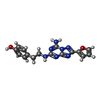
  • Ligand: 4-{2-[(7-amino-2-furan-2-yl[1,2,4]triazolo[1,5-a][1,3,5]triazin-5-yl)amino]ethyl}phenol
KeywordsG-protein coupled receptor / GPCR / fusion tag / MEMBRANE PROTEIN
Function / homology
Function and homology information


regulation of norepinephrine secretion / negative regulation of alpha-beta T cell activation / positive regulation of acetylcholine secretion, neurotransmission / positive regulation of circadian sleep/wake cycle, sleep / Adenosine P1 receptors / G protein-coupled adenosine receptor activity / response to purine-containing compound / G protein-coupled adenosine receptor signaling pathway / NGF-independant TRKA activation / Surfactant metabolism ...regulation of norepinephrine secretion / negative regulation of alpha-beta T cell activation / positive regulation of acetylcholine secretion, neurotransmission / positive regulation of circadian sleep/wake cycle, sleep / Adenosine P1 receptors / G protein-coupled adenosine receptor activity / response to purine-containing compound / G protein-coupled adenosine receptor signaling pathway / NGF-independant TRKA activation / Surfactant metabolism / synaptic transmission, dopaminergic / type 5 metabotropic glutamate receptor binding / negative regulation of vascular permeability / synaptic transmission, cholinergic / intermediate filament / presynaptic active zone / positive regulation of urine volume / response to caffeine / blood circulation / sensory perception / positive regulation of glutamate secretion / eating behavior / inhibitory postsynaptic potential / regulation of calcium ion transport / alpha-actinin binding / beta-lactam antibiotic catabolic process / asymmetric synapse / axolemma / membrane depolarization / cellular defense response / prepulse inhibition / phagocytosis / neuron projection morphogenesis / positive regulation of synaptic transmission, glutamatergic / astrocyte activation / presynaptic modulation of chemical synaptic transmission / bioluminescence / positive regulation of long-term synaptic potentiation / positive regulation of synaptic transmission, GABAergic / central nervous system development / positive regulation of protein secretion / regulation of mitochondrial membrane potential / response to amphetamine / positive regulation of apoptotic signaling pathway / generation of precursor metabolites and energy / apoptotic signaling pathway / synaptic transmission, glutamatergic / excitatory postsynaptic potential / locomotory behavior / beta-lactamase activity / beta-lactamase / negative regulation of inflammatory response / vasodilation / adenylate cyclase-modulating G protein-coupled receptor signaling pathway / blood coagulation / ubiquitin protein ligase activity / cell-cell signaling / adenylate cyclase-activating G protein-coupled receptor signaling pathway / presynaptic membrane / G alpha (s) signalling events / phospholipase C-activating G protein-coupled receptor signaling pathway / negative regulation of neuron apoptotic process / calmodulin binding / positive regulation of ERK1 and ERK2 cascade / postsynaptic membrane / response to xenobiotic stimulus / inflammatory response / negative regulation of cell population proliferation / response to antibiotic / neuronal cell body / apoptotic process / regulation of DNA-templated transcription / lipid binding / dendrite / protein-containing complex binding / glutamatergic synapse / enzyme binding / membrane / metal ion binding / identical protein binding / plasma membrane
Similarity search - Function
: / Regulator of chromosome condensation (RCC1) repeat / : / Regulator of chromosome condensation, RCC1 / Regulator of chromosome condensation (RCC1) repeat profile. / Regulator of chromosome condensation 1/beta-lactamase-inhibitor protein II / Adenosine A2A receptor / Adenosine receptor / Beta-lactamase, class-A active site / Beta-lactamase class-A active site. ...: / Regulator of chromosome condensation (RCC1) repeat / : / Regulator of chromosome condensation, RCC1 / Regulator of chromosome condensation (RCC1) repeat profile. / Regulator of chromosome condensation 1/beta-lactamase-inhibitor protein II / Adenosine A2A receptor / Adenosine receptor / Beta-lactamase, class-A active site / Beta-lactamase class-A active site. / Beta-lactamase class A, catalytic domain / Beta-lactamase enzyme family / Beta-lactamase, class-A / Green fluorescent protein, GFP / Green fluorescent protein-related / Green fluorescent protein / Green fluorescent protein / Serpentine type 7TM GPCR chemoreceptor Srsx / Beta-lactamase/transpeptidase-like / Prokaryotic membrane lipoprotein lipid attachment site profile. / G-protein coupled receptors family 1 signature. / 7 transmembrane receptor (rhodopsin family) / G protein-coupled receptor, rhodopsin-like / GPCR, rhodopsin-like, 7TM / G-protein coupled receptors family 1 profile.
Similarity search - Domain/homology
Beta-lactamase inhibitory protein II / Beta-lactamase / Adenosine receptor A2a / Green fluorescent protein
Similarity search - Component
Biological speciesother entries (others) / Streptomyces exfoliatus (bacteria) / Homo sapiens (human) / Bacillus licheniformis (bacteria) / Aequorea victoria (jellyfish)
Methodsingle particle reconstruction / cryo EM / Resolution: 3.0 Å
AuthorsShah NR / Bisson C / Hutchin A / McFarlane CR / Oosterlaken M / Pavic A / Zebisch M
Funding support1 items
OrganizationGrant numberCountry
Not funded
CitationJournal: Acta Crystallogr D Struct Biol / Year: 2026
Title: A novel fusion tool to enable G protein-coupled receptor structure determination.
Authors: Nita R Shah / Mathieu Oosterlaken / Claudine Bisson / Mattia Bertinelli / Alicia M Churchill-Angus / Andrew Hutchin / Jola Kopec / Vadim Kotov / Ciaran R McFarlane / Erika Griss Pascualli / ...Authors: Nita R Shah / Mathieu Oosterlaken / Claudine Bisson / Mattia Bertinelli / Alicia M Churchill-Angus / Andrew Hutchin / Jola Kopec / Vadim Kotov / Ciaran R McFarlane / Erika Griss Pascualli / Ana Pavic / Matthias Zebisch / Cédric Fiez-Vandal / Edoardo Fabini / Stéphanie Duclos /
Abstract: Structure determination of G protein-coupled receptors (GPCRs) plays an important role in accelerating drug development against this medically important protein family. This study outlines the ...Structure determination of G protein-coupled receptors (GPCRs) plays an important role in accelerating drug development against this medically important protein family. This study outlines the development of a new fusion tool to enable structure determination of GPCRs in inactive conformations by cryo-EM. Initially, a PDB mining approach was applied to select eight naturally occurring proteins with the intention of fusing them into the intracellular loop 3 (ICL3) of GPCRs to create a suitable fiducial marker for cryo-EM workflows. During the selection process, candidates with known high-affinity protein binders were prioritized to enable a further increase in the protein mass of the fiducial marker. Fusion constructs were generated with adenosine receptor A (AR) and were assessed for expression and aggregation levels. For the two best-performing new fusion constructs, ligand binding was characterized to ensure that the fusion tag did not significantly affect protein behaviour. AR with a β-lactamase fusion in ICL3 and binding partner β-lactamase inhibitory protein II (BLIPII) was then selected to solve an antagonist-bound structure. The overall map was resolved to an average of 3.2 Å resolution with continuous helices connecting the β-lactamase to helices 5 and 6 of AR. Focused refinement of the AR region improved the local resolution and map detail in the orthosteric site, thereby allowing confident modelling of the antagonist ligand, ZM241385, which matches previously described X-ray crystallographic structures. This new fusion provides an alternative option for GPCR structure determination, with several potential benefits compared with existing tools, such as a more favourable position relative to the GPCR to reduce potential clashes.
History
DepositionNov 24, 2025-
Header (metadata) releaseMay 27, 2026-
Map releaseMay 27, 2026-
UpdateMay 27, 2026-
Current statusMay 27, 2026Processing site: PDBe / Status: Released

-
Structure visualization

Supplemental images

Downloads & links

-
Map

FileDownload / File: emd_55723.map.gz / Format: CCP4 / Size: 178 MB / Type: IMAGE STORED AS FLOATING POINT NUMBER (4 BYTES)
Annotationcomposite map generated from 2 focused maps
Projections & slices

Image control

Size
Brightness
Contrast
Others
AxesZ (Sec.)Y (Row.)X (Col.)
0.84 Å/pix.
x 360 pix.
= 300.6 Å
0.84 Å/pix.
x 360 pix.
= 300.6 Å
0.84 Å/pix.
x 360 pix.
= 300.6 Å

Surface

Projections

Slices (1/3)

Slices (1/2)

Slices (2/3)

Images are generated by Spider.

Voxel sizeX=Y=Z: 0.835 Å
Density
Contour LevelBy AUTHOR: 18.300000000000001
Minimum - Maximum-74.825419999999994 - 119.811319999999995
Average (Standard dev.)-0.0016661905 (±1.2701161)
SymmetrySpace group: 1
Details

EMDB XML:

Map geometry
Axis orderXYZ
Origin000
Dimensions360360360
Spacing360360360
CellA=B=C: 300.6 Å
α=β=γ: 90.0 °

-
Supplemental data

-
Additional map: Overall map before focused refinement steps

Fileemd_55723_additional_1.map
AnnotationOverall map before focused refinement steps
Projections & Slices
AxesZYX

Projections

Slices (1/2)
Density Histograms

-
Additional map: beta-lactamase and BLIPII focused map

Fileemd_55723_additional_2.map
Annotationbeta-lactamase and BLIPII focused map
Projections & Slices
AxesZYX

Projections

Slices (1/2)
Density Histograms

-
Additional map: A2AR-focused map

Fileemd_55723_additional_3.map
AnnotationA2AR-focused map
Projections & Slices
AxesZYX

Projections

Slices (1/2)
Density Histograms

-
Sample components

-
Entire : A2AR-beta-lactamase fusion, BLIPII, ZM241385

EntireName: A2AR-beta-lactamase fusion, BLIPII, ZM241385
Components
  • Complex: A2AR-beta-lactamase fusion, BLIPII, ZM241385
    • Complex: A2AR-beta-lactamase fusion
      • Complex: adenosine receptor A2a (A2AR)
        • Protein or peptide: Beta-lactamase inhibitory protein II
      • Complex: beta-lactamase
    • Complex: beta-lactamase inhibitory protein II (BLIPII)
      • Protein or peptide: Adenosine receptor A2a,Small exopenicillinase,Green fluorescent protein
  • Ligand: 4-{2-[(7-amino-2-furan-2-yl[1,2,4]triazolo[1,5-a][1,3,5]triazin-5-yl)amino]ethyl}phenol

-
Supramolecule #1: A2AR-beta-lactamase fusion, BLIPII, ZM241385

SupramoleculeName: A2AR-beta-lactamase fusion, BLIPII, ZM241385 / type: complex / ID: 1 / Parent: 0 / Macromolecule list: #1-#2
Details: Complex of BLIPII bound to the beta-lactamase region of the chimeric A2AR-beta-lactamase fusion protein
Source (natural)Organism: other entries (others)

-
Supramolecule #2: A2AR-beta-lactamase fusion

SupramoleculeName: A2AR-beta-lactamase fusion / type: complex / ID: 2 / Parent: 1 / Macromolecule list: #1
Details: beta-lactamase fused into intracellular loop 3 of A2AR
Source (natural)Organism: other entries (others)

-
Supramolecule #3: beta-lactamase inhibitory protein II (BLIPII)

SupramoleculeName: beta-lactamase inhibitory protein II (BLIPII) / type: complex / ID: 3 / Parent: 1 / Macromolecule list: #2
Source (natural)Organism: Streptomyces exfoliatus (bacteria)

-
Supramolecule #4: adenosine receptor A2a (A2AR)

SupramoleculeName: adenosine receptor A2a (A2AR) / type: complex / ID: 4 / Parent: 2 / Macromolecule list: #1
Source (natural)Organism: Homo sapiens (human)

-
Supramolecule #5: beta-lactamase

SupramoleculeName: beta-lactamase / type: complex / ID: 5 / Parent: 2 / Macromolecule list: #1
Source (natural)Organism: Bacillus licheniformis (bacteria)

-
Macromolecule #1: Beta-lactamase inhibitory protein II

MacromoleculeName: Beta-lactamase inhibitory protein II / type: protein_or_peptide / ID: 1 / Number of copies: 1 / Enantiomer: LEVO
Source (natural)Organism: Streptomyces exfoliatus (bacteria)
Molecular weightTheoretical: 29.044723 KDa
Recombinant expressionOrganism: Escherichia coli BL21(DE3) (bacteria)
SequenceString: MATSVVAWGG NNDWGEATVP AEAQSGVDAI AGGYFHGLAL KGGKVLGWGA NLNGQLTMPA ATQSGVDAIA AGNYHSLALK DGEVIAWGG NEDGQTTVPA EARSGVDAIA AGAWASYALK DGKVIAWGDD SDGQTTVPAE AQSGVTALDG GVYTALAVKN G GVIAWGDN ...String:
MATSVVAWGG NNDWGEATVP AEAQSGVDAI AGGYFHGLAL KGGKVLGWGA NLNGQLTMPA ATQSGVDAIA AGNYHSLALK DGEVIAWGG NEDGQTTVPA EARSGVDAIA AGAWASYALK DGKVIAWGDD SDGQTTVPAE AQSGVTALDG GVYTALAVKN G GVIAWGDN YFGQTTVPAE AQSGVDDVAG GIFHSLALKD GKVIAWGDNR YKQTTVPTEA LSGVSAIASG EWYSLALKNG KV IAWGSSR TAPSSVQSGV SSIEAGPNAA YALKGGSGSG HHHHHHHHHH

UniProtKB: Beta-lactamase inhibitory protein II

-
Macromolecule #2: Adenosine receptor A2a,Small exopenicillinase,Green fluorescent p...

MacromoleculeName: Adenosine receptor A2a,Small exopenicillinase,Green fluorescent protein
type: protein_or_peptide / ID: 2 / Number of copies: 1 / Enantiomer: LEVO
Source (natural)Organism: Aequorea victoria (jellyfish)
Molecular weightTheoretical: 94.983242 KDa
Recombinant expressionOrganism: Spodoptera frugiperda (fall armyworm)
SequenceString: MKTIIALSYI FCLVFADYKD DDDKPIMGSS VYITVELAIA VLAILGNVLV CWAVWLNSNL QNVTNYFVVS LAAADIAVGV LAIPFAITI STGFCAACHG CLFIACFVLV LTQSSIFSLL AIAIDRYIAI RIPLRYNGLV TGTRAKGIIA ICWVLSFAIG L TPMLGWNN ...String:
MKTIIALSYI FCLVFADYKD DDDKPIMGSS VYITVELAIA VLAILGNVLV CWAVWLNSNL QNVTNYFVVS LAAADIAVGV LAIPFAITI STGFCAACHG CLFIACFVLV LTQSSIFSLL AIAIDRYIAI RIPLRYNGLV TGTRAKGIIA ICWVLSFAIG L TPMLGWNN CGQPKEGKNH SQGCGEGQVA CLFEDVVPMN YMVYFNFFAC VLVPLLLMLG VYLRIFLAAR RQLKQMESQA KD DFAKLEE QFDAKLGIFA LDTGTNSTVA YRPDERFAFA STIKALTVGV LLQQKSIEDL NQRITYTRDD LVNYNPITEK HVD TGMTLK ELADASLRYS DNAAQNLILK QIGGPESLKK ELRKIGDEVT NPERFEPELN EVNPGETQDT STARALVTSL RAFA LEDKL PSEKRELLID WMKRNTTGDA LIRAGVPDGW EVADKTGAAS YGTRNDIAII WPPKGDPVVL AVLSSRDKKD AKYDD KLIA EATKVVMKLL RARSTLQKEV HAAKSLAIIV GLFALCWLPL HIINCFTFFC PDCSHAPLWL MYLAIVLSHT NSVVNP FIY AYRIREFRQT FRKIIRSHVL RQQEPFKAEN LYFQGVSKGE ELFTGVVPIL VELDGDVNGH KFSVSGEGEG DATYGKL TL KFICTTGKLP VPWPTLVTTL TYGVQCFSRY PDHMKQHDFF KSAMPEGYVQ ERTIFFKDDG NYKTRAEVKF EGDTLVNR I ELKGIDFKED GNILGHKLEY NYNSHNVYIM ADKQKNGIKV NFKIRHNIED GSVQLADHYQ QNTPIGDGPV LLPDNHYLS TQSKLSKDPN EKRDHMVLLE FVTAAGITLG MDELYKHHHH HHHHHH

UniProtKB: Adenosine receptor A2a, Beta-lactamase, Adenosine receptor A2a, Green fluorescent protein

-
Macromolecule #3: 4-{2-[(7-amino-2-furan-2-yl[1,2,4]triazolo[1,5-a][1,3,5]triazin-5...

MacromoleculeName: 4-{2-[(7-amino-2-furan-2-yl[1,2,4]triazolo[1,5-a][1,3,5]triazin-5-yl)amino]ethyl}phenol
type: ligand / ID: 3 / Number of copies: 1 / Formula: ZMA
Molecular weightTheoretical: 337.336 Da
Chemical component information

ChemComp-ZMA:
4-{2-[(7-amino-2-furan-2-yl[1,2,4]triazolo[1,5-a][1,3,5]triazin-5-yl)amino]ethyl}phenol / antagonist*YM

-
Experimental details

-
Structure determination

Methodcryo EM
Processingsingle particle reconstruction
Aggregation stateparticle

-
Sample preparation

Concentration0.38 mg/mL
BufferpH: 7.5
Component:
ConcentrationName
40.0 mMHEPES
250.0 mMNaCl
0.01 %LMNG
0.001 %CHS
GridModel: UltrAuFoil R1.2/1.3 / Material: GOLD / Mesh: 300 / Support film - Material: GOLD / Support film - topology: HOLEY / Pretreatment - Type: GLOW DISCHARGE / Pretreatment - Time: 60 sec. / Pretreatment - Atmosphere: AIR
VitrificationCryogen name: ETHANE / Chamber humidity: 95 % / Chamber temperature: 277.15 K / Instrument: FEI VITROBOT MARK IV
DetailsComplex was formed and isolated by size exclusion chromatography

-
Electron microscopy

MicroscopeTFS KRIOS
Image recordingFilm or detector model: GATAN K3 (6k x 4k) / Average exposure time: 2.1 sec. / Average electron dose: 49.71 e/Å2
Electron beamAcceleration voltage: 300 kV / Electron source: FIELD EMISSION GUN
Electron opticsC2 aperture diameter: 50.0 µm / Illumination mode: FLOOD BEAM / Imaging mode: BRIGHT FIELD / Cs: 2.7 mm / Nominal defocus max: 2.3000000000000003 µm / Nominal defocus min: 1.1 µm / Nominal magnification: 105000
Sample stageSpecimen holder model: FEI TITAN KRIOS AUTOGRID HOLDER
Experimental equipment
Model: Titan Krios / Image courtesy: FEI Company

+
Image processing

CTF correctionSoftware - Name: cryoSPARC (ver. 4.7.1) / Type: PHASE FLIPPING AND AMPLITUDE CORRECTION
Startup modelType of model: INSILICO MODEL / In silico model: ab initio generated initial model
Final reconstructionApplied symmetry - Point group: C1 (asymmetric) / Resolution.type: BY AUTHOR / Resolution: 3.0 Å / Resolution method: FSC 0.143 CUT-OFF / Software - Name: cryoSPARC (ver. 4.7.1) / Number images used: 597000
Initial angle assignmentType: MAXIMUM LIKELIHOOD / Software - Name: cryoSPARC (ver. 4.7.1)
Final angle assignmentType: MAXIMUM LIKELIHOOD / Software - Name: cryoSPARC (ver. 4.7.1)
Final 3D classificationNumber classes: 3 / Software - Name: cryoSPARC (ver. 4.7.1)

-
Atomic model buiding 1

Initial model
PDB IDChain

source_name: PDB, initial_model_type: experimental model

source_name: PDB, initial_model_type: experimental model
source_name: AlphaFold, initial_model_type: in silico model
RefinementSpace: REAL / Protocol: FLEXIBLE FIT / Target criteria: cross-correlation coefficient
Output model

PDB-9t9p:
Adenosine receptor A2a (A2AR)-beta-lactamase fusion bound to beta-lactamase inhibitory protein II (BLIPII) and ZM241385

+
About Yorodumi

-
News

-
Feb 9, 2022. New format data for meta-information of EMDB entries

New format data for meta-information of EMDB entries

  • Version 3 of the EMDB header file is now the official format.
  • The previous official version 1.9 will be removed from the archive.

Related info.:EMDB header

External links:wwPDB to switch to version 3 of the EMDB data model

-
Aug 12, 2020. Covid-19 info

Covid-19 info

URL: https://pdbj.org/emnavi/covid19.php

New page: Covid-19 featured information page in EM Navigator.

Related info.:Covid-19 info / Mar 5, 2020. Novel coronavirus structure data

+
Mar 5, 2020. Novel coronavirus structure data

Novel coronavirus structure data

Related info.:Yorodumi Speices / Aug 12, 2020. Covid-19 info

External links:COVID-19 featured content - PDBj / Molecule of the Month (242):Coronavirus Proteases

+
Jan 31, 2019. EMDB accession codes are about to change! (news from PDBe EMDB page)

EMDB accession codes are about to change! (news from PDBe EMDB page)

  • The allocation of 4 digits for EMDB accession codes will soon come to an end. Whilst these codes will remain in use, new EMDB accession codes will include an additional digit and will expand incrementally as the available range of codes is exhausted. The current 4-digit format prefixed with “EMD-” (i.e. EMD-XXXX) will advance to a 5-digit format (i.e. EMD-XXXXX), and so on. It is currently estimated that the 4-digit codes will be depleted around Spring 2019, at which point the 5-digit format will come into force.
  • The EM Navigator/Yorodumi systems omit the EMD- prefix.

Related info.:Q: What is EMD? / ID/Accession-code notation in Yorodumi/EM Navigator

External links:EMDB Accession Codes are Changing Soon! / Contact to PDBj

+
Jul 12, 2017. Major update of PDB

Major update of PDB

  • wwPDB released updated PDB data conforming to the new PDBx/mmCIF dictionary.
  • This is a major update changing the version number from 4 to 5, and with Remediation, in which all the entries are updated.
  • In this update, many items about electron microscopy experimental information are reorganized (e.g. em_software).
  • Now, EM Navigator and Yorodumi are based on the updated data.

External links:wwPDB Remediation / Enriched Model Files Conforming to OneDep Data Standards Now Available in the PDB FTP Archive

-
Yorodumi

Thousand views of thousand structures

  • Yorodumi is a browser for structure data from EMDB, PDB, SASBDB, etc.
  • This page is also the successor to EM Navigator detail page, and also detail information page/front-end page for Omokage search.
  • The word "yorodu" (or yorozu) is an old Japanese word meaning "ten thousand". "mi" (miru) is to see.

Related info.:EMDB / PDB / SASBDB / Comparison of 3 databanks / Yorodumi Search / Aug 31, 2016. New EM Navigator & Yorodumi / Yorodumi Papers / Jmol/JSmol / Function and homology information / Changes in new EM Navigator and Yorodumi

Read more