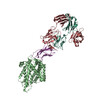
Journal: ACS Omega / Year: 2026 Title: Structural Analysis of Tilvestamab in Complex with AXL. Authors: Eleni Christakou / Andrea J Lopez / Gopinath Muruganandam / David Micklem / James B Lorens / Petri Kursula / Abstract: AXL is a receptor tyrosine kinase with a significant role in various biological processes and important medical implications, particularly in cancer. AXL transduces signals from the extracellular ...AXL is a receptor tyrosine kinase with a significant role in various biological processes and important medical implications, particularly in cancer. AXL transduces signals from the extracellular environment into the cytoplasm by binding to its ligand, growth arrest-specific protein 6 (GAS6). Activation of AXL leads to autophosphorylation of its intracellular domain and subsequent activation of downstream signaling pathways involved in cell proliferation, migration, differentiation, and survival. Tilvestamab (also known as BGB149) is a first-in-class, humanized, therapeutic anti-AXL function-blocking monoclonal antibody. We carried out a structural characterization of the AXL-tilvestamab complex using both negative-stain and cryogenic transmission electron microscopy as well as synchrotron small-angle X-ray scattering. While AXL-Fc was highly elongated and formed large heterogeneous complexes with the full antibody, homogeneous samples for structural studies could be made using the monomeric soluble AXL extracellular domain, the Fab fragment of tilvestamab, and an anti-Fab nanobody. Both SAXS and cryo-EM confirmed successful complex formation between the three proteins, and a low-resolution 3D model for the tilvestamab-AXL complex is presented. The data allow for sample optimization for high-resolution structural biology, as well as designing mutations that could alter binding affinity and specificity.
History
Deposition
Nov 16, 2025
Deposition site: PDBE / Processing site: PDBE
Revision 1.0
Jan 28, 2026
Provider: repository / Type: Initial release
Revision 1.0
Jan 28, 2026
Data content type: EM metadata / Data content type: EM metadata / Provider: repository / Type: Initial release
Revision 1.0
Jan 28, 2026
Data content type: FSC / Data content type: FSC / Provider: repository / Type: Initial release
Revision 1.0
Jan 28, 2026
Data content type: Half map / Part number: 1 / Data content type: Half map / Provider: repository / Type: Initial release
Revision 1.0
Jan 28, 2026
Data content type: Half map / Part number: 2 / Data content type: Half map / Provider: repository / Type: Initial release
Revision 1.0
Jan 28, 2026
Data content type: Image / Data content type: Image / Provider: repository / Type: Initial release
Revision 1.0
Jan 28, 2026
Data content type: Mask / Part number: 1 / Data content type: Mask / Provider: repository / Type: Initial release
Revision 1.0
Jan 28, 2026
Data content type: Primary map / Data content type: Primary map / Provider: repository / Type: Initial release
Evidence: electron microscopy, not applicable, SAXS
Type
Name
Symmetry operation
Number
identity operation
1_555
x,y,z
1
-
Components
#1: Antibody
LightchainofBGB149antibody
Mass: 23872.523 Da / Num. of mol.: 1 / Source method: isolated from a natural source Details: Light chain cleaved from the full-length BGB149 antibody using papain Source: (natural) Mus sp. (mice)
#2: Antibody
AntiNab-Fabnanobody
Mass: 13390.644 Da / Num. of mol.: 1 / Source method: isolated from a natural source / Details: Anti Nab-Fab nanobody / Source: (natural) Mus sp. (mice)
#3: Antibody
HeavychainofBGB149antibody
Mass: 23531.342 Da / Num. of mol.: 1 / Source method: isolated from a natural source Details: Heavy chain cleaved from the full-length BGB149 antibody using papain Source: (natural) Mus sp. (mice)
Has protein modification
Y
-
Experimental details
-
Experiment
Experiment
Method: ELECTRON MICROSCOPY
EM experiment
Aggregation state: PARTICLE / 3D reconstruction method: single particle reconstruction
-
Sample preparation
Component
ID
Name
Type
Details (eV)
Entity ID
Parent-ID
Source
1
TilvestamabFabandtheantiNabFabnanobody
COMPLEX
Fab fragment of tilvestamab (BGB149, BerGenBio, Norway), a humanized AXL monoclonal antibody (light and heavy chain), it was coupled with an anti-Nab-Fab nanobody recombinant expressed in E. coli
Average exposure time: 1.4 sec. / Electron dose: 59.597 e/Å2 / Film or detector model: GATAN K3 (6k x 4k) / Num. of grids imaged: 2 / Num. of real images: 17189
EM imaging optics
Energyfilter name: GIF Bioquantum / Energyfilter slit width: 20 eV
-
Processing
EM software
ID
Name
Version
Category
1
cryoSPARC
particleselection
4
cryoSPARC
CTFcorrection
7
UCSF ChimeraX
1.1
modelfitting
9
cryoSPARC
initialEulerassignment
10
cryoSPARC
finalEulerassignment
11
cryoSPARC
classification
12
cryoSPARC
3Dreconstruction
13
PHENIX
1.21.1_5286
modelrefinement
CTF correction
Type: PHASE FLIPPING AND AMPLITUDE CORRECTION
Particle selection
Num. of particles selected: 1244782
3D reconstruction
Resolution: 3.09 Å / Resolution method: FSC 0.143 CUT-OFF / Num. of particles: 1316916 / Num. of class averages: 3 / Symmetry type: POINT
In the structure databanks used in Yorodumi, some data are registered as the other names, "COVID-19 virus" and "2019-nCoV". Here are the details of the virus and the list of structure data.
Jan 31, 2019. EMDB accession codes are about to change! (news from PDBe EMDB page)
EMDB accession codes are about to change! (news from PDBe EMDB page)
The allocation of 4 digits for EMDB accession codes will soon come to an end. Whilst these codes will remain in use, new EMDB accession codes will include an additional digit and will expand incrementally as the available range of codes is exhausted. The current 4-digit format prefixed with “EMD-” (i.e. EMD-XXXX) will advance to a 5-digit format (i.e. EMD-XXXXX), and so on. It is currently estimated that the 4-digit codes will be depleted around Spring 2019, at which point the 5-digit format will come into force.
The EM Navigator/Yorodumi systems omit the EMD- prefix.
Related info.:Q: What is EMD? / ID/Accession-code notation in Yorodumi/EM Navigator
Yorodumi is a browser for structure data from EMDB, PDB, SASBDB, etc.
This page is also the successor to EM Navigator detail page, and also detail information page/front-end page for Omokage search.
The word "yorodu" (or yorozu) is an old Japanese word meaning "ten thousand". "mi" (miru) is to see.
Related info.:EMDB / PDB / SASBDB / Comparison of 3 databanks / Yorodumi Search / Aug 31, 2016. New EM Navigator & Yorodumi / Yorodumi Papers / Jmol/JSmol / Function and homology information / Changes in new EM Navigator and Yorodumi
 Movie
Movie Controller


 Open data
 Basic information
 Components
 Keywords
 Mus sp. (mice)
 Authors
 Norway, 1items
  Citation


 Structure visualization
 Molmil
 Downloads & links
 Other downloads
 PDBj
PDBj
 Assembly
 Sample preparation
 Homo sapiens (human)
 Escherichia coli (E. coli)
 Electron microscopy imaging
 FIELD EMISSION GUN / Accelerating voltage: 300 kV / Illumination mode: FLOOD BEAM
 Processing