 Movie
Movie Controller

[English] 日本語
 Yorodumi
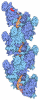
- PDB-9sqy: Cryo-EM structure of the ARISC(E33A)-RAP80:K63-Ub7 complex (Compo... -
+ Open data

- Basic information
| Entry | Database: PDB / ID: 9sqy | |||||||||||||||
|---|---|---|---|---|---|---|---|---|---|---|---|---|---|---|---|---|
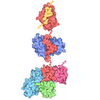
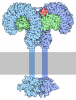
| Title | Cryo-EM structure of the ARISC(E33A)-RAP80:K63-Ub7 complex (Composite map) | |||||||||||||||
 Components Components |
| |||||||||||||||
 Keywords Keywords | HYDROLASE / Deubiquitylating enzymes / JAMM/MPN family / ubiquitin chains / DNA damage repair | |||||||||||||||
| Function / homology |  Function and homology information Function and homology informationperoxisome signal sequence receptor activity / BRISC complex / Hydrolases; Acting on peptide bonds (peptidases); Omega peptidases / response to vitamin B6 / BRCA1-A complex / attachment of spindle microtubules to kinetochore / ubiquitin-modified histone reader activity / nuclear ubiquitin ligase complex / tumor necrosis factor receptor binding / mitotic G2/M transition checkpoint ...peroxisome signal sequence receptor activity / BRISC complex / Hydrolases; Acting on peptide bonds (peptidases); Omega peptidases / response to vitamin B6 / BRCA1-A complex / attachment of spindle microtubules to kinetochore / ubiquitin-modified histone reader activity / nuclear ubiquitin ligase complex / tumor necrosis factor receptor binding / mitotic G2/M transition checkpoint / response to X-ray / K63-linked polyubiquitin modification-dependent protein binding / metal-dependent deubiquitinase activity / response to ionizing radiation / regulation of DNA damage checkpoint / protein K63-linked deubiquitination / K63-linked deubiquitinase activity / mitotic G2 DNA damage checkpoint signaling / polyubiquitin modification-dependent protein binding / DNA repair-dependent chromatin remodeling / mitotic spindle assembly / positive regulation of NLRP3 inflammasome complex assembly / protein deubiquitination / enzyme regulator activity / ubiquitin ligase complex / Maturation of protein E / Maturation of protein E / regulation of DNA repair / ER Quality Control Compartment (ERQC) / Myoclonic epilepsy of Lafora / FLT3 signaling by CBL mutants / IRAK2 mediated activation of TAK1 complex / Alpha-protein kinase 1 signaling pathway / Glycogen synthesis / IRAK1 recruits IKK complex / IRAK1 recruits IKK complex upon TLR7/8 or 9 stimulation / Prevention of phagosomal-lysosomal fusion / Endosomal Sorting Complex Required For Transport (ESCRT) / Membrane binding and targetting of GAG proteins / Regulation of TBK1, IKKε (IKBKE)-mediated activation of IRF3, IRF7 / Negative regulation of FLT3 / Regulation of TBK1, IKKε-mediated activation of IRF3, IRF7 upon TLR3 ligation / IRAK2 mediated activation of TAK1 complex upon TLR7/8 or 9 stimulation / Constitutive Signaling by NOTCH1 HD Domain Mutants / NOTCH2 Activation and Transmission of Signal to the Nucleus / TICAM1,TRAF6-dependent induction of TAK1 complex / PTK6 Regulates RTKs and Their Effectors AKT1 and DOK1 / positive regulation of DNA repair / TICAM1-dependent activation of IRF3/IRF7 / APC/C:Cdc20 mediated degradation of Cyclin B / Downregulation of ERBB4 signaling / APC-Cdc20 mediated degradation of Nek2A / Regulation of FZD by ubiquitination / p75NTR recruits signalling complexes / InlA-mediated entry of Listeria monocytogenes into host cells / TRAF6 mediated IRF7 activation in TLR7/8 or 9 signaling / NF-kB is activated and signals survival / TRAF6-mediated induction of TAK1 complex within TLR4 complex / Regulation of pyruvate metabolism / Pexophagy / PD-L1(CD274) glycosylation and translocation to plasma membrane / NRIF signals cell death from the nucleus / Downregulation of ERBB2:ERBB3 signaling / Regulation of PTEN localization / Regulation of innate immune responses to cytosolic DNA / cellular response to ionizing radiation / VLDLR internalisation and degradation / Activated NOTCH1 Transmits Signal to the Nucleus / Translesion synthesis by REV1 / TICAM1, RIP1-mediated IKK complex recruitment / Synthesis of active ubiquitin: roles of E1 and E2 enzymes / ZNF598 and the Ribosome-associated Quality Trigger (RQT) complex dissociate a ribosome stalled on a no-go mRNA / Translesion synthesis by POLK / Regulation of BACH1 activity / InlB-mediated entry of Listeria monocytogenes into host cell / JNK (c-Jun kinases) phosphorylation and activation mediated by activated human TAK1 / Activation of IRF3, IRF7 mediated by TBK1, IKKε (IKBKE) / MAP3K8 (TPL2)-dependent MAPK1/3 activation / Translesion synthesis by POLI / Downregulation of TGF-beta receptor signaling / Josephin domain DUBs / Gap-filling DNA repair synthesis and ligation in GG-NER / IKK complex recruitment mediated by RIP1 / PINK1-PRKN Mediated Mitophagy / TGF-beta receptor signaling in EMT (epithelial to mesenchymal transition) / TNFR1-induced NF-kappa-B signaling pathway / Regulation of activated PAK-2p34 by proteasome mediated degradation / TCF dependent signaling in response to WNT / activated TAK1 mediates p38 MAPK activation / Regulation of NF-kappa B signaling / Maturation of DENV proteins / Autodegradation of Cdh1 by Cdh1:APC/C / APC/C:Cdc20 mediated degradation of Securin / NOTCH3 Activation and Transmission of Signal to the Nucleus / N-glycan trimming in the ER and Calnexin/Calreticulin cycle / Regulation of signaling by CBL / Negative regulators of DDX58/IFIH1 signaling / Asymmetric localization of PCP proteins / Negative regulation of FGFR3 signaling / Ubiquitin-dependent degradation of Cyclin D Similarity search - Function | |||||||||||||||
| Biological species |  Homo sapiens (human) Homo sapiens (human) | |||||||||||||||
| Method | ELECTRON MICROSCOPY / single particle reconstruction / cryo EM / Resolution: 2.92 Å | |||||||||||||||
 Authors Authors | Foglizzo, M. / Zeqiraj, E. | |||||||||||||||
| Funding support |  United Kingdom, 4items United Kingdom, 4items
| |||||||||||||||
 Citation Citation | Journal: Nat Commun / Year: 2026 Title: Mechanism of K63-linked polyubiquitin recognition and cleavage by the BRCA1-A complex. Authors: Martina Foglizzo / Arindam Datta / Oksana Degtjarik / Hirunika Perera / Jordan Liburd / Upasana M Sykora / Sri Ranjani Ganji / Gemma Wildsmith / Francesca Chandler / Lisa J Campbell / ...Authors: Martina Foglizzo / Arindam Datta / Oksana Degtjarik / Hirunika Perera / Jordan Liburd / Upasana M Sykora / Sri Ranjani Ganji / Gemma Wildsmith / Francesca Chandler / Lisa J Campbell / Antonio N Calabrese / Roger A Greenberg / Elton Zeqiraj /  Abstract: Deubiquitylases modulate cellular processes by removing monoubiquitin or cleaving polyubiquitin chains. The ARISC-RAP80 complex partners with BRCA1-BARD1 to form the BRCA1-A supercomplex, which ...Deubiquitylases modulate cellular processes by removing monoubiquitin or cleaving polyubiquitin chains. The ARISC-RAP80 complex partners with BRCA1-BARD1 to form the BRCA1-A supercomplex, which recognises K63-linked ubiquitin chains at DNA damage sites. ARISC-RAP80 contains multiple ubiquitin-binding sites, yet how these influence recognition and cleavage of K63-polyubiquitylated substrates remains unknown. We discover that a composite three-subunit interface allows ARISC-RAP80 to position K63-linked polyubiquitin chains in its catalytic site. Substrate recognition is further supported by RAP80 and non-catalytic ubiquitin-binding sites that impose a compact conformation on K63-polyubiquitylated substrates. This mechanism exploits the inherent flexibility of long ubiquitin chains and differs considerably from other deubiquitylases. Structure-guided mutageneses validate ubiquitin chain interactions, and cell-based assays demonstrate a functional role of the observed interfaces in chromatin recruitment. Our findings define mechanisms of polyubiquitin chain decoding and cleavage by ARISC-RAP80, linking ubiquitin reading and erasing functions to BRCA1-A mediated DNA damage responses. | |||||||||||||||
| History |
|
- Structure visualization
| Structure viewer | Molecule: MolmilJmol/JSmol |
|---|
- Downloads & links
-Download
| PDBx/mmCIF format | 9sqy.cif.gz | 618.8 KB | Display | PDBx/mmCIF format |
|---|---|---|---|---|
| PDB format | pdb9sqy.ent.gz | 487.1 KB | Display | PDB format |
| PDBx/mmJSON format | 9sqy.json.gz | Tree view | PDBx/mmJSON format | |
| Others |  Other downloads Other downloads |
-Validation report
| Arichive directory | https://data.pdbj.org/pub/pdb/validation_reports/sq/9sqyftp://data.pdbj.org/pub/pdb/validation_reports/sq/9sqy | HTTPS FTP |
|---|
-Related structure data
| Related structure data |  55122MC  9sqvC  9sqwC C: citing same article ( M: map data used to model this data |
|---|---|
| Similar structure data |


-Links
 PDBj
PDBj



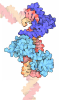
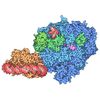
- Assembly
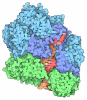
| Deposited unit | 
|
|---|---|
| 1 |
|
-Components
-BRCA1-A complex subunit ... , 2 types, 4 molecules DCIJ
| #1: Protein | Mass: 50623.969 Da / Num. of mol.: 2 Source method: isolated from a genetically manipulated source Source: (gene. exp.) Homo sapiens (human) / Gene: ABRAXAS1, ABRA1, CCDC98, FAM175A, UNQ496/PRO1013 / Production host:   Spodoptera frugiperda (fall armyworm) / References: UniProt: Q6UWZ7 Spodoptera frugiperda (fall armyworm) / References: UniProt: Q6UWZ7#4: Protein | Mass: 80243.945 Da / Num. of mol.: 2 Source method: isolated from a genetically manipulated source Source: (gene. exp.) Homo sapiens (human) / Gene: UIMC1, RAP80, RXRIP110 / Production host: Spodoptera frugiperda (fall armyworm) / References: UniProt: Q96RL1 |
|---|
-BRISC and BRCA1-A complex member ... , 2 types, 4 molecules EFGH
| #2: Protein | Mass: 43721.602 Da / Num. of mol.: 2 Source method: isolated from a genetically manipulated source Source: (gene. exp.) Homo sapiens (human) / Gene: BABAM2, BRCC45, BRE / Production host: Spodoptera frugiperda (fall armyworm) / References: UniProt: Q9NXR7#3: Protein | Mass: 36594.930 Da / Num. of mol.: 2 Source method: isolated from a genetically manipulated source Source: (gene. exp.) Homo sapiens (human) / Gene: BABAM1, C19orf62, MERIT40, NBA1, HSPC142 / Production host: Spodoptera frugiperda (fall armyworm) / References: UniProt: Q9NWV8 |
|---|
-Protein , 2 types, 8 molecules KLMNOPAB
| #5: Protein | Mass: 8576.831 Da / Num. of mol.: 6 Source method: isolated from a genetically manipulated source Source: (gene. exp.) Homo sapiens (human) / Gene: UBC / Production host:   Escherichia coli (E. coli) / References: UniProt: P0CG48 Escherichia coli (E. coli) / References: UniProt: P0CG48#6: Protein | Mass: 36061.883 Da / Num. of mol.: 2 Source method: isolated from a genetically manipulated source Source: (gene. exp.) Homo sapiens (human) / Gene: BRCC3, BRCC36, C6.1A, CXorf53 / Production host: Spodoptera frugiperda (fall armyworm)References: UniProt: P46736, Hydrolases; Acting on peptide bonds (peptidases); Omega peptidases |
|---|
-Non-polymers , 1 types, 2 molecules 
| #7: Chemical |  Mass: 65.409 Da / Num. of mol.: 2 / Source method: obtained synthetically / Formula: Zn / Feature type: SUBJECT OF INVESTIGATION Mass: 65.409 Da / Num. of mol.: 2 / Source method: obtained synthetically / Formula: Zn / Feature type: SUBJECT OF INVESTIGATION |
|---|
-Details
| Has ligand of interest | Y |
|---|---|
| Has protein modification | N |
-Experimental details
-Experiment
| Experiment | Method: ELECTRON MICROSCOPY |
|---|---|
| EM experiment | Aggregation state: PARTICLE / 3D reconstruction method: single particle reconstruction |
- Sample preparation
| Component | Name: ARISC(E33A)-RAP80 in complex with K63-linked ubiquitin chains Type: COMPLEX / Entity ID: #1-#6 / Source: RECOMBINANT | ||||||||||||||||||||
|---|---|---|---|---|---|---|---|---|---|---|---|---|---|---|---|---|---|---|---|---|---|
| Molecular weight | Value: 0.207 MDa / Experimental value: NO | ||||||||||||||||||||
| Source (natural) | Organism: Homo sapiens (human) | ||||||||||||||||||||
| Source (recombinant) |
| ||||||||||||||||||||
| Buffer solution | pH: 7.3 | ||||||||||||||||||||
| Buffer component |
| ||||||||||||||||||||
| Specimen | Conc.: 0.6 mg/ml / Embedding applied: NO / Shadowing applied: NO / Staining applied: NO / Vitrification applied: YES Details: Freshly purified ARISC(E33A)-RAP80 (at 0.6 mg/mL) was mixed with 1.5-fold molar excess of K63-linked heptaUb (Ub7) chains, and incubated in the presence of 0.025% (v/v) glutaraldehyde (Sigma- ...Details: Freshly purified ARISC(E33A)-RAP80 (at 0.6 mg/mL) was mixed with 1.5-fold molar excess of K63-linked heptaUb (Ub7) chains, and incubated in the presence of 0.025% (v/v) glutaraldehyde (Sigma-Aldrich) at room temperature for 4 min. The cross-linking reaction was then quenched by the addition of 100 mM Tris-HCl pH 7.5 prior to cryo-EM grids preparation. | ||||||||||||||||||||
| Specimen support | Details: UltraAuFoil R1.2/1.3 300-mesh grids (Quantifoil Micro Tools GmbH) were glow-discharged for 1 min at 12 mA and 0.38 mBar pressure using a PELCO easiGlow system (Ted Pella). Grid material: GOLD / Grid mesh size: 300 divisions/in. / Grid type: UltrAuFoil R1.2/1.3 | ||||||||||||||||||||
| Vitrification | Instrument: FEI VITROBOT MARK IV / Cryogen name: ETHANE / Humidity: 100 % / Chamber temperature: 277 K Details: blot force = 1 N; blot time = 6 s; waiting time = 27 s |
- Electron microscopy imaging
| Experimental equipment |  Model: Titan Krios / Image courtesy: FEI Company |
|---|---|
| Microscopy | Model: TFS KRIOS |
| Electron gun | Electron source:  FIELD EMISSION GUN / Accelerating voltage: 300 kV / Illumination mode: FLOOD BEAM FIELD EMISSION GUN / Accelerating voltage: 300 kV / Illumination mode: FLOOD BEAM |
| Electron lens | Mode: BRIGHT FIELD / Nominal magnification: 165000 X / Nominal defocus max: 3000 nm / Nominal defocus min: 900 nm / Cs: 2.7 mm / Alignment procedure: COMA FREE |
| Specimen holder | Cryogen: NITROGEN / Specimen holder model: FEI TITAN KRIOS AUTOGRID HOLDER |
| Image recording | Average exposure time: 3.4 sec. / Electron dose: 45.5 e/Å2 / Film or detector model: TFS FALCON 4i (4k x 4k) / Num. of grids imaged: 1 / Num. of real images: 10649 |
| EM imaging optics | Energyfilter name: TFS Selectris / Energyfilter slit width: 10 eV / Phase plate: VOLTA PHASE PLATE |
- Processing
| EM software |
| ||||||||||||||||||||||||||||||||||||
|---|---|---|---|---|---|---|---|---|---|---|---|---|---|---|---|---|---|---|---|---|---|---|---|---|---|---|---|---|---|---|---|---|---|---|---|---|---|
| CTF correction | Type: PHASE FLIPPING AND AMPLITUDE CORRECTION | ||||||||||||||||||||||||||||||||||||
| Particle selection | Num. of particles selected: 789840 | ||||||||||||||||||||||||||||||||||||
| Symmetry | Point symmetry: C1 (asymmetric) | ||||||||||||||||||||||||||||||||||||
| 3D reconstruction | Resolution: 2.92 Å / Resolution method: FSC 0.143 CUT-OFF / Num. of particles: 214650 / Num. of class averages: 1 / Symmetry type: POINT |
