 Movie
Movie Controller

[English] 日本語
 Yorodumi
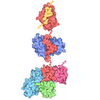
- EMDB-55122: Cryo-EM structure of the ARISC(E33A)-RAP80:K63-Ub7 complex (Compo... -
+ Open data

- Basic information
| Entry |  | |||||||||||||||
|---|---|---|---|---|---|---|---|---|---|---|---|---|---|---|---|---|
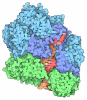
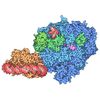
| Title | Cryo-EM structure of the ARISC(E33A)-RAP80:K63-Ub7 complex (Composite map) | |||||||||||||||
 Map data Map data | Composite map of the ARISC(E33A)-RAP80:K63-Ub7 complex | |||||||||||||||
 Sample Sample |
| |||||||||||||||
 Keywords Keywords | Deubiquitylating enzymes / JAMM/MPN family / ubiquitin chains / DNA damage repair / HYDROLASE | |||||||||||||||
| Function / homology |  Function and homology information Function and homology informationperoxisome signal sequence receptor activity / BRISC complex / Hydrolases; Acting on peptide bonds (peptidases); Omega peptidases / response to vitamin B6 / BRCA1-A complex / attachment of spindle microtubules to kinetochore / ubiquitin-modified histone reader activity / nuclear ubiquitin ligase complex / tumor necrosis factor receptor binding / mitotic G2/M transition checkpoint ...peroxisome signal sequence receptor activity / BRISC complex / Hydrolases; Acting on peptide bonds (peptidases); Omega peptidases / response to vitamin B6 / BRCA1-A complex / attachment of spindle microtubules to kinetochore / ubiquitin-modified histone reader activity / nuclear ubiquitin ligase complex / tumor necrosis factor receptor binding / mitotic G2/M transition checkpoint / response to X-ray / K63-linked polyubiquitin modification-dependent protein binding / metal-dependent deubiquitinase activity / response to ionizing radiation / regulation of DNA damage checkpoint / protein K63-linked deubiquitination / K63-linked deubiquitinase activity / mitotic G2 DNA damage checkpoint signaling / polyubiquitin modification-dependent protein binding / DNA repair-dependent chromatin remodeling / mitotic spindle assembly / positive regulation of NLRP3 inflammasome complex assembly / protein deubiquitination / enzyme regulator activity / ubiquitin ligase complex / Maturation of protein E / Maturation of protein E / regulation of DNA repair / ER Quality Control Compartment (ERQC) / Myoclonic epilepsy of Lafora / FLT3 signaling by CBL mutants / IRAK2 mediated activation of TAK1 complex / Alpha-protein kinase 1 signaling pathway / Glycogen synthesis / IRAK1 recruits IKK complex / IRAK1 recruits IKK complex upon TLR7/8 or 9 stimulation / Prevention of phagosomal-lysosomal fusion / Endosomal Sorting Complex Required For Transport (ESCRT) / Membrane binding and targetting of GAG proteins / Regulation of TBK1, IKKε (IKBKE)-mediated activation of IRF3, IRF7 / Negative regulation of FLT3 / Regulation of TBK1, IKKε-mediated activation of IRF3, IRF7 upon TLR3 ligation / IRAK2 mediated activation of TAK1 complex upon TLR7/8 or 9 stimulation / Constitutive Signaling by NOTCH1 HD Domain Mutants / NOTCH2 Activation and Transmission of Signal to the Nucleus / TICAM1,TRAF6-dependent induction of TAK1 complex / PTK6 Regulates RTKs and Their Effectors AKT1 and DOK1 / positive regulation of DNA repair / TICAM1-dependent activation of IRF3/IRF7 / APC/C:Cdc20 mediated degradation of Cyclin B / Downregulation of ERBB4 signaling / APC-Cdc20 mediated degradation of Nek2A / Regulation of FZD by ubiquitination / p75NTR recruits signalling complexes / InlA-mediated entry of Listeria monocytogenes into host cells / TRAF6 mediated IRF7 activation in TLR7/8 or 9 signaling / NF-kB is activated and signals survival / TRAF6-mediated induction of TAK1 complex within TLR4 complex / Regulation of pyruvate metabolism / Pexophagy / PD-L1(CD274) glycosylation and translocation to plasma membrane / NRIF signals cell death from the nucleus / Downregulation of ERBB2:ERBB3 signaling / Regulation of PTEN localization / Regulation of innate immune responses to cytosolic DNA / cellular response to ionizing radiation / VLDLR internalisation and degradation / Activated NOTCH1 Transmits Signal to the Nucleus / Translesion synthesis by REV1 / TICAM1, RIP1-mediated IKK complex recruitment / Synthesis of active ubiquitin: roles of E1 and E2 enzymes / ZNF598 and the Ribosome-associated Quality Trigger (RQT) complex dissociate a ribosome stalled on a no-go mRNA / Translesion synthesis by POLK / Regulation of BACH1 activity / InlB-mediated entry of Listeria monocytogenes into host cell / JNK (c-Jun kinases) phosphorylation and activation mediated by activated human TAK1 / Activation of IRF3, IRF7 mediated by TBK1, IKKε (IKBKE) / MAP3K8 (TPL2)-dependent MAPK1/3 activation / Translesion synthesis by POLI / Downregulation of TGF-beta receptor signaling / Josephin domain DUBs / Gap-filling DNA repair synthesis and ligation in GG-NER / IKK complex recruitment mediated by RIP1 / PINK1-PRKN Mediated Mitophagy / TGF-beta receptor signaling in EMT (epithelial to mesenchymal transition) / TNFR1-induced NF-kappa-B signaling pathway / Regulation of activated PAK-2p34 by proteasome mediated degradation / TCF dependent signaling in response to WNT / activated TAK1 mediates p38 MAPK activation / Regulation of NF-kappa B signaling / Maturation of DENV proteins / Autodegradation of Cdh1 by Cdh1:APC/C / APC/C:Cdc20 mediated degradation of Securin / NOTCH3 Activation and Transmission of Signal to the Nucleus / N-glycan trimming in the ER and Calnexin/Calreticulin cycle / Regulation of signaling by CBL / Negative regulators of DDX58/IFIH1 signaling / Asymmetric localization of PCP proteins / Negative regulation of FGFR3 signaling / Ubiquitin-dependent degradation of Cyclin D Similarity search - Function | |||||||||||||||
| Biological species |  Homo sapiens (human) Homo sapiens (human) | |||||||||||||||
| Method | single particle reconstruction / cryo EM / Resolution: 2.92 Å | |||||||||||||||
 Authors Authors | Foglizzo M / Zeqiraj E | |||||||||||||||
| Funding support |  United Kingdom, 4 items United Kingdom, 4 items
| |||||||||||||||
 Citation Citation | Journal: Nat Commun / Year: 2026 Title: Mechanism of K63-linked polyubiquitin recognition and cleavage by the BRCA1-A complex. Authors: Martina Foglizzo / Arindam Datta / Oksana Degtjarik / Hirunika Perera / Jordan Liburd / Upasana M Sykora / Sri Ranjani Ganji / Gemma Wildsmith / Francesca Chandler / Lisa J Campbell / ...Authors: Martina Foglizzo / Arindam Datta / Oksana Degtjarik / Hirunika Perera / Jordan Liburd / Upasana M Sykora / Sri Ranjani Ganji / Gemma Wildsmith / Francesca Chandler / Lisa J Campbell / Antonio N Calabrese / Roger A Greenberg / Elton Zeqiraj /  Abstract: Deubiquitylases modulate cellular processes by removing monoubiquitin or cleaving polyubiquitin chains. The ARISC-RAP80 complex partners with BRCA1-BARD1 to form the BRCA1-A supercomplex, which ...Deubiquitylases modulate cellular processes by removing monoubiquitin or cleaving polyubiquitin chains. The ARISC-RAP80 complex partners with BRCA1-BARD1 to form the BRCA1-A supercomplex, which recognises K63-linked ubiquitin chains at DNA damage sites. ARISC-RAP80 contains multiple ubiquitin-binding sites, yet how these influence recognition and cleavage of K63-polyubiquitylated substrates remains unknown. We discover that a composite three-subunit interface allows ARISC-RAP80 to position K63-linked polyubiquitin chains in its catalytic site. Substrate recognition is further supported by RAP80 and non-catalytic ubiquitin-binding sites that impose a compact conformation on K63-polyubiquitylated substrates. This mechanism exploits the inherent flexibility of long ubiquitin chains and differs considerably from other deubiquitylases. Structure-guided mutageneses validate ubiquitin chain interactions, and cell-based assays demonstrate a functional role of the observed interfaces in chromatin recruitment. Our findings define mechanisms of polyubiquitin chain decoding and cleavage by ARISC-RAP80, linking ubiquitin reading and erasing functions to BRCA1-A mediated DNA damage responses. | |||||||||||||||
| History |
|
- Structure visualization
| Supplemental images |
|---|

- Downloads & links
-EMDB archive
| Map data | emd_55122.map.gz | 322.2 MB | EMDB map data format | |
|---|---|---|---|---|
| Header (meta data) | emd-55122-v30.xmlemd-55122.xml | 31.6 KB 31.6 KB | Display Display | EMDB header |
| Images |  emd_55122.png emd_55122.png | 75.2 KB | ||
| Filedesc metadata | emd-55122.cif.gz | 9.2 KB | ||
| Archive directory |  https://data.pdbj.org/pub/emdb/structures/EMD-55122ftp://data.pdbj.org/pub/emdb/structures/EMD-55122 https://data.pdbj.org/pub/emdb/structures/EMD-55122ftp://data.pdbj.org/pub/emdb/structures/EMD-55122 | HTTPS FTP |
-Related structure data
| Related structure data |  9sqyMC  9sqvC  9sqwC C: citing same article ( M: atomic model generated by this map |
|---|---|
| Similar structure data |


-Links
| EMDB pages | EMDB (EBI/PDBe) / EMDataResource |
|---|---|
| Related items in Molecule of the Month |

-Map
| File | Download / File: emd_55122.map.gz / Format: CCP4 / Size: 387.7 MB / Type: IMAGE STORED AS FLOATING POINT NUMBER (4 BYTES) | ||||||||||||||||||||||||||||||||||||
|---|---|---|---|---|---|---|---|---|---|---|---|---|---|---|---|---|---|---|---|---|---|---|---|---|---|---|---|---|---|---|---|---|---|---|---|---|---|
| Annotation | Composite map of the ARISC(E33A)-RAP80:K63-Ub7 complex | ||||||||||||||||||||||||||||||||||||
| Projections & slices | Image control
Images are generated by Spider. generated in cubic-lattice coordinate | ||||||||||||||||||||||||||||||||||||
| Voxel size | X=Y=Z: 0.74 Å | ||||||||||||||||||||||||||||||||||||
| Density |
| ||||||||||||||||||||||||||||||||||||
| Symmetry | Space group: 1 | ||||||||||||||||||||||||||||||||||||
| Details | EMDB XML:
|
 Z (Sec.)
 Y (Row.)
 X (Col.)


-Supplemental data
- Sample components
-Entire : ARISC(E33A)-RAP80 in complex with K63-linked ubiquitin chains
| Entire | Name: ARISC(E33A)-RAP80 in complex with K63-linked ubiquitin chains |
|---|---|
| Components |
|
-Supramolecule #1: ARISC(E33A)-RAP80 in complex with K63-linked ubiquitin chains
| Supramolecule | Name: ARISC(E33A)-RAP80 in complex with K63-linked ubiquitin chains type: complex / ID: 1 / Parent: 0 / Macromolecule list: #1-#6 |
|---|---|
| Source (natural) | Organism: Homo sapiens (human) |
| Molecular weight | Theoretical: 207 KDa |
-Macromolecule #1: BRCA1-A complex subunit Abraxas 1
| Macromolecule | Name: BRCA1-A complex subunit Abraxas 1 / type: protein_or_peptide / ID: 1 / Number of copies: 2 / Enantiomer: LEVO |
|---|---|
| Source (natural) | Organism: Homo sapiens (human) |
| Molecular weight | Theoretical: 50.623969 KDa |
| Recombinant expression | Organism:   Spodoptera frugiperda (fall armyworm) Spodoptera frugiperda (fall armyworm) |
| Sequence | String: MWSHPQFEKG GGSGGGSGGS AWSHPQFEKL EVLFQGTMEG ESTSAVLSGF VLGALAFQHL NTDSDTEGFL LGEVKGEAKN SITDSQMDD VEVVYTIDIQ KYIPCYQLFS FYNSSGEVNE QALKKILSNV KKNVVGWYKF RRHSDQIMTF RERLLHKNLQ E HFSNQDLV ...String: MWSHPQFEKG GGSGGGSGGS AWSHPQFEKL EVLFQGTMEG ESTSAVLSGF VLGALAFQHL NTDSDTEGFL LGEVKGEAKN SITDSQMDD VEVVYTIDIQ KYIPCYQLFS FYNSSGEVNE QALKKILSNV KKNVVGWYKF RRHSDQIMTF RERLLHKNLQ E HFSNQDLV FLLLTPSIIT ESCSTHRLEH SLYKPQKGLF HRVPLVVANL GMSEQLGYKT VSGSCMSTGF SRAVQTHSSK FF EEDGSLK EVHKINEMYA SLQEELKSIC KKVEDSEQAV DKLVKDVNRL KREIEKRRGA QIQAAREKNI QKDPQENIFL CQA LRTFFP NSEFLHSCVM SLKNRHVSKS SCNYNHHLDV VDNLTLMVEH TDIPEASPAS TPQIIKHKAL DLDDRWQFKR SRLL DTQDK RSKADTGSSN QDKASKMSSP ETDEEIEKMK GFGEYSRSPT F UniProtKB: BRCA1-A complex subunit Abraxas 1 |
-Macromolecule #2: BRISC and BRCA1-A complex member 2
| Macromolecule | Name: BRISC and BRCA1-A complex member 2 / type: protein_or_peptide / ID: 2 / Number of copies: 2 / Enantiomer: LEVO |
|---|---|
| Source (natural) | Organism: Homo sapiens (human) |
| Molecular weight | Theoretical: 43.721602 KDa |
| Recombinant expression | Organism: Spodoptera frugiperda (fall armyworm) |
| Sequence | String: GAMSPEVALN RISPMLSPFI SSVVRNGKVG LDATNCLRIT DLKSGCTSLT PGPNCDRFKL HIPYAGETLK WDIIFNAQYP ELPPDFIFG EDAEFLPDPS ALQNLASWNP SNPECLLLVV KELVQQYHQF QCSRLRESSR LMFEYQTLLE EPQYGENMEI Y AGKKNNWT ...String: GAMSPEVALN RISPMLSPFI SSVVRNGKVG LDATNCLRIT DLKSGCTSLT PGPNCDRFKL HIPYAGETLK WDIIFNAQYP ELPPDFIFG EDAEFLPDPS ALQNLASWNP SNPECLLLVV KELVQQYHQF QCSRLRESSR LMFEYQTLLE EPQYGENMEI Y AGKKNNWT GEFSARFLLK LPVDFSNIPT YLLKDVNEDP GEDVALLSVS FEDTEATQVY PKLYLSPRIE HALGGSSALH IP AFPGGGC LIDYVPQVCH LLTNKVQYVI QGYHKRREYI AAFLSHFGTG VVEYDAEGFT KLTLLLMWKD FCFLVHIDLP LFF PRDQPT LTFQSVYHFT NSGQLYSQAQ KNYPYSPRWD GNEMAKRAKA YFKTFVPQFQ EAAFANGKL UniProtKB: BRISC and BRCA1-A complex member 2 |
-Macromolecule #3: BRISC and BRCA1-A complex member 1
| Macromolecule | Name: BRISC and BRCA1-A complex member 1 / type: protein_or_peptide / ID: 3 / Number of copies: 2 / Enantiomer: LEVO |
|---|---|
| Source (natural) | Organism: Homo sapiens (human) |
| Molecular weight | Theoretical: 36.59493 KDa |
| Recombinant expression | Organism: Spodoptera frugiperda (fall armyworm) |
| Sequence | String: MEVAEPSSPT EEEEEEEEHS AEPRPRTRSN PEGAEDRAVG AQASVGSRSE GEGEAASADD GSLNTSGAGP KSWQVPPPAP EVQIRTPRV NCPEKVIICL DLSEEMSLPK LESFNGSKTN ALNVSQKMIE MFVRTKHKID KSHEFALVVV NDDTAWLSGL T SDPRELCS ...String: MEVAEPSSPT EEEEEEEEHS AEPRPRTRSN PEGAEDRAVG AQASVGSRSE GEGEAASADD GSLNTSGAGP KSWQVPPPAP EVQIRTPRV NCPEKVIICL DLSEEMSLPK LESFNGSKTN ALNVSQKMIE MFVRTKHKID KSHEFALVVV NDDTAWLSGL T SDPRELCS CLYDLETASC STFNLEGLFS LIQQKTELPV TENVQTIPPP YVVRTILVYS RPPCQPQFSL TEPMKKMFQC PY FFFDVVY IHNGTEEKEE EMSWKDMFAF MGSLDTKGTS YKYEVALAGP ALELHNCMAK LLAHPLQRPC QSHASYSLLE EED EAIEVE ATV UniProtKB: BRISC and BRCA1-A complex member 1 |
-Macromolecule #4: BRCA1-A complex subunit RAP80
| Macromolecule | Name: BRCA1-A complex subunit RAP80 / type: protein_or_peptide / ID: 4 / Number of copies: 2 / Enantiomer: LEVO |
|---|---|
| Source (natural) | Organism: Homo sapiens (human) |
| Molecular weight | Theoretical: 80.243945 KDa |
| Recombinant expression | Organism: Spodoptera frugiperda (fall armyworm) |
| Sequence | String: GAMGSMPRRK KKVKEVSESR NLEKKDVETT SSVSVKRKRR LEDAFIVISD SDGEEPKEEN GLQKTKTKQS NRAKCLAKRK IAQMTEEEQ FALALKMSEQ EAREVNSQEE EEEELLRKAI AESLNSCRPS DASATRSRPL ATGPSSQSHQ EKTTDSGLTE G IWQLVPPS ...String: GAMGSMPRRK KKVKEVSESR NLEKKDVETT SSVSVKRKRR LEDAFIVISD SDGEEPKEEN GLQKTKTKQS NRAKCLAKRK IAQMTEEEQ FALALKMSEQ EAREVNSQEE EEEELLRKAI AESLNSCRPS DASATRSRPL ATGPSSQSHQ EKTTDSGLTE G IWQLVPPS LFKGSHISQG NEAEEREEPW DHTEKTEEEP VSGSSGSWDQ SSQPVFENVN VKSFDRCTGH SAEHTQCGKP QE STGRGSA FLKAVQGSGD TSRHCLPTLA DAKGLQDTGG TVNYFWGIPF CPDGVDPNQY TKVILCQLEV YQKSLKMAQR QLL NKKGFG EPVLPRPPSL IQNECGQGEQ ASEKNECISE DMGDEDKEER QESRASDWHS KTKDFQESSI KSLKEKLLLE EEPT TSHGQ SSQGIVEETS EEGNSVPASQ SVAALTSKRS LVLMPESSAE EITVCPETQL SSSETFDLER EVSPGSRDIL DGVRI IMAD KEVGNKEDAE KEVAISTFSS SNQVSCPLCD QCFPPTKIER HAMYCNGLME EDTVLTRRQK EAKTKSDSGT AAQTSL DID KNEKCYLCKS LVPFREYQCH VDSCLQLAKA DQGDGPEGSG RACSTVEGKW QQRLKNPKEK GHSEGRLLSF LEQSEHK TS DADIKSSETG AFRVPSPGME EAGCSREMQS SFTRRDLNES PVKSFVSISE ATDCLVDFKK QVTVQPGSRT RTKAGRGR R RKF UniProtKB: BRCA1-A complex subunit RAP80 |
-Macromolecule #5: Ubiquitin
| Macromolecule | Name: Ubiquitin / type: protein_or_peptide / ID: 5 / Number of copies: 6 / Enantiomer: LEVO |
|---|---|
| Source (natural) | Organism: Homo sapiens (human) |
| Molecular weight | Theoretical: 8.576831 KDa |
| Recombinant expression | Organism:   Escherichia coli (E. coli) Escherichia coli (E. coli) |
| Sequence | String: MQIFVKTLTG KTITLEVEPS DTIENVKAKI QDKEGIPPDQ QRLIFAGKQL EDGRTLSDYN IQKESTLHLV LRLRGG UniProtKB: Polyubiquitin-C |
-Macromolecule #6: Lys-63-specific deubiquitinase BRCC36
| Macromolecule | Name: Lys-63-specific deubiquitinase BRCC36 / type: protein_or_peptide / ID: 6 / Number of copies: 2 / Enantiomer: LEVO EC number: Hydrolases; Acting on peptide bonds (peptidases); Omega peptidases |
|---|---|
| Source (natural) | Organism: Homo sapiens (human) |
| Molecular weight | Theoretical: 36.061883 KDa |
| Recombinant expression | Organism: Spodoptera frugiperda (fall armyworm) |
| Sequence | String: MAVQVVQAVQ AVHLESDAFL VCLNHALSTE KEAVMGLCIG ELNDDTRSDS KFAYTGTEMR TVAEKVDAVR IVHIHSVIIL RRSDKRKDR VEISPEQLSA ASTEAERLAE LTGRPMRVVG WYHSHPHITV WPSHVDVRTQ AMYQMMDQGF VGLIFSCFIE D KNTKTGRV ...String: MAVQVVQAVQ AVHLESDAFL VCLNHALSTE KEAVMGLCIG ELNDDTRSDS KFAYTGTEMR TVAEKVDAVR IVHIHSVIIL RRSDKRKDR VEISPEQLSA ASTEAERLAE LTGRPMRVVG WYHSHPHITV WPSHVDVRTQ AMYQMMDQGF VGLIFSCFIE D KNTKTGRV LYTCFQSIQA QKSSESLHGP RDFWSSSQHI SIEGQKEEER YERIEIPIHI VPHVTIGKVC LESAVELPKI LC QEEQDAY RRIHSLTHLD SVTKIHNGSV FTKNLCSQMS AVSGPLLQWL EDRLEQNQQH LQELQQEKEE LMQELSSLE UniProtKB: Lys-63-specific deubiquitinase BRCC36 |
-Macromolecule #7: ZINC ION
| Macromolecule | Name: ZINC ION / type: ligand / ID: 7 / Number of copies: 2 / Formula: ZN |
|---|---|
| Molecular weight | Theoretical: 65.409 Da |
-Experimental details
-Structure determination
| Method | cryo EM |
|---|---|
 Processing Processing | single particle reconstruction |
| Aggregation state | particle |
-Sample preparation
| Concentration | 0.6 mg/mL | ||||||||||||
|---|---|---|---|---|---|---|---|---|---|---|---|---|---|
| Buffer | pH: 7.3 Component:
| ||||||||||||
| Grid | Model: UltrAuFoil R1.2/1.3 / Material: GOLD / Mesh: 300 / Pretreatment - Type: GLOW DISCHARGE / Pretreatment - Time: 60 sec. / Pretreatment - Atmosphere: AIR / Pretreatment - Pressure: 3.8e-07 kPa Details: UltraAuFoil R1.2/1.3 300-mesh grids (Quantifoil Micro Tools GmbH) were glow-discharged for 1 min at 12 mA and 0.38 mBar pressure using a PELCO easiGlow system (Ted Pella). | ||||||||||||
| Vitrification | Cryogen name: ETHANE / Chamber humidity: 100 % / Chamber temperature: 277 K / Instrument: FEI VITROBOT MARK IV Details: blot force = 1 N; blot time = 6 s; waiting time = 27 s. | ||||||||||||
| Details | Freshly purified ARISC(E33A)-RAP80 (at 0.6 mg/mL) was mixed with 1.5-fold molar excess of K63-linked heptaUb (Ub7) chains, and incubated in the presence of 0.025% (v/v) glutaraldehyde (Sigma-Aldrich) at room temperature for 4 min. The cross-linking reaction was then quenched by the addition of 100 mM Tris-HCl pH 7.5 prior to cryo-EM grids preparation. |
- Electron microscopy
| Microscope | TFS KRIOS |
|---|---|
| Specialist optics | Phase plate: VOLTA PHASE PLATE / Energy filter - Name: TFS Selectris / Energy filter - Slit width: 10 eV |
| Image recording | Film or detector model: TFS FALCON 4i (4k x 4k) / Number grids imaged: 1 / Number real images: 10649 / Average exposure time: 3.4 sec. / Average electron dose: 45.5 e/Å2 |
| Electron beam | Acceleration voltage: 300 kV / Electron source:  FIELD EMISSION GUN FIELD EMISSION GUN |
| Electron optics | Illumination mode: FLOOD BEAM / Imaging mode: BRIGHT FIELD / Cs: 2.7 mm / Nominal defocus max: 3.0 µm / Nominal defocus min: 0.9 µm / Nominal magnification: 165000 |
| Sample stage | Specimen holder model: FEI TITAN KRIOS AUTOGRID HOLDER / Cooling holder cryogen: NITROGEN |
| Experimental equipment |  Model: Titan Krios / Image courtesy: FEI Company |
