 Movie
Movie Controller

[English] 日本語
 Yorodumi
- PDB-9sp8: Cryo-EM structure of the Arabidopsis thaliana CAT4 transporter in... -
+ Open data

- Basic information
| Entry | Database: PDB / ID: 9sp8 | |||||||||
|---|---|---|---|---|---|---|---|---|---|---|
| Title | Cryo-EM structure of the Arabidopsis thaliana CAT4 transporter in the outward-open L-ornithine bound state | |||||||||
 Components Components |
| |||||||||
 Keywords Keywords | TRANSPORT PROTEIN / membrane transporter / cationic amino acid | |||||||||
| Function / homology |  Function and homology information Function and homology informationplant-type vacuole membrane / plant-type vacuole / amino acid transmembrane transporter activity / amino acid transport Similarity search - Function | |||||||||
| Biological species | synthetic construct (others)  Arabidopsis thaliana (thale cress) Arabidopsis thaliana (thale cress) | |||||||||
| Method | ELECTRON MICROSCOPY / single particle reconstruction / cryo EM / Resolution: 3.32 Å | |||||||||
 Authors Authors | Kolokouris, D. / Newstead, S. | |||||||||
| Funding support |  United Kingdom, 1items United Kingdom, 1items
| |||||||||
 Citation Citation | Journal: Nat Commun / Year: 2026 Title: Structural basis for pH-responsive amino acid transport via SLC7A4. Authors: Dimitrios Kolokouris / Anuja Bothra / Takafumi Kato / Yi C Zeng / Simon Lichtinger / Joanne L Parker / Philip C Biggin / Simon Newstead / Abstract: The transport of amino acids across cell membranes is essential for metabolism, neuronal signalling, and immune system function. The amino acid polyamine organocation (APC) superfamily controls amino ...The transport of amino acids across cell membranes is essential for metabolism, neuronal signalling, and immune system function. The amino acid polyamine organocation (APC) superfamily controls amino acid transport via mechanisms including amino acid exchange, facilitative diffusion, and sodium- or proton-coupled transport. Although many mammalian APC members functioning as exchangers and sodium-coupled systems have been identified, the mechanisms underlying pH-regulated amino acid transport in mammalian cells remain unclear. Here, we show that the plasma membrane amino acid transporter SLC7A4 is regulated by low extracellular pH and functions as a leucine transporter in human cells. Using Cryo-EM structures of the plant homologue, CAT4, from Arabidopsis thaliana in outward-open apo and L-ornithine-bound states, as well as transport assays and molecular dynamics simulations based on homology models of the human transporter, we identify residues responsible for amino acid selectivity that supports an allosteric mechanism linking ligand recognition to pH regulation. This mechanism is consistent with an evolutionary link to proton-coupled prokaryotic homologues. Overall, our findings provide a structural and functional basis for pH-gated leucine transport by the human SLC7A4 transporter and provides a framework for understanding amino acid selectivity within the wider SLC7 family. | |||||||||
| History |
|
- Structure visualization
| Structure viewer | Molecule: MolmilJmol/JSmol |
|---|
- Downloads & links
-Download
| PDBx/mmCIF format | 9sp8.cif.gz | 152 KB | Display | PDBx/mmCIF format |
|---|---|---|---|---|
| PDB format | pdb9sp8.ent.gz | 105 KB | Display | PDB format |
| PDBx/mmJSON format | 9sp8.json.gz | Tree view | PDBx/mmJSON format | |
| Others |  Other downloads Other downloads |
-Validation report
| Arichive directory | https://data.pdbj.org/pub/pdb/validation_reports/sp/9sp8ftp://data.pdbj.org/pub/pdb/validation_reports/sp/9sp8 | HTTPS FTP |
|---|
-Related structure data
| Related structure data |  55065MC  9sqhC M: map data used to model this data C: citing same article ( |
|---|---|
| Similar structure data |

-Links
 PDBj
PDBj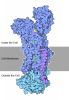
- Assembly
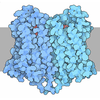
| Deposited unit | 
|
|---|---|
| 1 |
|
-Components
-Protein , 2 types, 2 molecules BA
| #1: Protein | Mass: 12508.005 Da / Num. of mol.: 1 Source method: isolated from a genetically manipulated source Source: (gene. exp.) synthetic construct (others) / Production host:   Escherichia coli (E. coli) Escherichia coli (E. coli) |
|---|---|
| #2: Protein | Mass: 63680.152 Da / Num. of mol.: 1 Source method: isolated from a genetically manipulated source Source: (gene. exp.) Arabidopsis thaliana (thale cress) / Gene: CAT4, At3g03720, F20H23.25 / Plasmid: pDDGFP2-LEU2d / Production host:   Saccharomyces cerevisiae (brewer's yeast) / Strain (production host): BJ5460 / References: UniProt: Q8W4K3 Saccharomyces cerevisiae (brewer's yeast) / Strain (production host): BJ5460 / References: UniProt: Q8W4K3 |
-Non-polymers , 5 types, 8 molecules 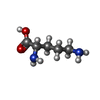


| #3: Chemical | ChemComp-ORN / 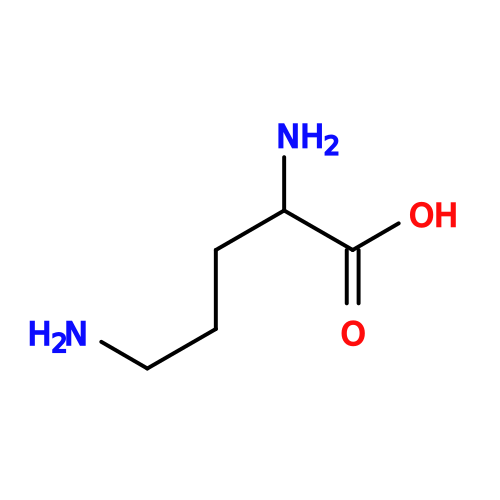 Type: L-peptide linking / Mass: 132.161 Da / Num. of mol.: 1 / Source method: obtained synthetically / Formula: C5H12N2O2 / Feature type: SUBJECT OF INVESTIGATION Type: L-peptide linking / Mass: 132.161 Da / Num. of mol.: 1 / Source method: obtained synthetically / Formula: C5H12N2O2 / Feature type: SUBJECT OF INVESTIGATION | ||||
|---|---|---|---|---|---|
| #4: Chemical | ChemComp-AV0 /  Mass: 1005.188 Da / Num. of mol.: 1 / Source method: obtained synthetically / Formula: C47H88O22 / Feature type: SUBJECT OF INVESTIGATION Mass: 1005.188 Da / Num. of mol.: 1 / Source method: obtained synthetically / Formula: C47H88O22 / Feature type: SUBJECT OF INVESTIGATION | ||||
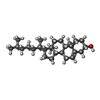
| #5: Chemical | 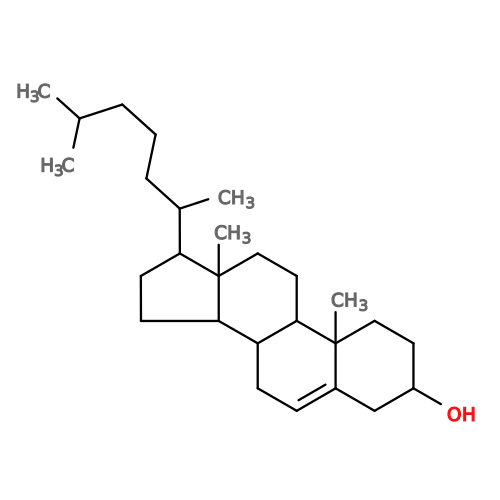 Mass: 386.654 Da / Num. of mol.: 2 / Source method: obtained synthetically / Formula: C27H46O / Feature type: SUBJECT OF INVESTIGATION Mass: 386.654 Da / Num. of mol.: 2 / Source method: obtained synthetically / Formula: C27H46O / Feature type: SUBJECT OF INVESTIGATION#6: Chemical |  Mass: 760.076 Da / Num. of mol.: 2 / Source method: obtained synthetically / Formula: C42H82NO8P / Feature type: SUBJECT OF INVESTIGATION / Comment: phospholipid*YM Mass: 760.076 Da / Num. of mol.: 2 / Source method: obtained synthetically / Formula: C42H82NO8P / Feature type: SUBJECT OF INVESTIGATION / Comment: phospholipid*YM#7: Water | ChemComp-HOH / | Mass: 18.015 Da / Num. of mol.: 2 / Source method: isolated from a natural source / Formula: H2O |
-Details
| Has ligand of interest | Y |
|---|---|
| Has protein modification | Y |
-Experimental details
-Experiment
| Experiment | Method: ELECTRON MICROSCOPY |
|---|---|
| EM experiment | Aggregation state: PARTICLE / 3D reconstruction method: single particle reconstruction |
- Sample preparation
| Component | Name: Complex of Arabidopsis thaliana cationic amino acid transporter 4 with a synthetic nanobody bound to L-ornithine, cholesterol and LMNG Type: COMPLEX / Entity ID: #1-#2 / Source: RECOMBINANT |
|---|---|
| Molecular weight | Experimental value: NO |
| Source (natural) | Organism: Arabidopsis thaliana (thale cress) |
| Source (recombinant) | Organism: Saccharomyces cerevisiae (brewer's yeast) / Strain: BJ5460 |
| Buffer solution | pH: 7.5 / Details: 20 mM Tris-HCl, 150 mM NaCl, 0.003% w/v LMNG |
| Specimen | Conc.: 5 mg/ml / Embedding applied: NO / Shadowing applied: NO / Staining applied: NO / Vitrification applied: YES / Details: The sample was homogeneously monodisperse. |
| Specimen support | Grid material: COPPER / Grid type: Quantifoil R1.2/1.3 |
| Vitrification | Instrument: FEI VITROBOT MARK IV / Cryogen name: ETHANE / Humidity: 100 % / Chamber temperature: 277.15 K |
- Electron microscopy imaging
| Experimental equipment |  Model: Titan Krios / Image courtesy: FEI Company |
|---|---|
| Microscopy | Model: TFS KRIOS |
| Electron gun | Electron source:  FIELD EMISSION GUN / Accelerating voltage: 300 kV / Illumination mode: FLOOD BEAM FIELD EMISSION GUN / Accelerating voltage: 300 kV / Illumination mode: FLOOD BEAM |
| Electron lens | Mode: BRIGHT FIELD / Nominal magnification: 105000 X / Nominal defocus max: 2000 nm / Nominal defocus min: 800 nm / Cs: 2.7 mm / C2 aperture diameter: 100 µm |
| Specimen holder | Cryogen: NITROGEN / Specimen holder model: FEI TITAN KRIOS AUTOGRID HOLDER |
| Image recording | Average exposure time: 2 sec. / Electron dose: 50 e/Å2 / Film or detector model: GATAN K3 BIOQUANTUM (6k x 4k) |
- Processing
| EM software |
| ||||||||||||||||||||||||
|---|---|---|---|---|---|---|---|---|---|---|---|---|---|---|---|---|---|---|---|---|---|---|---|---|---|
| CTF correction | Type: PHASE FLIPPING AND AMPLITUDE CORRECTION | ||||||||||||||||||||||||
| Symmetry | Point symmetry: C1 (asymmetric) | ||||||||||||||||||||||||
| 3D reconstruction | Resolution: 3.32 Å / Resolution method: FSC 0.143 CUT-OFF / Num. of particles: 76191 / Symmetry type: POINT | ||||||||||||||||||||||||
| Atomic model building | Protocol: RIGID BODY FIT / Space: REAL / Target criteria: cross-correlation coefficient | ||||||||||||||||||||||||
| Atomic model building | PDB-ID: 9HJK Accession code: 9HJK / Source name: PDB / Type: experimental model | ||||||||||||||||||||||||
| Refinement | Cross valid method: NONE Stereochemistry target values: GeoStd + Monomer Library + CDL v1.2 | ||||||||||||||||||||||||
| Displacement parameters | Biso mean: 74.85 Å2 | ||||||||||||||||||||||||
| Refine LS restraints |
|

