 Movie
Movie Controller

[English] 日本語
 Yorodumi
- EMDB-55065: Cryo-EM structure of the Arabidopsis thaliana CAT4 transporter in... -
+ Open data

- Basic information
| Entry |  | |||||||||
|---|---|---|---|---|---|---|---|---|---|---|
| Title | Cryo-EM structure of the Arabidopsis thaliana CAT4 transporter in the outward-open L-ornithine bound state | |||||||||
 Map data Map data | None | |||||||||
 Sample Sample |
| |||||||||
 Keywords Keywords | membrane transporter / cationic amino acid / TRANSPORT PROTEIN | |||||||||
| Function / homology | Cationic amino acid transporter, C-terminal / C-terminus of AA_permease / plant-type vacuole membrane / Amino acid/polyamine transporter I / Amino acid permease / plant-type vacuole / amino acid transmembrane transporter activity / amino acid transport / Cationic amino acid transporter 4, vacuolar Function and homology information Function and homology information | |||||||||
| Biological species |   Arabidopsis thaliana (thale cress) / synthetic construct (others) Arabidopsis thaliana (thale cress) / synthetic construct (others) | |||||||||
| Method | single particle reconstruction / cryo EM / Resolution: 3.32 Å | |||||||||
 Authors Authors | Kolokouris D / Newstead S | |||||||||
| Funding support |  United Kingdom, 1 items United Kingdom, 1 items
| |||||||||
 Citation Citation | Journal: Nat Commun / Year: 2026 Title: Structural basis for pH-responsive amino acid transport via SLC7A4. Authors: Dimitrios Kolokouris / Anuja Bothra / Takafumi Kato / Yi C Zeng / Simon Lichtinger / Joanne L Parker / Philip C Biggin / Simon Newstead / Abstract: The transport of amino acids across cell membranes is essential for metabolism, neuronal signalling, and immune system function. The amino acid polyamine organocation (APC) superfamily controls amino ...The transport of amino acids across cell membranes is essential for metabolism, neuronal signalling, and immune system function. The amino acid polyamine organocation (APC) superfamily controls amino acid transport via mechanisms including amino acid exchange, facilitative diffusion, and sodium- or proton-coupled transport. Although many mammalian APC members functioning as exchangers and sodium-coupled systems have been identified, the mechanisms underlying pH-regulated amino acid transport in mammalian cells remain unclear. Here, we show that the plasma membrane amino acid transporter SLC7A4 is regulated by low extracellular pH and functions as a leucine transporter in human cells. Using Cryo-EM structures of the plant homologue, CAT4, from Arabidopsis thaliana in outward-open apo and L-ornithine-bound states, as well as transport assays and molecular dynamics simulations based on homology models of the human transporter, we identify residues responsible for amino acid selectivity that supports an allosteric mechanism linking ligand recognition to pH regulation. This mechanism is consistent with an evolutionary link to proton-coupled prokaryotic homologues. Overall, our findings provide a structural and functional basis for pH-gated leucine transport by the human SLC7A4 transporter and provides a framework for understanding amino acid selectivity within the wider SLC7 family. | |||||||||
| History |
|
- Structure visualization
| Supplemental images |
|---|

- Downloads & links
-EMDB archive
| Map data | emd_55065.map.gz | 45.5 MB | EMDB map data format | |
|---|---|---|---|---|
| Header (meta data) | emd-55065-v30.xmlemd-55065.xml | 22.4 KB 22.4 KB | Display Display | EMDB header |
| FSC (resolution estimation) | emd_55065_fsc.xml | 9.5 KB | Display | FSC data file |
| Images |  emd_55065.png emd_55065.png | 43.1 KB | ||
| Masks | emd_55065_msk_1.map | 91.1 MB | Mask map | |
| Filedesc metadata | emd-55065.cif.gz | 7.1 KB | ||
| Others | emd_55065_additional_1.map.gzemd_55065_half_map_1.map.gzemd_55065_half_map_2.map.gz | 86 MB 84.7 MB 84.7 MB | ||
| Archive directory |  https://data.pdbj.org/pub/emdb/structures/EMD-55065ftp://data.pdbj.org/pub/emdb/structures/EMD-55065 https://data.pdbj.org/pub/emdb/structures/EMD-55065ftp://data.pdbj.org/pub/emdb/structures/EMD-55065 | HTTPS FTP |
-Related structure data
| Related structure data |  9sp8MC  9sqhC M: atomic model generated by this map C: citing same article ( |
|---|---|
| Similar structure data |

-Links
| EMDB pages | EMDB (EBI/PDBe) / EMDataResource |
|---|
-Map
| File | Download / File: emd_55065.map.gz / Format: CCP4 / Size: 91.1 MB / Type: IMAGE STORED AS FLOATING POINT NUMBER (4 BYTES) | ||||||||||||||||||||||||||||||||||||
|---|---|---|---|---|---|---|---|---|---|---|---|---|---|---|---|---|---|---|---|---|---|---|---|---|---|---|---|---|---|---|---|---|---|---|---|---|---|
| Annotation | None | ||||||||||||||||||||||||||||||||||||
| Projections & slices | Image control
Images are generated by Spider. | ||||||||||||||||||||||||||||||||||||
| Voxel size | X=Y=Z: 0.835 Å | ||||||||||||||||||||||||||||||||||||
| Density |
| ||||||||||||||||||||||||||||||||||||
| Symmetry | Space group: 1 | ||||||||||||||||||||||||||||||||||||
| Details | EMDB XML:
|
 Z (Sec.)
 Y (Row.)
 X (Col.)


-Supplemental data
-Mask #1
| File | emd_55065_msk_1.map | ||||||||||||
|---|---|---|---|---|---|---|---|---|---|---|---|---|---|
| Projections & Slices |
| ||||||||||||
| Density Histograms |


-Additional map: None
| File | emd_55065_additional_1.map | ||||||||||||
|---|---|---|---|---|---|---|---|---|---|---|---|---|---|
| Annotation | None | ||||||||||||
| Projections & Slices |
| ||||||||||||
| Density Histograms |


-Half map: None
| File | emd_55065_half_map_1.map | ||||||||||||
|---|---|---|---|---|---|---|---|---|---|---|---|---|---|
| Annotation | None | ||||||||||||
| Projections & Slices |
| ||||||||||||
| Density Histograms |


-Half map: #1
| File | emd_55065_half_map_2.map | ||||||||||||
|---|---|---|---|---|---|---|---|---|---|---|---|---|---|
| Projections & Slices |
| ||||||||||||
| Density Histograms |


- Sample components
-Entire : Complex of Arabidopsis thaliana cationic amino acid transporter 4...
| Entire | Name: Complex of Arabidopsis thaliana cationic amino acid transporter 4 with a synthetic nanobody bound to L-ornithine, cholesterol and LMNG |
|---|---|
| Components |
|
-Supramolecule #1: Complex of Arabidopsis thaliana cationic amino acid transporter 4...
| Supramolecule | Name: Complex of Arabidopsis thaliana cationic amino acid transporter 4 with a synthetic nanobody bound to L-ornithine, cholesterol and LMNG type: complex / ID: 1 / Parent: 0 / Macromolecule list: #1-#2 |
|---|---|
| Source (natural) | Organism: Arabidopsis thaliana (thale cress) |
-Macromolecule #1: SybB5
| Macromolecule | Name: SybB5 / type: protein_or_peptide / ID: 1 / Number of copies: 1 / Enantiomer: LEVO |
|---|---|
| Source (natural) | Organism: synthetic construct (others) |
| Molecular weight | Theoretical: 12.508005 KDa |
| Recombinant expression | Organism:   Escherichia coli (E. coli) Escherichia coli (E. coli) |
| Sequence | String: QVQLVESGGG LVQAGGSLRL SCAASGFPVN MYWMHWYRQA PGKEREWVAA IQSYGQWTAY ADSVKGRFTI SRDNAKNTVY LQMNSLKPE DTAVYYCAVG VGGYYLGQGT QVTVS |
-Macromolecule #2: Cationic amino acid transporter 4, vacuolar
| Macromolecule | Name: Cationic amino acid transporter 4, vacuolar / type: protein_or_peptide / ID: 2 / Number of copies: 1 / Enantiomer: LEVO |
|---|---|
| Source (natural) | Organism: Arabidopsis thaliana (thale cress) |
| Molecular weight | Theoretical: 63.680152 KDa |
| Recombinant expression | Organism:   Saccharomyces cerevisiae (brewer's yeast) Saccharomyces cerevisiae (brewer's yeast) |
| Sequence | String: MNSLVRRKQV DSVHLIKNDG PHQLAKKLSA VDLVAIGVGT TIGAGVYILV GTVAREHTGP ALAVSFFIAG VAAALSACCY AELASRCPS AGSAYHYAYI CLGEGIAWLV GWALVLDYTI GGSAIARGIT PNLASFFGGL DNLPVFLARQ TIPGVGIVVD P CAALLIMI ...String: MNSLVRRKQV DSVHLIKNDG PHQLAKKLSA VDLVAIGVGT TIGAGVYILV GTVAREHTGP ALAVSFFIAG VAAALSACCY AELASRCPS AGSAYHYAYI CLGEGIAWLV GWALVLDYTI GGSAIARGIT PNLASFFGGL DNLPVFLARQ TIPGVGIVVD P CAALLIMI VTILLCFGIK ESSTVQAIVT SVNVCTLVFI IVVGGYLACK TGWVGYDLPS GYFPFGLNGI LAGSAVVFFS YI GFDTVTS TAEEVKNPQR DLPLGIGIAL LICCILYMLL SVVIVGLVPY YSLNPDTPIS SAFGDSGMQW AAYILTTGAI TAL CASLLG SLLAQPRIFM AMARDGLLPA FFSEISPRTQ VPVKSTIAIG VLAAALAFFM DVAQLSEMVS VGTLMAFTAV AVCV LVLRY VPPDGVPLSS SSQTLSDTDE SRAETENFLV DAIESSDSPL LGNETARDEK YFGKRRKIAA WSIALVCIGV LGLAS AASA ERLPSFPRFT ICGVSAVILL GSLITLGYID EDEERHNFGH KGGFLCPFVP YLPVLCILIN TYLIINIGAG TWIRVL IWL LIGSMIYIFY GRSHSLLNNA VYVPTMTCTR KTTDHLA UniProtKB: Cationic amino acid transporter 4, vacuolar |
-Macromolecule #3: L-ornithine
| Macromolecule | Name: L-ornithine / type: ligand / ID: 3 / Number of copies: 1 / Formula: ORN |
|---|---|
| Molecular weight | Theoretical: 132.161 Da |
| Chemical component information | 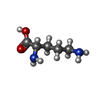 ChemComp-ORN: |
-Macromolecule #4: Lauryl Maltose Neopentyl Glycol
| Macromolecule | Name: Lauryl Maltose Neopentyl Glycol / type: ligand / ID: 4 / Number of copies: 1 / Formula: AV0 |
|---|---|
| Molecular weight | Theoretical: 1.005188 KDa |
| Chemical component information |  ChemComp-AV0: |
-Macromolecule #5: CHOLESTEROL
| Macromolecule | Name: CHOLESTEROL / type: ligand / ID: 5 / Number of copies: 2 / Formula: CLR |
|---|---|
| Molecular weight | Theoretical: 386.654 Da |
| Chemical component information | 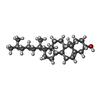 ChemComp-CLR: |
-Macromolecule #6: 1-palmitoyl-2-oleoyl-sn-glycero-3-phosphocholine
| Macromolecule | Name: 1-palmitoyl-2-oleoyl-sn-glycero-3-phosphocholine / type: ligand / ID: 6 / Number of copies: 2 / Formula: LBN |
|---|---|
| Molecular weight | Theoretical: 760.076 Da |
| Chemical component information | 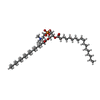 ChemComp-LBN: |
-Macromolecule #7: water
| Macromolecule | Name: water / type: ligand / ID: 7 / Number of copies: 2 / Formula: HOH |
|---|---|
| Molecular weight | Theoretical: 18.015 Da |
| Chemical component information |  ChemComp-HOH: |
-Experimental details
-Structure determination
| Method | cryo EM |
|---|---|
 Processing Processing | single particle reconstruction |
| Aggregation state | particle |
-Sample preparation
| Concentration | 5.0 mg/mL |
|---|---|
| Buffer | pH: 7.5 / Details: 20 mM Tris-HCl, 150 mM NaCl, 0.003% w/v LMNG |
| Grid | Model: Quantifoil R1.2/1.3 / Material: COPPER / Support film - Material: CARBON / Support film - topology: HOLEY / Pretreatment - Time: 20 sec. / Pretreatment - Atmosphere: AIR |
| Vitrification | Cryogen name: ETHANE / Chamber humidity: 100 % / Chamber temperature: 277.15 K / Instrument: FEI VITROBOT MARK IV |
| Details | The sample was homogeneously monodisperse. |
- Electron microscopy
| Microscope | TFS KRIOS |
|---|---|
| Image recording | Film or detector model: GATAN K3 BIOQUANTUM (6k x 4k) / Average exposure time: 2.0 sec. / Average electron dose: 50.0 e/Å2 |
| Electron beam | Acceleration voltage: 300 kV / Electron source:  FIELD EMISSION GUN FIELD EMISSION GUN |
| Electron optics | C2 aperture diameter: 100.0 µm / Illumination mode: FLOOD BEAM / Imaging mode: BRIGHT FIELD / Cs: 2.7 mm / Nominal defocus max: 2.0 µm / Nominal defocus min: 0.8 µm / Nominal magnification: 105000 |
| Sample stage | Specimen holder model: FEI TITAN KRIOS AUTOGRID HOLDER / Cooling holder cryogen: NITROGEN |
| Experimental equipment |  Model: Titan Krios / Image courtesy: FEI Company |
+Image processing

-Atomic model buiding 1
| Initial model | PDB ID: Chain - Source name: PDB / Chain - Initial model type: experimental model |
|---|---|
| Refinement | Space: REAL / Protocol: RIGID BODY FIT / Target criteria: cross-correlation coefficient |
| Output model | PDB-9sp8: |

