 Movie
Movie Controller


+ Open data

- Basic information
| Entry | Database: PDB / ID: 9rkd | |||||||||||||||||||||
|---|---|---|---|---|---|---|---|---|---|---|---|---|---|---|---|---|---|---|---|---|---|---|
| Title | Insulin receptor ectodomain in apo-conformation | |||||||||||||||||||||
 Components Components |
| |||||||||||||||||||||
 Keywords Keywords | MEMBRANE PROTEIN / complex / IR / apo-form | |||||||||||||||||||||
| Function / homology |  Function and homology information Function and homology informationregulation of female gonad development / positive regulation of meiotic cell cycle / insulin-like growth factor II binding / positive regulation of developmental growth / insulin receptor complex / insulin-like growth factor I binding / insulin receptor activity / positive regulation of protein-containing complex disassembly / adrenal gland development / dendritic spine maintenance ...regulation of female gonad development / positive regulation of meiotic cell cycle / insulin-like growth factor II binding / positive regulation of developmental growth / insulin receptor complex / insulin-like growth factor I binding / insulin receptor activity / positive regulation of protein-containing complex disassembly / adrenal gland development / dendritic spine maintenance / insulin binding / Signaling by Insulin receptor / PTB domain binding / IRS activation / cargo receptor activity / neuronal cell body membrane / positive regulation of respiratory burst / amyloid-beta clearance / heart morphogenesis / positive regulation of receptor internalization / insulin receptor substrate binding / positive regulation of glycogen biosynthetic process / Signal attenuation / protein kinase activator activity / phosphatidylinositol 3-kinase binding / Insulin receptor recycling / transport across blood-brain barrier / insulin-like growth factor receptor binding / positive regulation of D-glucose import across plasma membrane / positive regulation of mitotic nuclear division / neuron projection maintenance / male gonad development / receptor-mediated endocytosis / positive regulation of glycolytic process / learning / regulation of embryonic development / Insulin receptor signalling cascade / dendrite membrane / memory / receptor protein-tyrosine kinase / caveola / insulin receptor signaling pathway / positive regulation of nitric oxide biosynthetic process / cellular response to insulin stimulus / glucose homeostasis / late endosome / protein autophosphorylation / amyloid-beta binding / PI5P, PP2A and IER3 Regulate PI3K/AKT Signaling / protein tyrosine kinase activity / positive regulation of phosphatidylinositol 3-kinase/protein kinase B signal transduction / positive regulation of canonical NF-kappaB signal transduction / positive regulation of MAPK cascade / signaling receptor complex / lysosome / endosome membrane / positive regulation of cell migration / G protein-coupled receptor signaling pathway / external side of plasma membrane / protein domain specific binding / axon / positive regulation of cell population proliferation / symbiont entry into host cell / regulation of DNA-templated transcription / GTP binding / positive regulation of DNA-templated transcription / protein-containing complex binding / extracellular exosome / ATP binding / membrane / identical protein binding / plasma membrane Similarity search - Function | |||||||||||||||||||||
| Biological species |  Homo sapiens (human) Homo sapiens (human) | |||||||||||||||||||||
| Method | ELECTRON MICROSCOPY / single particle reconstruction / cryo EM / Resolution: 6 Å | |||||||||||||||||||||
 Authors Authors | Polak, M. / Novacek, J. / Jiracek, J. | |||||||||||||||||||||
| Funding support |  Czech Republic, 2items Czech Republic, 2items
| |||||||||||||||||||||
 Citation Citation | Journal: To Be Published Title: Antagonistic insulin mimetics lock the insulin receptor in an alternative apo-state Authors: Polak, M. / Pinkas, M. / Hernandez, M.S.G. / Fabre, B. / Lubos, M. / Zakova, L. / Grzybek, M. / Schaefer, I.B. / Coskun, U. / Jiracek, J. / Novacek, J. | |||||||||||||||||||||
| History |
|
- Structure visualization
| Structure viewer | Molecule: MolmilJmol/JSmol |
|---|
- Downloads & links
-Download
| PDBx/mmCIF format | 9rkd.cif.gz | 264.7 KB | Display | PDBx/mmCIF format |
|---|---|---|---|---|
| PDB format | pdb9rkd.ent.gz | 206.6 KB | Display | PDB format |
| PDBx/mmJSON format | 9rkd.json.gz | Tree view | PDBx/mmJSON format | |
| Others |  Other downloads Other downloads |
-Validation report
| Arichive directory | https://data.pdbj.org/pub/pdb/validation_reports/rk/9rkdftp://data.pdbj.org/pub/pdb/validation_reports/rk/9rkd | HTTPS FTP |
|---|
-Related structure data
| Related structure data |  54015MC  29rtC  9rkwC M: map data used to model this data C: citing same article ( |
|---|---|
| Similar structure data |


-Links
 PDBj
PDBj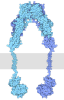
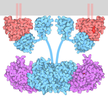
- Assembly
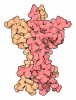
| Deposited unit | 
|
|---|---|
| 1 |
|
-Components
| #1: Protein | Mass: 82464.664 Da / Num. of mol.: 2 Source method: isolated from a genetically manipulated source Source: (gene. exp.) Homo sapiens (human) / Gene: INSR / Production host: Homo sapiens (human)References: UniProt: P06213, receptor protein-tyrosine kinase #2: Protein | Mass: 18513.900 Da / Num. of mol.: 2 Source method: isolated from a genetically manipulated source Source: (gene. exp.) Homo sapiens (human) / Gene: INSR / Production host: Homo sapiens (human)References: UniProt: P06213, receptor protein-tyrosine kinase Has protein modification | Y | |
|---|
-Experimental details
-Experiment
| Experiment | Method: ELECTRON MICROSCOPY |
|---|---|
| EM experiment | Aggregation state: PARTICLE / 3D reconstruction method: single particle reconstruction |
- Sample preparation
| Component | Name: Insulin receptor ecto-domain in inverted-V apo-conformation Type: COMPLEX / Entity ID: all / Source: RECOMBINANT |
|---|---|
| Molecular weight | Value: 0.2 MDa / Experimental value: NO |
| Source (natural) | Organism: Homo sapiens (human) |
| Source (recombinant) | Organism: Homo sapiens (human) |
| Buffer solution | pH: 7.5 |
| Specimen | Embedding applied: NO / Shadowing applied: NO / Staining applied: NO / Vitrification applied: YES |
| Vitrification | Instrument: FEI VITROBOT MARK IV / Cryogen name: ETHANE / Humidity: 90 % / Chamber temperature: 278 K |
- Electron microscopy imaging
| Experimental equipment |  Model: Titan Krios / Image courtesy: FEI Company |
|---|---|
| Microscopy | Model: TFS KRIOS |
| Electron gun | Electron source:  FIELD EMISSION GUN / Accelerating voltage: 300 kV / Illumination mode: FLOOD BEAM FIELD EMISSION GUN / Accelerating voltage: 300 kV / Illumination mode: FLOOD BEAM |
| Electron lens | Mode: BRIGHT FIELD / Nominal magnification: 105000 X / Nominal defocus max: 2400 nm / Nominal defocus min: 1200 nm / Cs: 2.7 mm / C2 aperture diameter: 30 µm / Alignment procedure: COMA FREE |
| Specimen holder | Cryogen: NITROGEN / Specimen holder model: FEI TITAN KRIOS AUTOGRID HOLDER / Temperature (max): 80 K / Temperature (min): 80 K |
| Image recording | Electron dose: 43.2 e/Å2 / Film or detector model: GATAN K3 BIOQUANTUM (6k x 4k) |
- Processing
| EM software |
| ||||||||||||
|---|---|---|---|---|---|---|---|---|---|---|---|---|---|
| CTF correction | Type: PHASE FLIPPING ONLY | ||||||||||||
| 3D reconstruction | Resolution: 6 Å / Resolution method: FSC 0.143 CUT-OFF / Num. of particles: 34347 / Symmetry type: POINT | ||||||||||||
| Atomic model building | B value: 480 / Protocol: FLEXIBLE FIT / Space: REAL / Target criteria: cryoss-correlation coefficient |
