 Movie
Movie Controller

[English] 日本語
 Yorodumi
- PDB-9qvx: The targeting of non-fibrillar polyQ via distinct VCP-proteasome ... -
+ Open data

- Basic information
| Entry | Database: PDB / ID: 9qvx | |||||||||||||||||||||
|---|---|---|---|---|---|---|---|---|---|---|---|---|---|---|---|---|---|---|---|---|---|---|
| Title | The targeting of non-fibrillar polyQ via distinct VCP-proteasome coupling | |||||||||||||||||||||
 Components Components |
| |||||||||||||||||||||
 Keywords Keywords | HYDROLASE / human 20S peptide co-complex | |||||||||||||||||||||
| Function / homology |  Function and homology information Function and homology informationpurine ribonucleoside triphosphate binding / Antigen processing: Ub, ATP-independent proteasomal degradation / sperm glycocalyx / Regulation of ornithine decarboxylase (ODC) / Proteasome assembly / proteasome core complex / perinuclear theca / Cross-presentation of soluble exogenous antigens (endosomes) / Somitogenesis / myofibril ...purine ribonucleoside triphosphate binding / Antigen processing: Ub, ATP-independent proteasomal degradation / sperm glycocalyx / Regulation of ornithine decarboxylase (ODC) / Proteasome assembly / proteasome core complex / perinuclear theca / Cross-presentation of soluble exogenous antigens (endosomes) / Somitogenesis / myofibril / proteasomal ubiquitin-independent protein catabolic process / sperm head-tail coupling apparatus / immune system process / proteasome endopeptidase complex / NF-kappaB binding / proteasome core complex, beta-subunit complex / threonine-type endopeptidase activity / proteasome assembly / proteasome core complex, alpha-subunit complex / : / ciliary tip / proteasome complex / sarcomere / Regulation of activated PAK-2p34 by proteasome mediated degradation / Autodegradation of Cdh1 by Cdh1:APC/C / APC/C:Cdc20 mediated degradation of Securin / Asymmetric localization of PCP proteins / centriole / Ubiquitin-dependent degradation of Cyclin D / sperm end piece / negative regulation of inflammatory response to antigenic stimulus / P-body / SCF-beta-TrCP mediated degradation of Emi1 / NIK-->noncanonical NF-kB signaling / AUF1 (hnRNP D0) binds and destabilizes mRNA / TNFR2 non-canonical NF-kB pathway / lipopolysaccharide binding / Assembly of the pre-replicative complex / Vpu mediated degradation of CD4 / Cdc20:Phospho-APC/C mediated degradation of Cyclin A / Dectin-1 mediated noncanonical NF-kB signaling / Degradation of DVL / Degradation of AXIN / Degradation of CRY and PER proteins / Hh mutants are degraded by ERAD / Activation of NF-kappaB in B cells / G2/M Checkpoints / Degradation of GLI1 by the proteasome / Hedgehog ligand biogenesis / Regulation of RUNX3 expression and activity / Autodegradation of the E3 ubiquitin ligase COP1 / Defective CFTR causes cystic fibrosis / GSK3B and BTRC:CUL1-mediated-degradation of NFE2L2 / Negative regulation of NOTCH4 signaling / APC/C:Cdh1 mediated degradation of Cdc20 and other APC/C:Cdh1 targeted proteins in late mitosis/early G1 / Hedgehog 'on' state / Vif-mediated degradation of APOBEC3G / FBXL7 down-regulates AURKA during mitotic entry and in early mitosis / Degradation of GLI2 by the proteasome / GLI3 is processed to GLI3R by the proteasome / Ubiquitin-Mediated Degradation of Phosphorylated Cdc25A / MAPK6/MAPK4 signaling / Degradation of CDH1 / Degradation of beta-catenin by the destruction complex / Oxygen-dependent proline hydroxylation of Hypoxia-inducible Factor Alpha / CDK-mediated phosphorylation and removal of Cdc6 / ABC-family protein mediated transport / CLEC7A (Dectin-1) signaling / SCF(Skp2)-mediated degradation of p27/p21 / FCERI mediated NF-kB activation / response to virus / nuclear matrix / Regulation of expression of SLITs and ROBOs / Regulation of PTEN stability and activity / Interleukin-1 signaling / Orc1 removal from chromatin / Regulation of RAS by GAPs / Regulation of RUNX2 expression and activity / The role of GTSE1 in G2/M progression after G2 checkpoint / Separation of Sister Chromatids / UCH proteinases / KEAP1-NFE2L2 pathway / peptidase activity / Downstream TCR signaling / Antigen processing: Ubiquitination & Proteasome degradation / sperm principal piece / RUNX1 regulates transcription of genes involved in differentiation of HSCs / ER-Phagosome pathway / Neddylation / regulation of inflammatory response / response to oxidative stress / sperm midpiece / secretory granule lumen / endopeptidase activity / ficolin-1-rich granule lumen / proteasome-mediated ubiquitin-dependent protein catabolic process / positive regulation of canonical NF-kappaB signal transduction / Ub-specific processing proteases / cilium / nuclear body Similarity search - Function | |||||||||||||||||||||
| Biological species |  Homo sapiens (human) Homo sapiens (human) | |||||||||||||||||||||
| Method | ELECTRON MICROSCOPY / single particle reconstruction / cryo EM / Resolution: 3.9 Å | |||||||||||||||||||||
 Authors Authors | Zhao, D.Y. / Mi, C.C. | |||||||||||||||||||||
| Funding support |  Germany, 1items Germany, 1items
| |||||||||||||||||||||
 Citation Citation | Journal: To Be Published Title: The targeting of non-fibrillar polyQ via distinct VCP-proteasome coupling Authors: Zhao, D.Y. | |||||||||||||||||||||
| History |
|
- Structure visualization
| Structure viewer | Molecule: MolmilJmol/JSmol |
|---|
- Downloads & links
-Download
| PDBx/mmCIF format | 9qvx.cif.gz | 1020.7 KB | Display | PDBx/mmCIF format |
|---|---|---|---|---|
| PDB format | pdb9qvx.ent.gz | 820 KB | Display | PDB format |
| PDBx/mmJSON format | 9qvx.json.gz | Tree view | PDBx/mmJSON format | |
| Others |  Other downloads Other downloads |
-Validation report
| Arichive directory | https://data.pdbj.org/pub/pdb/validation_reports/qv/9qvxftp://data.pdbj.org/pub/pdb/validation_reports/qv/9qvx | HTTPS FTP |
|---|
-Related structure data
| Related structure data |  53414MC M: map data used to model this data C: citing same article ( |
|---|---|
| Similar structure data |
-Links
 PDBj
PDBj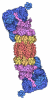

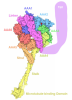
- Assembly
| Deposited unit | 
|
|---|---|
| 1 |
|
-Components
-Proteasome subunit alpha type- ... , 7 types, 14 molecules AOBPCQDRESFTGU
| #1: Protein | Mass: 26741.711 Da / Num. of mol.: 2 Source method: isolated from a genetically manipulated source Source: (gene. exp.) Homo sapiens (human) / Gene: PSMA6, PROS27 / Production host: Homo sapiens (human) / References: UniProt: P60900#2: Protein | Mass: 25411.910 Da / Num. of mol.: 2 Source method: isolated from a genetically manipulated source Source: (gene. exp.) Homo sapiens (human) / Gene: PSMA2, HC3, PSC3 / Production host: Homo sapiens (human) / References: UniProt: P25787#3: Protein | Mass: 27702.703 Da / Num. of mol.: 2 Source method: isolated from a genetically manipulated source Source: (gene. exp.) Homo sapiens (human) / Gene: PSMA4, HC9, PSC9 / Production host: Homo sapiens (human) / References: UniProt: P25789#4: Protein | Mass: 25977.590 Da / Num. of mol.: 2 Source method: isolated from a genetically manipulated source Source: (gene. exp.) Homo sapiens (human) / Gene: PSMA7, HSPC / Production host: Homo sapiens (human) / References: UniProt: O14818#5: Protein | Mass: 25406.785 Da / Num. of mol.: 2 Source method: isolated from a genetically manipulated source Source: (gene. exp.) Homo sapiens (human) / Gene: PSMA5 / Production host: Homo sapiens (human)References: UniProt: P28066, proteasome endopeptidase complex #6: Protein | Mass: 26087.762 Da / Num. of mol.: 2 Source method: isolated from a genetically manipulated source Source: (gene. exp.) Homo sapiens (human) / Gene: PSMA1, HC2, NU, PROS30, PSC2 / Production host: Homo sapiens (human) / References: UniProt: P25786#7: Protein | Mass: 26712.516 Da / Num. of mol.: 2 Source method: isolated from a genetically manipulated source Source: (gene. exp.) Homo sapiens (human) / Gene: PSMA3, HC8, PSC8 / Production host: Homo sapiens (human) / References: UniProt: P25788 |
|---|
-Proteasome subunit beta type- ... , 7 types, 14 molecules HVIWJXKYLZMaNb
| #8: Protein | Mass: 21656.527 Da / Num. of mol.: 2 Source method: isolated from a genetically manipulated source Source: (gene. exp.) Homo sapiens (human) / Gene: PSMB6, LMPY, Y / Production host: Homo sapiens (human)References: UniProt: P28072, proteasome endopeptidase complex #9: Protein | Mass: 23745.256 Da / Num. of mol.: 2 Source method: isolated from a genetically manipulated source Source: (gene. exp.) Homo sapiens (human) / Gene: PSMB7, Z / Production host: Homo sapiens (human)References: UniProt: Q99436, proteasome endopeptidase complex #10: Protein | Mass: 22841.701 Da / Num. of mol.: 2 Source method: isolated from a genetically manipulated source Source: (gene. exp.) Homo sapiens (human) / Gene: PSMB3 / Production host: Homo sapiens (human)References: UniProt: P49720, proteasome endopeptidase complex #11: Protein | Mass: 22365.721 Da / Num. of mol.: 2 Source method: isolated from a genetically manipulated source Source: (gene. exp.) Homo sapiens (human) / Gene: PSMB2 / Production host: Homo sapiens (human)References: UniProt: P49721, proteasome endopeptidase complex #12: Protein | Mass: 22142.020 Da / Num. of mol.: 2 Source method: isolated from a genetically manipulated source Source: (gene. exp.) Homo sapiens (human) / Gene: PSMB5, LMPX, MB1, X / Production host: Homo sapiens (human)References: UniProt: P28074, proteasome endopeptidase complex #13: Protein | Mass: 23421.793 Da / Num. of mol.: 2 Source method: isolated from a genetically manipulated source Source: (gene. exp.) Homo sapiens (human) / Gene: PSMB1, PSC5 / Production host: Homo sapiens (human) / References: UniProt: P20618#14: Protein | Mass: 23611.822 Da / Num. of mol.: 2 Source method: isolated from a genetically manipulated source Source: (gene. exp.) Homo sapiens (human) / Gene: PSMB4, PROS26 / Production host: Homo sapiens (human) / References: UniProt: P28070 |
|---|
-Protein/peptide , 1 types, 2 molecules cd
| #15: Protein/peptide | Mass: 358.434 Da / Num. of mol.: 2 / Source method: obtained synthetically / Source: (synth.) Homo sapiens (human) |
|---|
-Details
| Has protein modification | N |
|---|
-Experimental details
-Experiment
| Experiment | Method: ELECTRON MICROSCOPY |
|---|---|
| EM experiment | Aggregation state: PARTICLE / 3D reconstruction method: single particle reconstruction |
- Sample preparation
| Component | Name: Neuro2a expressing Q150-GFP aggregate / Type: CELL / Source: NATURAL |
|---|---|
| Source (natural) | Organism:   mouse (mice) mouse (mice) |
| Buffer solution | pH: 7.5 |
| Specimen | Embedding applied: NO / Shadowing applied: NO / Staining applied: NO / Vitrification applied: YES Details: The H-DNDDDLYG-OH peptide was synthesized at the MPI Biochemistry Core Facility. For single-particle analysis, 20S proteasome (1 ug/uL) was incubated with 1 mM DNDDDLYG peptide dissolved in ...Details: The H-DNDDDLYG-OH peptide was synthesized at the MPI Biochemistry Core Facility. For single-particle analysis, 20S proteasome (1 ug/uL) was incubated with 1 mM DNDDDLYG peptide dissolved in PBS for 15 minutes at room temperature. Copper EM grids with 200 mesh R1/4 carbon film (Quantifoil Micro Tools, Jena, Germany) were glow-discharged prior to sample vitrification using a Vitrobot Mark IV (Thermo Fisher Scientific) at 4 degrees C and 100% humidity. Three microliters of the sample were applied and blotted using FEI Vitrobot Perforated Filter Paper (Whatman) with a blot force of 3.5 for 4 seconds. |
| Specimen support | Grid material: COPPER / Grid type: Quantifoil |
| Vitrification | Instrument: FEI VITROBOT MARK IV / Cryogen name: ETHANE-PROPANE / Humidity: 100 % / Chamber temperature: 277 K |
- Electron microscopy imaging
| Experimental equipment |  Model: Titan Krios / Image courtesy: FEI Company |
|---|---|
| Microscopy | Model: TFS KRIOS Details: For dataset 2, 410 tilt series were collected on a Titan Krios G4 instrument at 300 kV equipped with a Selectris X energy filter operating at zero-loss with a slit width of 10 eV, and a ...Details: For dataset 2, 410 tilt series were collected on a Titan Krios G4 instrument at 300 kV equipped with a Selectris X energy filter operating at zero-loss with a slit width of 10 eV, and a Falcon 4i camera (Thermo). Low-magnification images were taken at 11500x (object pixel size 2.13 nm) to generate lamella overviews. Tilt series were recorded at 1.89 A pixel size using the Tomography 5 (Thermo) in EER file format, with a dose-symmetric tilt scheme. The tilt series were collected with a 3 degree tilt increment with an angular range of ~120 degrees, and with cumulative dose of 80-120 electrons/A^2. Targeted defocus was in the range of -5 to -3 um. |
| Electron gun | Electron source:  FIELD EMISSION GUN / Accelerating voltage: 300 kV / Illumination mode: FLOOD BEAM FIELD EMISSION GUN / Accelerating voltage: 300 kV / Illumination mode: FLOOD BEAM |
| Electron lens | Mode: BRIGHT FIELD / Nominal defocus max: 5000 nm / Nominal defocus min: 3000 nm / Cs: 2.7 mm / C2 aperture diameter: 50 µm / Alignment procedure: COMA FREE |
| Specimen holder | Cryogen: NITROGEN / Specimen holder model: FEI TITAN KRIOS AUTOGRID HOLDER / Temperature (max): 100 K / Temperature (min): 80 K |
| Image recording | Average exposure time: 1 sec. / Electron dose: 2 e/Å2 / Film or detector model: FEI FALCON IV (4k x 4k) |
- Processing
| EM software |
| ||||||||||||||||||||||||
|---|---|---|---|---|---|---|---|---|---|---|---|---|---|---|---|---|---|---|---|---|---|---|---|---|---|
| CTF correction | Type: NONE | ||||||||||||||||||||||||
| Symmetry | Point symmetry: C2 (2 fold cyclic) | ||||||||||||||||||||||||
| 3D reconstruction | Resolution: 3.9 Å / Resolution method: FSC 0.143 CUT-OFF / Num. of particles: 43227 / Symmetry type: POINT | ||||||||||||||||||||||||
| Refinement | Highest resolution: 3.9 Å Stereochemistry target values: REAL-SPACE (WEIGHTED MAP SUM AT ATOM CENTERS) | ||||||||||||||||||||||||
| Refine LS restraints |
|
