Name: polypeptide traced as poly-Ala / type: protein_or_peptide / ID: 15 / Number of copies: 2 / Enantiomer: LEVO
Source (natural)
Organism: Homo sapiens (human)
Molecular weight
Theoretical: 358.434 Da
Sequence
String:
(UNK)(UNK)(UNK)(UNK)
-
Experimental details
-
Structure determination
Method
cryo EM
Processing
single particle reconstruction
Aggregation state
particle
-
Sample preparation
Buffer
pH: 7.5
Grid
Model: Quantifoil / Material: COPPER / Support film - Material: CARBON / Support film - topology: HOLEY
Vitrification
Cryogen name: ETHANE-PROPANE / Chamber humidity: 100 % / Chamber temperature: 277 K / Instrument: FEI VITROBOT MARK IV
Details
The H-DNDDDLYG-OH peptide was synthesized at the MPI Biochemistry Core Facility. For single-particle analysis, 20S proteasome (1 ug/uL) was incubated with 1 mM DNDDDLYG peptide dissolved in PBS for 15 minutes at room temperature. Copper EM grids with 200 mesh R1/4 carbon film (Quantifoil Micro Tools, Jena, Germany) were glow-discharged prior to sample vitrification using a Vitrobot Mark IV (Thermo Fisher Scientific) at 4 degrees C and 100% humidity. Three microliters of the sample were applied and blotted using FEI Vitrobot Perforated Filter Paper (Whatman) with a blot force of 3.5 for 4 seconds.
-
Electron microscopy
Microscope
TFS KRIOS
Temperature
Min: 80.0 K / Max: 100.0 K
Details
For dataset 2, 410 tilt series were collected on a Titan Krios G4 instrument at 300 kV equipped with a Selectris X energy filter operating at zero-loss with a slit width of 10 eV, and a Falcon 4i camera (Thermo). Low-magnification images were taken at 11500x (object pixel size 2.13 nm) to generate lamella overviews. Tilt series were recorded at 1.89 A pixel size using the Tomography 5 (Thermo) in EER file format, with a dose-symmetric tilt scheme. The tilt series were collected with a 3 degree tilt increment with an angular range of ~120 degrees, and with cumulative dose of 80-120 electrons/A^2. Targeted defocus was in the range of -5 to -3 um.
Image recording
Film or detector model: FEI FALCON IV (4k x 4k) / Average exposure time: 1.0 sec. / Average electron dose: 2.0 e/Å2
Electron beam
Acceleration voltage: 300 kV / Electron source: FIELD EMISSION GUN
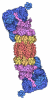
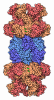
Details: The vitrified sample was collected on a Titan Krios cryo-TEM operating at 300 kV with a field emission gun, a post-column energy filter (Gatan, Pleasanton, CA, USA) set to zero-loss mode ...Details: The vitrified sample was collected on a Titan Krios cryo-TEM operating at 300 kV with a field emission gun, a post-column energy filter (Gatan, Pleasanton, CA, USA) set to zero-loss mode with a 20 eV slit width, and a K2 Summit direct detector (Gatan). Data were acquired at a pixel size of 1.69 angstroms, with a targeted defocus range of -0.5 to -3 micrometers. A total of 5552 movies were collected using SerialEM and processed in Relion 4.0. After 2D and 3D classifications to clean the dataset, more than 300,000 20S particles remained. Local 3D classification without alignment, using a mask around the 20S alpha subunits, resulted in several classes. Approximately 35% of particles contained no additional density compared to the known human 20S structure (PDB 7PG9), while 20% of particles contained an additional density between PSMA1 and PSMA2. Postprocessing was performed with a B factor of -120 applied.
Final reconstruction
Applied symmetry - Point group: C2 (2 fold cyclic) / Resolution.type: BY AUTHOR / Resolution: 3.9 Å / Resolution method: FSC 0.143 CUT-OFF / Software - Name: RELION (ver. 4.0) / Number images used: 43227
Initial angle assignment
Type: MAXIMUM LIKELIHOOD
Final angle assignment
Type: MAXIMUM LIKELIHOOD
+
About Yorodumi
-
News
-
Feb 9, 2022. New format data for meta-information of EMDB entries
New format data for meta-information of EMDB entries
Version 3 of the EMDB header file is now the official format.
The previous official version 1.9 will be removed from the archive.
In the structure databanks used in Yorodumi, some data are registered as the other names, "COVID-19 virus" and "2019-nCoV". Here are the details of the virus and the list of structure data.
Jan 31, 2019. EMDB accession codes are about to change! (news from PDBe EMDB page)
EMDB accession codes are about to change! (news from PDBe EMDB page)
The allocation of 4 digits for EMDB accession codes will soon come to an end. Whilst these codes will remain in use, new EMDB accession codes will include an additional digit and will expand incrementally as the available range of codes is exhausted. The current 4-digit format prefixed with “EMD-” (i.e. EMD-XXXX) will advance to a 5-digit format (i.e. EMD-XXXXX), and so on. It is currently estimated that the 4-digit codes will be depleted around Spring 2019, at which point the 5-digit format will come into force.
The EM Navigator/Yorodumi systems omit the EMD- prefix.
Related info.:Q: What is EMD? / ID/Accession-code notation in Yorodumi/EM Navigator
Yorodumi is a browser for structure data from EMDB, PDB, SASBDB, etc.
This page is also the successor to EM Navigator detail page, and also detail information page/front-end page for Omokage search.
The word "yorodu" (or yorozu) is an old Japanese word meaning "ten thousand". "mi" (miru) is to see.
Related info.:EMDB / PDB / SASBDB / Comparison of 3 databanks / Yorodumi Search / Aug 31, 2016. New EM Navigator & Yorodumi / Yorodumi Papers / Jmol/JSmol / Function and homology information / Changes in new EM Navigator and Yorodumi
 Movie
Movie Controller

 Yorodumi
 Open data
 Basic information
 Map data
 Sample
 Keywords
 Function and homology information
 mouse (mice) /
  Homo sapiens (human)
 Authors
 Germany, 1 items
  Citation
 Structure visualization
 Downloads & links
 emd_53414.png
 http://ftp.pdbj.org/pub/emdb/structures/EMD-53414

 Z (Sec.)
 Y (Row.)
 X (Col.)


 Sample components
 Processing
 Electron microscopy
 FIELD EMISSION GUN

