SUMOylation of nuclear envelope proteins / SUMO is proteolytically processed / Negative regulation of activity of TFAP2 (AP-2) family transcription factors / SUMO is conjugated to E1 (UBA2:SAE1) / SUMO is transferred from E1 to E2 (UBE2I, UBC9) / negative regulation of action potential / nuclear stress granule / negative regulation of transcription initiation by RNA polymerase II / small protein activating enzyme binding / regulation of calcium ion transmembrane transport ...SUMOylation of nuclear envelope proteins / SUMO is proteolytically processed / Negative regulation of activity of TFAP2 (AP-2) family transcription factors / SUMO is conjugated to E1 (UBA2:SAE1) / SUMO is transferred from E1 to E2 (UBE2I, UBC9) / negative regulation of action potential / nuclear stress granule / negative regulation of transcription initiation by RNA polymerase II / small protein activating enzyme binding / regulation of calcium ion transmembrane transport / SUMOylation of immune response proteins / SUMOylation of SUMOylation proteins / negative regulation of protein import into nucleus / SUMOylation of DNA methylation proteins / Maturation of nucleoprotein / SUMOylation of RNA binding proteins / regulation of cardiac muscle cell contraction / Postmitotic nuclear pore complex (NPC) reformation / roof of mouth development / Maturation of nucleoprotein / SUMOylation of ubiquitinylation proteins / ubiquitin-specific protease binding / cellular response to cadmium ion / SUMOylation of transcription factors / SUMOylation of DNA replication proteins / potassium channel regulator activity / ubiquitin-like protein ligase binding / protein sumoylation / Regulation of IFNG signaling / transporter activator activity / nuclear pore / NuRD complex assembly / SUMOylation of DNA damage response and repair proteins / cysteine-type peptidase activity / Transcriptional and post-translational regulation of MITF-M expression and activity / SUMOylation of transcription cofactors / SUMOylation of chromatin organization proteins / SUMOylation of intracellular receptors / regulation of protein stability / Maturation of DENV proteins / positive regulation of protein-containing complex assembly / PML body / PKR-mediated signaling / Formation of Incision Complex in GG-NER / protein tag activity / positive regulation of proteasomal ubiquitin-dependent protein catabolic process / host cell / cellular response to heat / nuclear membrane / Recruitment and ATM-mediated phosphorylation of repair and signaling proteins at DNA double strand breaks / nuclear body / Hydrolases; Acting on peptide bonds (peptidases); Cysteine endopeptidases / nuclear speck / protein stabilization / DNA repair / negative regulation of DNA-templated transcription / ubiquitin protein ligase binding / nucleolus / negative regulation of transcription by RNA polymerase II / enzyme binding / proteolysis / RNA binding / nucleoplasm / extracellular region / membrane / nucleus / plasma membrane / cytosol / cytoplasm Similarity search - Function
In the structure databanks used in Yorodumi, some data are registered as the other names, "COVID-19 virus" and "2019-nCoV". Here are the details of the virus and the list of structure data.
Jan 31, 2019. EMDB accession codes are about to change! (news from PDBe EMDB page)
EMDB accession codes are about to change! (news from PDBe EMDB page)
The allocation of 4 digits for EMDB accession codes will soon come to an end. Whilst these codes will remain in use, new EMDB accession codes will include an additional digit and will expand incrementally as the available range of codes is exhausted. The current 4-digit format prefixed with “EMD-” (i.e. EMD-XXXX) will advance to a 5-digit format (i.e. EMD-XXXXX), and so on. It is currently estimated that the 4-digit codes will be depleted around Spring 2019, at which point the 5-digit format will come into force.
The EM Navigator/Yorodumi systems omit the EMD- prefix.
Related info.:Q: What is EMD? / ID/Accession-code notation in Yorodumi/EM Navigator
Yorodumi is a browser for structure data from EMDB, PDB, SASBDB, etc.
This page is also the successor to EM Navigator detail page, and also detail information page/front-end page for Omokage search.
The word "yorodu" (or yorozu) is an old Japanese word meaning "ten thousand". "mi" (miru) is to see.
Related info.:EMDB / PDB / SASBDB / Comparison of 3 databanks / Yorodumi Search / Aug 31, 2016. New EM Navigator & Yorodumi / Yorodumi Papers / Jmol/JSmol / Function and homology information / Changes in new EM Navigator and Yorodumi
 Movie
Movie Controller

 Yorodumi
 Open data
 Basic information
 Components
 Keywords
 Function and homology information
 Simkania negevensis Z (bacteria)
 Homo sapiens (human)
 X-RAY DIFFRACTION /
  Authors
 Germany, 1items
  Citation
 Structure visualization
 Downloads & links
 Other downloads

 PDBj
PDBj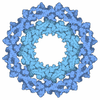
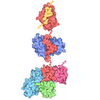
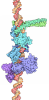
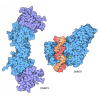
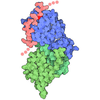
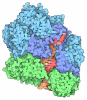
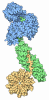
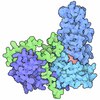
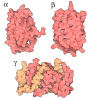
 Assembly
 Escherichia coli BL21(DE3) (bacteria) / References: UniProt: F8L4W9



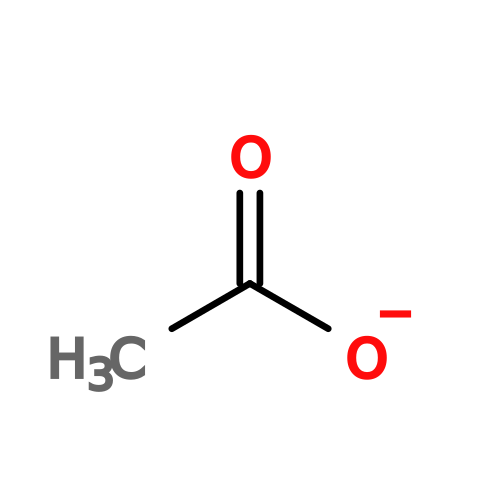 Mass: 59.044 Da / Num. of mol.: 1 / Source method: obtained synthetically / Formula: C2H3O2
 Mass: 40.078 Da / Num. of mol.: 1 / Source method: isolated from a natural source / Formula: Ca
 Mass: 57.094 Da / Num. of mol.: 1 / Source method: obtained synthetically / Formula: C3H7N / Feature type: SUBJECT OF INVESTIGATION
 Sample preparation
 Processing