Journal: Cell Rep / Year: 2025 Title: Cryo-EM structure of a type VI secretion system-delivered membrane-depolarizing toxin involved in bacterial antagonism. Authors: Jake Colautti / Dmitry Shatskiy / Eileen M Bates / Nathan P Bullen / Alexander Belyy / John C Whitney / Abstract: Many Gram-negative bacteria use type VI secretion systems (T6SSs) to deliver toxic effector proteins into neighboring cells. Proteins in the VasX toxin family form ion-permeable channels in the ...Many Gram-negative bacteria use type VI secretion systems (T6SSs) to deliver toxic effector proteins into neighboring cells. Proteins in the VasX toxin family form ion-permeable channels in the bacterial cytoplasmic membrane that dissipate the proton motive force, thereby interfering with essential physiological processes. However, the structure of any VasX family effector has remained unknown. Here, we present a cryo-EM structure of Ptx2, a recently identified VasX family effector exported by a T6SS of Pseudomonas aeruginosa. Our structure reveals that Ptx2 is an elongated, multi-domain protein that bears little resemblance to proteins of known function. Notably, the apparent flexibility of its domains suggests that Ptx2 undergoes substantial conformational changes to facilitate membrane insertion. Guided by these predicted structural rearrangements, we used mutagenesis coupled with phenotypic assays to identify key features required for its toxic activity. Together, these findings provide molecular insights into the structure and mechanism of VasX family effectors.
History
Deposition
Mar 29, 2025
Deposition site: PDBE / Processing site: PDBE
Revision 1.0
Jul 16, 2025
Provider: repository / Type: Initial release
Revision 1.0
Jul 16, 2025
Data content type: EM metadata / Data content type: EM metadata / Provider: repository / Type: Initial release
Revision 1.0
Jul 16, 2025
Data content type: Half map / Part number: 1 / Data content type: Half map / Provider: repository / Type: Initial release
Revision 1.0
Jul 16, 2025
Data content type: Half map / Part number: 2 / Data content type: Half map / Provider: repository / Type: Initial release
Revision 1.0
Jul 16, 2025
Data content type: Image / Data content type: Image / Provider: repository / Type: Initial release
Revision 1.0
Jul 16, 2025
Data content type: Primary map / Data content type: Primary map / Provider: repository / Type: Initial release
In the structure databanks used in Yorodumi, some data are registered as the other names, "COVID-19 virus" and "2019-nCoV". Here are the details of the virus and the list of structure data.
Jan 31, 2019. EMDB accession codes are about to change! (news from PDBe EMDB page)
EMDB accession codes are about to change! (news from PDBe EMDB page)
The allocation of 4 digits for EMDB accession codes will soon come to an end. Whilst these codes will remain in use, new EMDB accession codes will include an additional digit and will expand incrementally as the available range of codes is exhausted. The current 4-digit format prefixed with “EMD-” (i.e. EMD-XXXX) will advance to a 5-digit format (i.e. EMD-XXXXX), and so on. It is currently estimated that the 4-digit codes will be depleted around Spring 2019, at which point the 5-digit format will come into force.
The EM Navigator/Yorodumi systems omit the EMD- prefix.
Related info.:Q: What is EMD? / ID/Accession-code notation in Yorodumi/EM Navigator
Yorodumi is a browser for structure data from EMDB, PDB, SASBDB, etc.
This page is also the successor to EM Navigator detail page, and also detail information page/front-end page for Omokage search.
The word "yorodu" (or yorozu) is an old Japanese word meaning "ten thousand". "mi" (miru) is to see.
Related info.:EMDB / PDB / SASBDB / Comparison of 3 databanks / Yorodumi Search / Aug 31, 2016. New EM Navigator & Yorodumi / Yorodumi Papers / Jmol/JSmol / Function and homology information / Changes in new EM Navigator and Yorodumi
 Movie
Movie Controller


 Open data
 Basic information
 Components
 Keywords
 Function and homology information
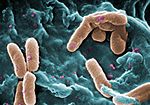 Pseudomonas aeruginosa (bacteria)
 Authors
 Citation

 Structure visualization
 Downloads & links
 Other downloads
 PDBj
PDBj Assembly
 Escherichia coli (E. coli) / References: UniProt: A0A0H2ZJ92
 Sample preparation
 Electron microscopy imaging
 FIELD EMISSION GUN / Accelerating voltage: 300 kV / Illumination mode: SPOT SCAN
 Processing