 Movie
Movie Controller


+ Open data

- Basic information
| Entry |  | |||||||||
|---|---|---|---|---|---|---|---|---|---|---|
| Title | Pseudomonas aeruginosa Ptx2 toxin | |||||||||
 Map data Map data | Local resolution-filtered map used for model building | |||||||||
 Sample Sample |
| |||||||||
 Keywords Keywords | toxin / soluble protein / pre-pore state | |||||||||
| Function / homology | Toxin VasX, N-terminal region / VasX toxin N-terminal region / Toxin VasX N-terminal region domain-containing protein Function and homology information Function and homology information | |||||||||
| Biological species |  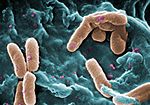 Pseudomonas aeruginosa (bacteria) Pseudomonas aeruginosa (bacteria) | |||||||||
| Method | single particle reconstruction / cryo EM / Resolution: 3.3 Å | |||||||||
 Authors Authors | Shatskiy D / Belyy A | |||||||||
| Funding support | 1 items
| |||||||||
 Citation Citation | Journal: Cell Rep / Year: 2025 Title: Cryo-EM structure of a type VI secretion system-delivered membrane-depolarizing toxin involved in bacterial antagonism. Authors: Jake Colautti / Dmitry Shatskiy / Eileen M Bates / Nathan P Bullen / Alexander Belyy / John C Whitney /   Abstract: Many Gram-negative bacteria use type VI secretion systems (T6SSs) to deliver toxic effector proteins into neighboring cells. Proteins in the VasX toxin family form ion-permeable channels in the ...Many Gram-negative bacteria use type VI secretion systems (T6SSs) to deliver toxic effector proteins into neighboring cells. Proteins in the VasX toxin family form ion-permeable channels in the bacterial cytoplasmic membrane that dissipate the proton motive force, thereby interfering with essential physiological processes. However, the structure of any VasX family effector has remained unknown. Here, we present a cryo-EM structure of Ptx2, a recently identified VasX family effector exported by a T6SS of Pseudomonas aeruginosa. Our structure reveals that Ptx2 is an elongated, multi-domain protein that bears little resemblance to proteins of known function. Notably, the apparent flexibility of its domains suggests that Ptx2 undergoes substantial conformational changes to facilitate membrane insertion. Guided by these predicted structural rearrangements, we used mutagenesis coupled with phenotypic assays to identify key features required for its toxic activity. Together, these findings provide molecular insights into the structure and mechanism of VasX family effectors. | |||||||||
| History |
|
- Structure visualization
| Supplemental images |
|---|

- Downloads & links
-EMDB archive
| Map data | emd_53284.map.gz | 41.5 MB | EMDB map data format | |
|---|---|---|---|---|
| Header (meta data) | emd-53284-v30.xmlemd-53284.xml | 17 KB 17 KB | Display Display | EMDB header |
| Images |  emd_53284.png emd_53284.png | 139.9 KB | ||
| Filedesc metadata | emd-53284.cif.gz | 6.4 KB | ||
| Others | emd_53284_half_map_1.map.gzemd_53284_half_map_2.map.gz | 49.7 MB 49.7 MB | ||
| Archive directory |  https://data.pdbj.org/pub/emdb/structures/EMD-53284ftp://data.pdbj.org/pub/emdb/structures/EMD-53284 https://data.pdbj.org/pub/emdb/structures/EMD-53284ftp://data.pdbj.org/pub/emdb/structures/EMD-53284 | HTTPS FTP |
-Related structure data
| Related structure data |  9qpvMC M: atomic model generated by this map C: citing same article ( |
|---|---|
| Similar structure data |
-Links
| EMDB pages | EMDB (EBI/PDBe) / EMDataResource |
|---|
-Map
| File | Download / File: emd_53284.map.gz / Format: CCP4 / Size: 64 MB / Type: IMAGE STORED AS FLOATING POINT NUMBER (4 BYTES) | ||||||||||||||||||||||||||||||||||||
|---|---|---|---|---|---|---|---|---|---|---|---|---|---|---|---|---|---|---|---|---|---|---|---|---|---|---|---|---|---|---|---|---|---|---|---|---|---|
| Annotation | Local resolution-filtered map used for model building | ||||||||||||||||||||||||||||||||||||
| Projections & slices | Image control
Images are generated by Spider. | ||||||||||||||||||||||||||||||||||||
| Voxel size | X=Y=Z: 0.84 Å | ||||||||||||||||||||||||||||||||||||
| Density |
| ||||||||||||||||||||||||||||||||||||
| Symmetry | Space group: 1 | ||||||||||||||||||||||||||||||||||||
| Details | EMDB XML:
|
 Z (Sec.)
 Y (Row.)
 X (Col.)


-Supplemental data
-Half map: #2
| File | emd_53284_half_map_1.map | ||||||||||||
|---|---|---|---|---|---|---|---|---|---|---|---|---|---|
| Projections & Slices |
| ||||||||||||
| Density Histograms |


-Half map: #1
| File | emd_53284_half_map_2.map | ||||||||||||
|---|---|---|---|---|---|---|---|---|---|---|---|---|---|
| Projections & Slices |
| ||||||||||||
| Density Histograms |


- Sample components
-Entire : Ptx2 toxin
| Entire | Name: Ptx2 toxin |
|---|---|
| Components |
|
-Supramolecule #1: Ptx2 toxin
| Supramolecule | Name: Ptx2 toxin / type: organelle_or_cellular_component / ID: 1 / Parent: 0 / Macromolecule list: all |
|---|---|
| Source (natural) | Organism: Pseudomonas aeruginosa (bacteria) |
-Macromolecule #1: Ptx2 toxin
| Macromolecule | Name: Ptx2 toxin / type: protein_or_peptide / ID: 1 / Number of copies: 1 / Enantiomer: LEVO |
|---|---|
| Source (natural) | Organism: Pseudomonas aeruginosa (bacteria) |
| Molecular weight | Theoretical: 131.467609 KDa |
| Recombinant expression | Organism:  Escherichia coli (E. coli) Escherichia coli (E. coli) |
| Sequence | String: MGSSHHHHHH SQDPNSSSMT AQATPRRDSA NLAANEASSS DSRSPSGTCP LMNAKVQLLP LRYGLTEGVD PSAELAMPFA LKSRPLGLR LVRNGYLYVI DGGTGKLHEY RIDKGAIDKL LWQDAEVRAD VRSRAVGEPQ LVFPRTSVLY VAYSELQWTA R KCMQVLAS ...String: MGSSHHHHHH SQDPNSSSMT AQATPRRDSA NLAANEASSS DSRSPSGTCP LMNAKVQLLP LRYGLTEGVD PSAELAMPFA LKSRPLGLR LVRNGYLYVI DGGTGKLHEY RIDKGAIDKL LWQDAEVRAD VRSRAVGEPQ LVFPRTSVLY VAYSELQWTA R KCMQVLAS PKDREHFMQA VDLRRADPQQ GGPHLLTRRQ AETWLAEVVQ NKVHRDEQGQ QRFPPHQQRP ASPPAAHPDE RR DYVWEDP PLFRDTQLGE LTAQVLPQYE HDALFLALRD DIGVMRDLAA YQDEVVGWLE EWLQGGAQAG ANERDYVIAC YIE SLTQIR AAELPKLADE SAQPLFDDLD RLPPPERERS RQALLDYLNG EPLPKPMDPA MPEPLHRPVE RHFTKRKMAV ADPA FVERN LDALIRLKKS HGEKVDDALH GAKFGQRGID DLIDRPAMDS FLAANRPNLA RWNALLEQIS ADRTQMLTEQ RFHRA AWYY DFQQAEQLGL AFATQYACLK DICRSDEASE AVLAFLEENP QYDRPLFQTL PLNTQAELIA QYAQLGPPGH LWLSKL KEW AQQRDSLELG KLPALDGLPE ATRALADSAQ ATLNPALTLG ISRTMEGFFK SVGQQQAPDL DALFRKLPKA LPGRLLD AA VREGVTFTIA SEAEKAILQA DLKEVLEQRA ELRRLVRQRK QVKSQAGHKS TDARALLADI QRVRLQLNAL EPRLAAAL S PIAELPDNSI RLAGATPGRA GITLILPSAQ LQEVASGIRN LRNGYSSAAA FNKVGDGIGL AVFVAQFVNM VQVWRGVIA TSPDKRELMP LAGSIFTTIS AGVAAAQAIA DTALQARSVQ LAQGLQNHAV EVAHVQMGKL HLRLGFVGYA AGFFAAAVAT QTHYGEWLG AIRSGNAQAQ QGAALAMVGS SGMLASSAYG VWHTGYALKG VLRAATPAAE RTAWALAGTR LSSIFARFNI A GAIFTALE LVGTYWYNRS NTTPHDDWLL STPWSRDIGG RLNQSLEIYQ QRLLGIVQTP RGEVKHASHG SWWRDLLSSS AT AEISLAL PGISLGALQQ TLAGRPEVRL SLAAYRIRSV KYERGSPMVR WFPVTEVVGD SLQVASAEPL VLLVPRLAPL EGV TGGSVT EDLLLAVQIE RLNPQGQYHA DRHMVRLSPH SEGDYPASPQ RIQGQEASWM LIDPRLLPDF ADAPER UniProtKB: Toxin VasX N-terminal region domain-containing protein |
-Experimental details
-Structure determination
| Method | cryo EM |
|---|---|
 Processing Processing | single particle reconstruction |
| Aggregation state | particle |
-Sample preparation
| Buffer | pH: 8 |
|---|---|
| Vitrification | Cryogen name: ETHANE-PROPANE |
- Electron microscopy
| Microscope | TFS KRIOS |
|---|---|
| Image recording | Film or detector model: GATAN K3 BIOQUANTUM (6k x 4k) / Average electron dose: 50.0 e/Å2 |
| Electron beam | Acceleration voltage: 300 kV / Electron source:  FIELD EMISSION GUN FIELD EMISSION GUN |
| Electron optics | Illumination mode: SPOT SCAN / Imaging mode: BRIGHT FIELD / Nominal defocus max: 2.5 µm / Nominal defocus min: 0.5 µm |
| Experimental equipment |  Model: Titan Krios / Image courtesy: FEI Company |
