 Movie
Movie Controller

[English] 日本語
 Yorodumi
- PDB-9qo8: Inward-open structure of human GABA transporter 3 bound to select... -
+ Open data

- Basic information
| Entry | Database: PDB / ID: 9qo8 | ||||||||||||||||||||||||
|---|---|---|---|---|---|---|---|---|---|---|---|---|---|---|---|---|---|---|---|---|---|---|---|---|---|
| Title | Inward-open structure of human GABA transporter 3 bound to selective inhibitor SR-THAP | ||||||||||||||||||||||||
 Components Components | Sodium- and chloride-dependent GABA transporter 3 | ||||||||||||||||||||||||
 Keywords Keywords | MEMBRANE PROTEIN / Transport protein / SLC6A11 / neurotransmitter/sodium symporter / Sodium- and chloride-dependent GABA transporter 3 / GAT3 | ||||||||||||||||||||||||
| Function / homology |  Function and homology information Function and homology informationgamma-aminobutyric acid reuptake / Reuptake of GABA / monocarboxylic acid transmembrane transporter activity / monocarboxylic acid transport / Creatine metabolism / taurine:sodium symporter activity / gamma-aminobutyric acid:sodium:chloride symporter activity / SLC-mediated transport of neurotransmitters / amino acid binding / neurotransmitter transport ...gamma-aminobutyric acid reuptake / Reuptake of GABA / monocarboxylic acid transmembrane transporter activity / monocarboxylic acid transport / Creatine metabolism / taurine:sodium symporter activity / gamma-aminobutyric acid:sodium:chloride symporter activity / SLC-mediated transport of neurotransmitters / amino acid binding / neurotransmitter transport / amino acid transport / cell projection / sodium ion transmembrane transport / GABA-ergic synapse / presynaptic membrane / postsynaptic membrane / response to xenobiotic stimulus / membrane / plasma membrane Similarity search - Function | ||||||||||||||||||||||||
| Biological species |  Homo sapiens (human) Homo sapiens (human) | ||||||||||||||||||||||||
| Method | ELECTRON MICROSCOPY / single particle reconstruction / cryo EM / Resolution: 2.9 Å | ||||||||||||||||||||||||
 Authors Authors | Mortensen, J.S. / Bavo, F. / Jensen, M.H. / Pedersen, A.P.S. / Storm, J.P. / Pape, T. / Frolund, B. / Wellendorph, P. / Shahsavar, A. | ||||||||||||||||||||||||
| Funding support |  Denmark, 4items Denmark, 4items
| ||||||||||||||||||||||||
 Citation Citation | Journal: Nat Commun / Year: 2026 Title: Structural basis for selective inhibition of human GABA transporter GAT3. Authors: Jonas Sigurd Mortensen / Francesco Bavo / Malene Hall Jensen / Alexander Peder Smiszek Pedersen / Julian Philipp Storm / Tillmann Pape / Bente Frølund / Petrine Wellendorph / Azadeh Shahsavar / Abstract: The astrocytic γ-aminobutyric acid (GABA) transporter, GAT3, is essential for terminating GABAergic signaling in the central nervous system. Selective inhibition of GAT3 offers a potential strategy ...The astrocytic γ-aminobutyric acid (GABA) transporter, GAT3, is essential for terminating GABAergic signaling in the central nervous system. Selective inhibition of GAT3 offers a potential strategy for elevating extracellular GABA levels for the treatment of neurological disorders including epilepsy. However, few potent and selective GAT3 inhibitors have been developed, and their mechanisms of inhibition remain poorly understood. Here, we present the cryo-electron microscopy structures of full-length, wild-type human GAT3, hGAT3, bound to a selective inhibitor, to substrate GABA, or in substrate-free state. hGAT3 bound to the inhibitor or in the substrate-free state exhibits an inward-open conformation. The inhibitor binds within the intracellular permeation pathway, positioned between transmembrane helices 1, 2, 3, 6, 7, and 8. The GABA-bound hGAT3 is captured in an inward-occluded state, revealing the ion coordination and substrate recognition network, including a cation-π interaction between GABA's γ-amino group and a phenylalanine residue in transmembrane helix 6. Our data reveal the molecular determinants for the inhibitor selectivity, and the mode of substrate binding and transport inhibition, providing blueprints for the rational design of next-generation selective GAT3 inhibitors. | ||||||||||||||||||||||||
| History |
|
- Structure visualization
| Structure viewer | Molecule: MolmilJmol/JSmol |
|---|
- Downloads & links
-Download
| PDBx/mmCIF format | 9qo8.cif.gz | 120.7 KB | Display | PDBx/mmCIF format |
|---|---|---|---|---|
| PDB format | pdb9qo8.ent.gz | Display | PDB format | |
| PDBx/mmJSON format | 9qo8.json.gz | Tree view | PDBx/mmJSON format | |
| Others |  Other downloads Other downloads |
-Validation report
| Arichive directory | https://data.pdbj.org/pub/pdb/validation_reports/qo/9qo8ftp://data.pdbj.org/pub/pdb/validation_reports/qo/9qo8 | HTTPS FTP |
|---|
-Related structure data
| Related structure data |  53259MC  9qo9C  9qoa C: citing same article ( M: map data used to model this data |
|---|---|
| Similar structure data |

-Links
 PDBj
PDBj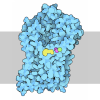
- Assembly
| Deposited unit | 
|
|---|---|
| 1 |
|
-Components
| #1: Protein | Mass: 70660.438 Da / Num. of mol.: 1 Source method: isolated from a genetically manipulated source Source: (gene. exp.) Homo sapiens (human) / Gene: SLC6A11, GABT3, GAT3 / Cell line (production host): Expi293F / Production host: Homo sapiens (human) / References: UniProt: P48066 |
|---|---|
| #2: Chemical | ChemComp-A1I87 / ( Mass: 517.613 Da / Num. of mol.: 1 / Source method: obtained synthetically / Formula: C31H35NO6 / Feature type: SUBJECT OF INVESTIGATION |
| #3: Chemical | ChemComp-CL /  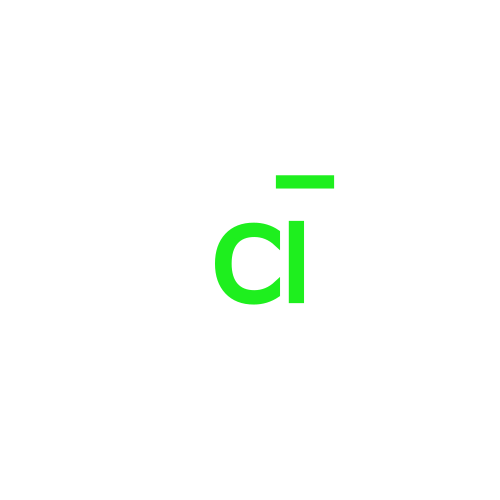 Mass: 35.453 Da / Num. of mol.: 1 / Source method: obtained synthetically / Formula: Cl Mass: 35.453 Da / Num. of mol.: 1 / Source method: obtained synthetically / Formula: Cl |
| #4: Water | ChemComp-HOH / 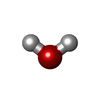 Mass: 18.015 Da / Num. of mol.: 7 / Source method: isolated from a natural source / Formula: H2O Mass: 18.015 Da / Num. of mol.: 7 / Source method: isolated from a natural source / Formula: H2O |
| Has ligand of interest | Y |
| Has protein modification | Y |
-Experimental details
-Experiment
| Experiment | Method: ELECTRON MICROSCOPY |
|---|---|
| EM experiment | Aggregation state: PARTICLE / 3D reconstruction method: single particle reconstruction |
- Sample preparation
| Component | Name: Human GABA transporter 3 bound to selective inhibitor SR-THAP Type: COMPLEX / Entity ID: #1 / Source: RECOMBINANT |
|---|---|
| Molecular weight | Value: 0.07 MDa / Experimental value: NO |
| Source (natural) | Organism: Homo sapiens (human) |
| Source (recombinant) | Organism: Homo sapiens (human) / Strain: Expi293F / Plasmid: pCDNA3.1 |
| Buffer solution | pH: 7.5 |
| Specimen | Conc.: 4 mg/ml / Embedding applied: NO / Shadowing applied: NO / Staining applied: NO / Vitrification applied: YES |
| Specimen support | Grid material: GOLD / Grid mesh size: 300 divisions/in. / Grid type: Quantifoil |
| Vitrification | Cryogen name: ETHANE / Humidity: 100 % / Chamber temperature: 277.15 K |
- Electron microscopy imaging
| Experimental equipment |  Model: Titan Krios / Image courtesy: FEI Company |
|---|---|
| Microscopy | Model: TFS KRIOS |
| Electron gun | Electron source:  FIELD EMISSION GUN / Accelerating voltage: 300 kV / Illumination mode: FLOOD BEAM FIELD EMISSION GUN / Accelerating voltage: 300 kV / Illumination mode: FLOOD BEAM |
| Electron lens | Mode: BRIGHT FIELD / Nominal magnification: 165000 X / Nominal defocus max: 1800 nm / Nominal defocus min: 600 nm / Cs: 2.7 mm / Alignment procedure: COMA FREE |
| Specimen holder | Cryogen: NITROGEN / Specimen holder model: FEI TITAN KRIOS AUTOGRID HOLDER |
| Image recording | Average exposure time: 3.3 sec. / Electron dose: 60 e/Å2 / Film or detector model: FEI FALCON IV (4k x 4k) / Num. of grids imaged: 1 / Num. of real images: 44460 |
| EM imaging optics | Energyfilter name: TFS Selectris X / Energyfilter slit width: 10 eV |
- Processing
| EM software |
| ||||||||||||||||||||||||||||||||
|---|---|---|---|---|---|---|---|---|---|---|---|---|---|---|---|---|---|---|---|---|---|---|---|---|---|---|---|---|---|---|---|---|---|
| CTF correction | Type: NONE | ||||||||||||||||||||||||||||||||
| 3D reconstruction | Resolution: 2.9 Å / Resolution method: FSC 0.143 CUT-OFF / Num. of particles: 139776 / Symmetry type: POINT | ||||||||||||||||||||||||||||||||
| Atomic model building | Accession code: AF-P48066-F1-v4 / Source name: AlphaFold / Type: in silico model | ||||||||||||||||||||||||||||||||
| Refine LS restraints |
|
