 Movie
Movie Controller


+ Open data

- Basic information
| Entry | Database: PDB / ID: 9qip | |||||||||||||||||||||||||||
|---|---|---|---|---|---|---|---|---|---|---|---|---|---|---|---|---|---|---|---|---|---|---|---|---|---|---|---|---|
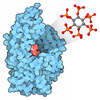
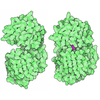
| Title | Structure of UBA6-BIRC6 (cluster 4) | |||||||||||||||||||||||||||
 Components Components |
| |||||||||||||||||||||||||||
 Keywords Keywords | LIGASE / E1 / E2 / SIGNALING PROTEIN | |||||||||||||||||||||||||||
| Function / homology |  Function and homology information Function and homology informationFAT10 activating enzyme activity / E1 ubiquitin-activating enzyme / ubiquitin activating enzyme activity / ALK mutants bind TKIs / Flemming body / (E3-independent) E2 ubiquitin-conjugating enzyme / microtubule organizing center / ubiquitin conjugating enzyme activity / Dengue Virus Attachment and Entry / placenta development ...FAT10 activating enzyme activity / E1 ubiquitin-activating enzyme / ubiquitin activating enzyme activity / ALK mutants bind TKIs / Flemming body / (E3-independent) E2 ubiquitin-conjugating enzyme / microtubule organizing center / ubiquitin conjugating enzyme activity / Dengue Virus Attachment and Entry / placenta development / cysteine-type endopeptidase inhibitor activity / negative regulation of extrinsic apoptotic signaling pathway / regulation of cytokinesis / Synthesis of active ubiquitin: roles of E1 and E2 enzymes / trans-Golgi network / mitotic spindle / spindle pole / ubiquitin-protein transferase activity / Signaling by ALK fusions and activated point mutants / regulation of cell population proliferation / Antigen processing: Ubiquitination & Proteasome degradation / midbody / ubiquitin-dependent protein catabolic process / protein phosphorylation / endosome / protein ubiquitination / cell division / apoptotic process / centrosome / negative regulation of apoptotic process / DNA damage response / Golgi apparatus / nucleoplasm / ATP binding / membrane / metal ion binding / nucleus / cytosol / cytoplasm Similarity search - Function | |||||||||||||||||||||||||||
| Biological species |  Homo sapiens (human) Homo sapiens (human) | |||||||||||||||||||||||||||
| Method | ELECTRON MICROSCOPY / single particle reconstruction / cryo EM / Resolution: 4.15 Å | |||||||||||||||||||||||||||
 Authors Authors | Riechmann, C. / Elliott, P.R. | |||||||||||||||||||||||||||
| Funding support |  United Kingdom, 2items United Kingdom, 2items
| |||||||||||||||||||||||||||
 Citation Citation | Journal: Nat Struct Mol Biol / Year: 2026 Title: UBA6 specificity for ubiquitin E2 conjugating enzymes reveals a priority mechanism of BIRC6. Authors: Carlos Riechmann / Cara J Ellison / Jake W Anderson / Kay Hofmann / Peter Sarkies / Paul R Elliott /  Abstract: In mammals, ubiquitylation is orchestrated by the canonical ubiquitin-activating E1 enzyme UBA1 and the orthogonal E1 UBA6. Growing evidence underscores the essentiality of both E1s, which ...In mammals, ubiquitylation is orchestrated by the canonical ubiquitin-activating E1 enzyme UBA1 and the orthogonal E1 UBA6. Growing evidence underscores the essentiality of both E1s, which differentiate between 29 active ubiquitin-conjugating enzymes (E2s). The mechanisms governing this distinction have remained unclear. Here we establish a framework for ubiquitin E1-E2 specificity. Focusing on UBA6-controlled ubiquitylation cascades, we reveal that BIRC6, a UBA6-exclusive E2, gains priority over all other UBA6-competent E2s, underpinning the functional importance of defined UBA6-BIRC6 ubiquitylation events in regulating cell death, embryogenesis and autophagy. By capturing BIRC6 receiving ubiquitin from UBA6 in different states, we observe BIRC6 engaging with the UBA6 ubiquitin fold domain, driving an exceptionally high-affinity interaction that is modulated by the UBA6 Cys-Cap loop. Using this interaction as a template, we demonstrate how to confer activity between E2s and their noncognate E1, providing a tool to delineate E1-E2-dependent pathways. Lastly, we explain how BIRC6 priority does not lead to inhibition of UBA6, through a bespoke thioester switch mechanism that disengages BIRC6 upon receiving ubiquitin. Our findings propose a concept of hierarchy of E2 activity with cognate E1s, which may explain how ubiquitin E1s can each function with over a dozen E2s and orchestrate E2-specific cellular functions. | |||||||||||||||||||||||||||
| History |
|
- Structure visualization
| Structure viewer | Molecule: MolmilJmol/JSmol |
|---|
- Downloads & links
-Download
| PDBx/mmCIF format | 9qip.cif.gz | 246.9 KB | Display | PDBx/mmCIF format |
|---|---|---|---|---|
| PDB format | pdb9qip.ent.gz | 192.4 KB | Display | PDB format |
| PDBx/mmJSON format | 9qip.json.gz | Tree view | PDBx/mmJSON format | |
| Others |  Other downloads Other downloads |
-Validation report
| Arichive directory | https://data.pdbj.org/pub/pdb/validation_reports/qi/9qipftp://data.pdbj.org/pub/pdb/validation_reports/qi/9qip | HTTPS FTP |
|---|
-Related structure data
| Related structure data |  53193MC  9qggC  9qgiC  9qgrC  9qgwC  9qh5C  9qhiC  9qiaC  9qicC  9qigC  9qiiC  9qimC  9qioC  9qivC C: citing same article ( M: map data used to model this data |
|---|---|
| Similar structure data |


-Links
 PDBj
PDBj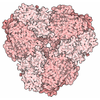

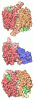
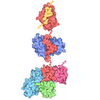
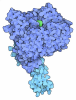
- Assembly
| Deposited unit | 
|
|---|---|
| 1 |
|
-Components
| #1: Protein | Mass: 36834.668 Da / Num. of mol.: 1 Source method: isolated from a genetically manipulated source Source: (gene. exp.) Homo sapiens (human) / Gene: BIRC6, KIAA1289 / Production host:   Escherichia coli BL21(DE3) (bacteria) / Variant (production host): Rosetta Escherichia coli BL21(DE3) (bacteria) / Variant (production host): RosettaReferences: UniProt: Q9NR09, (E3-independent) E2 ubiquitin-conjugating enzyme |
|---|---|
| #2: Protein | Mass: 118250.820 Da / Num. of mol.: 1 Source method: isolated from a genetically manipulated source Source: (gene. exp.) Homo sapiens (human) / Gene: UBA6, MOP4, UBE1L2 / Production host:   Spodoptera frugiperda (fall armyworm) / References: UniProt: A0AVT1, E1 ubiquitin-activating enzyme Spodoptera frugiperda (fall armyworm) / References: UniProt: A0AVT1, E1 ubiquitin-activating enzyme |
| #3: Chemical | ChemComp-IHP / 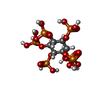 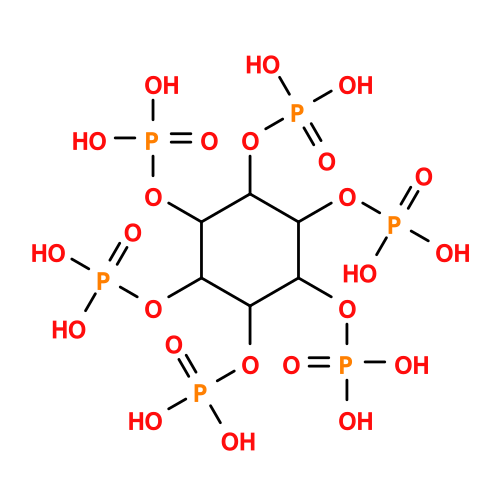 Mass: 660.035 Da / Num. of mol.: 1 / Source method: obtained synthetically / Formula: C6H18O24P6 Mass: 660.035 Da / Num. of mol.: 1 / Source method: obtained synthetically / Formula: C6H18O24P6 |
| #4: Chemical | ChemComp-ATP /  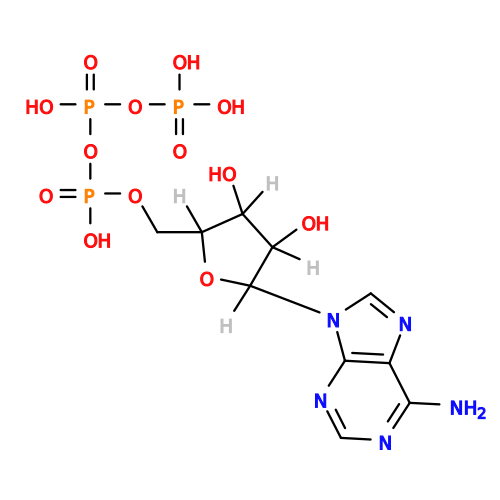 Mass: 507.181 Da / Num. of mol.: 1 / Source method: obtained synthetically / Formula: C10H16N5O13P3 / Comment: ATP, energy-carrying molecule*YM Mass: 507.181 Da / Num. of mol.: 1 / Source method: obtained synthetically / Formula: C10H16N5O13P3 / Comment: ATP, energy-carrying molecule*YM |
| Has ligand of interest | N |
| Has protein modification | N |
-Experimental details
-Experiment
| Experiment | Method: ELECTRON MICROSCOPY |
|---|---|
| EM experiment | Aggregation state: PARTICLE / 3D reconstruction method: single particle reconstruction |
- Sample preparation
| Component | Name: UBA6 bound to BIRC6 / Type: COMPLEX / Entity ID: #1-#2 / Source: RECOMBINANT |
|---|---|
| Molecular weight | Value: 0.15 MDa / Experimental value: NO |
| Source (natural) | Organism: Homo sapiens (human) |
| Source (recombinant) | Organism: Spodoptera frugiperda (fall armyworm) |
| Buffer solution | pH: 7.5 |
| Specimen | Embedding applied: NO / Shadowing applied: NO / Staining applied: NO / Vitrification applied: YES |
| Vitrification | Cryogen name: ETHANE |
- Electron microscopy imaging
| Experimental equipment |  Model: Titan Krios / Image courtesy: FEI Company |
|---|---|
| Microscopy | Model: TFS KRIOS |
| Electron gun | Electron source:  FIELD EMISSION GUN / Accelerating voltage: 300 kV / Illumination mode: FLOOD BEAM FIELD EMISSION GUN / Accelerating voltage: 300 kV / Illumination mode: FLOOD BEAM |
| Electron lens | Mode: BRIGHT FIELD / Nominal defocus max: 2500 nm / Nominal defocus min: 500 nm |
| Image recording | Electron dose: 37.45 e/Å2 / Film or detector model: GATAN K3 BIOQUANTUM (6k x 4k) |
- Processing
| CTF correction | Type: PHASE FLIPPING AND AMPLITUDE CORRECTION |
|---|---|
| 3D reconstruction | Resolution: 4.15 Å / Resolution method: FSC 0.143 CUT-OFF / Num. of particles: 9889 / Symmetry type: POINT |
