 Movie
Movie Controller


+ Open data

- Basic information
| Entry | Database: PDB / ID: 9q57 | ||||||||||||||||||||||||
|---|---|---|---|---|---|---|---|---|---|---|---|---|---|---|---|---|---|---|---|---|---|---|---|---|---|
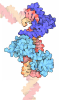
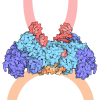
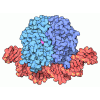
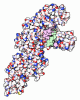
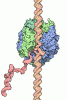
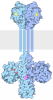
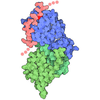
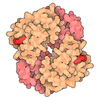
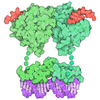
| Title | XZ440 integrase inhibitor bound to Wild-type HIV-1 intasome | ||||||||||||||||||||||||
 Components Components |
| ||||||||||||||||||||||||
 Keywords Keywords | VIRAL PROTEIN/INHIBITOR/DNA / viral protein / protein complex / integrase inhibitor / VIRAL PROTEIN-INHIBITOR-DNA complex | ||||||||||||||||||||||||
| Function / homology |  Function and homology information Function and homology informationHIV-1 retropepsin / symbiont-mediated activation of host apoptosis / retroviral ribonuclease H / exoribonuclease H / exoribonuclease H activity / DNA integration / viral genome integration into host DNA / establishment of integrated proviral latency / RNA-directed DNA polymerase / RNA stem-loop binding ...HIV-1 retropepsin / symbiont-mediated activation of host apoptosis / retroviral ribonuclease H / exoribonuclease H / exoribonuclease H activity / DNA integration / viral genome integration into host DNA / establishment of integrated proviral latency / RNA-directed DNA polymerase / RNA stem-loop binding / viral penetration into host nucleus / host multivesicular body / RNA-directed DNA polymerase activity / RNA-DNA hybrid ribonuclease activity / Transferases; Transferring phosphorus-containing groups; Nucleotidyltransferases / host cell / viral nucleocapsid / DNA recombination / DNA-directed DNA polymerase / aspartic-type endopeptidase activity / Hydrolases; Acting on ester bonds / DNA-directed DNA polymerase activity / symbiont-mediated suppression of host gene expression / viral translational frameshifting / symbiont entry into host cell / lipid binding / host cell nucleus / host cell plasma membrane / virion membrane / structural molecule activity / proteolysis / DNA binding / zinc ion binding Similarity search - Function | ||||||||||||||||||||||||
| Biological species |  HIV-1 06TG.HT008 (virus) HIV-1 06TG.HT008 (virus) | ||||||||||||||||||||||||
| Method | ELECTRON MICROSCOPY / single particle reconstruction / cryo EM / Resolution: 2.28 Å | ||||||||||||||||||||||||
 Authors Authors | Jing, T. / Li, M. / Lyumkis, D. | ||||||||||||||||||||||||
| Funding support |  United States, 1items United States, 1items
| ||||||||||||||||||||||||
 Citation Citation | Journal: NAR Mol Med / Year: 2025 Title: Pi-pi stacking interactions with viral DNA contribute to the potency of naphthyridine-based HIV-1 integrase inhibitors. Authors: Xue Zhi Zhao / Min Li / Steven J Smith / Arvin Karbasi / Indrani Choudhuri / Tao Jing / Dmitry Lyumkis / Robert Craigie / Terrence R Burke / Abstract: Drug resistance remains a significant obstacle to identifying effective treatments for HIV-1 infection. Integrase strand transfer inhibitors (INSTIs) are frontline treatments used in combination ...Drug resistance remains a significant obstacle to identifying effective treatments for HIV-1 infection. Integrase strand transfer inhibitors (INSTIs) are frontline treatments used in combination antiretroviral therapy, but their efficacy can be compromised by emergence of resistance-associated mutations. The development of compounds that will retain efficacy against drug-resistant variants is of significant interest. Herein, we report the synthesis of naphthyridine-based INSTIs with a combination of 4-amino and 5-hydroxymethyl groups. Comparison of the resistance mutant profiles of the new compounds with FDA-approved second-generation INSTIs showed that the lead compounds are comparable to or surpass the efficacy of clinically used drugs against some of the most prevalent drug-resistant mutations that emerge in patient-derived viral isolates. High-resolution cryogenic electron microscopy (cryo-EM) structures of HIV-1 intasomes with two of the best naphthyridine-based INSTIs bound highlight how these inhibitors make enhanced interactions with viral DNA, particularly through optimized DNA stacking. Molecular dynamics simulations together with quantum mechanical and molecular mechanical calculations indicate that the interplay between intramolecular bonding, stacking geometry, resonance effects, and charge distribution governs drug binding within the active site of the intasome. The data mechanistically explain how key interactions contribute to improved antiviral potency against drug-resistant mutants and highlight a new strategy to combat HIV-1 resistance. | ||||||||||||||||||||||||
| History |
|
- Structure visualization
| Structure viewer | Molecule: MolmilJmol/JSmol |
|---|
- Downloads & links
-Download
| PDBx/mmCIF format | 9q57.cif.gz | 164.4 KB | Display | PDBx/mmCIF format |
|---|---|---|---|---|
| PDB format | pdb9q57.ent.gz | 116.1 KB | Display | PDB format |
| PDBx/mmJSON format | 9q57.json.gz | Tree view | PDBx/mmJSON format | |
| Others |  Other downloads Other downloads |
-Validation report
| Arichive directory | https://data.pdbj.org/pub/pdb/validation_reports/q5/9q57ftp://data.pdbj.org/pub/pdb/validation_reports/q5/9q57 | HTTPS FTP |
|---|
-Related structure data
| Related structure data |  72222MC  9q50C M: map data used to model this data C: citing same article ( |
|---|---|
| Similar structure data |

-Links
 PDBj
PDBj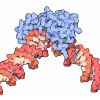
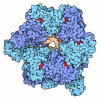
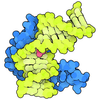
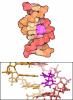
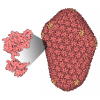

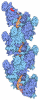
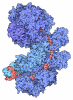
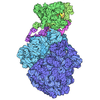


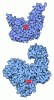
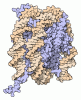
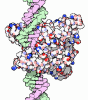
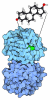
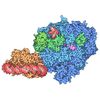
- Assembly
| Deposited unit | 
|
|---|---|
| 1 |
|
-Components
-Protein , 1 types, 4 molecules ACDB
| #1: Protein | Mass: 40149.902 Da / Num. of mol.: 4 Source method: isolated from a genetically manipulated source Source: (gene. exp.) HIV-1 06TG.HT008 (virus) / Gene: gag-polProduction host:   Escherichia coli 'BL21-Gold(DE3)pLysS AG' (bacteria) Escherichia coli 'BL21-Gold(DE3)pLysS AG' (bacteria)References: UniProt: P12497, Transferases; Transferring phosphorus-containing groups; Nucleotidyltransferases, Hydrolases; Acting on ester bonds |
|---|
-DNA chain , 2 types, 2 molecules FE
| #2: DNA chain | Mass: 5795.758 Da / Num. of mol.: 1 / Source method: obtained synthetically / Source: (synth.) HIV-1 06TG.HT008 (virus) |
|---|---|
| #3: DNA chain | Mass: 5220.413 Da / Num. of mol.: 1 / Source method: obtained synthetically / Source: (synth.) HIV-1 06TG.HT008 (virus) |
-Non-polymers , 4 types, 96 molecules 



| #4: Chemical |  Mass: 24.305 Da / Num. of mol.: 2 / Source method: obtained synthetically / Formula: Mg / Feature type: SUBJECT OF INVESTIGATION Mass: 24.305 Da / Num. of mol.: 2 / Source method: obtained synthetically / Formula: Mg / Feature type: SUBJECT OF INVESTIGATION#5: Chemical |  Mass: 65.409 Da / Num. of mol.: 2 / Source method: obtained synthetically / Formula: Zn Mass: 65.409 Da / Num. of mol.: 2 / Source method: obtained synthetically / Formula: Zn#6: Chemical | ChemComp-R7K / ~{ |  Mass: 377.299 Da / Num. of mol.: 1 / Source method: obtained synthetically / Formula: C17H13F2N3O5 / Feature type: SUBJECT OF INVESTIGATION Mass: 377.299 Da / Num. of mol.: 1 / Source method: obtained synthetically / Formula: C17H13F2N3O5 / Feature type: SUBJECT OF INVESTIGATION#7: Water | ChemComp-HOH / | Mass: 18.015 Da / Num. of mol.: 91 / Source method: isolated from a natural source / Formula: H2O |
|---|
-Details
| Has ligand of interest | Y |
|---|---|
| Has protein modification | N |
-Experimental details
-Experiment
| Experiment | Method: ELECTRON MICROSCOPY |
|---|---|
| EM experiment | Aggregation state: PARTICLE / 3D reconstruction method: single particle reconstruction |
- Sample preparation
| Component | Name: integrase strand transfer inhibitor XZ440 bound to HIV-1 wild-type intasome Type: COMPLEX / Entity ID: #1-#3 / Source: RECOMBINANT | ||||||||||||||||||||||||||||||
|---|---|---|---|---|---|---|---|---|---|---|---|---|---|---|---|---|---|---|---|---|---|---|---|---|---|---|---|---|---|---|---|
| Molecular weight | Value: 0.6 MDa / Experimental value: YES | ||||||||||||||||||||||||||||||
| Source (natural) | Organism: HIV type 1 (virus) | ||||||||||||||||||||||||||||||
| Source (recombinant) | Organism: Escherichia coli 'BL21-Gold(DE3)pLysS AG' (bacteria) | ||||||||||||||||||||||||||||||
| Buffer solution | pH: 6.2 | ||||||||||||||||||||||||||||||
| Buffer component |
| ||||||||||||||||||||||||||||||
| Specimen | Embedding applied: NO / Shadowing applied: NO / Staining applied: NO / Vitrification applied: YES | ||||||||||||||||||||||||||||||
| Specimen support | Grid material: GOLD / Grid mesh size: 300 divisions/in. / Grid type: Quantifoil R1.2/1.3 | ||||||||||||||||||||||||||||||
| Vitrification | Cryogen name: ETHANE Details: Cryo-EM grids were prepared by freezing using a Vitrobot plunge freezer (Thermo Fisher Scientific) at 20C with 100% humidity |
- Electron microscopy imaging
| Experimental equipment |  Model: Titan Krios / Image courtesy: FEI Company |
|---|---|
| Microscopy | Model: TFS KRIOS |
| Electron gun | Electron source:  FIELD EMISSION GUN / Accelerating voltage: 300 kV / Illumination mode: FLOOD BEAM FIELD EMISSION GUN / Accelerating voltage: 300 kV / Illumination mode: FLOOD BEAM |
| Electron lens | Mode: BRIGHT FIELD / Nominal magnification: 105000 X / Nominal defocus max: 2200 nm / Nominal defocus min: 600 nm / Cs: 2.7 mm / C2 aperture diameter: 50 µm / Alignment procedure: COMA FREE |
| Specimen holder | Cryogen: NITROGEN / Specimen holder model: FEI TITAN KRIOS AUTOGRID HOLDER |
| Image recording | Electron dose: 58 e/Å2 / Film or detector model: GATAN K3 (6k x 4k) |
- Processing
| EM software |
| ||||||||||||||||||||||||||||||||||||||||||||
|---|---|---|---|---|---|---|---|---|---|---|---|---|---|---|---|---|---|---|---|---|---|---|---|---|---|---|---|---|---|---|---|---|---|---|---|---|---|---|---|---|---|---|---|---|---|
| CTF correction | Type: PHASE FLIPPING AND AMPLITUDE CORRECTION | ||||||||||||||||||||||||||||||||||||||||||||
| Symmetry | Point symmetry: C2 (2 fold cyclic) | ||||||||||||||||||||||||||||||||||||||||||||
| 3D reconstruction | Resolution: 2.28 Å / Resolution method: FSC 0.143 CUT-OFF / Num. of particles: 261868 / Symmetry type: POINT | ||||||||||||||||||||||||||||||||||||||||||||
| Atomic model building | Protocol: FLEXIBLE FIT / Space: REAL / Target criteria: correlation coefficient | ||||||||||||||||||||||||||||||||||||||||||||
| Refinement | Highest resolution: 2.28 Å Stereochemistry target values: REAL-SPACE (WEIGHTED MAP SUM AT ATOM CENTERS) | ||||||||||||||||||||||||||||||||||||||||||||
| Refine LS restraints |
|
