National Institutes of Health/National Cancer Institute (NIH/NCI)
Z01-BC 006150 and Z01-BC 006198
United States
Citation
Journal: NAR Mol Med / Year: 2025 Title: Pi-pi stacking interactions with viral DNA contribute to the potency of naphthyridine-based HIV-1 integrase inhibitors. Authors: Xue Zhi Zhao / Min Li / Steven J Smith / Arvin Karbasi / Indrani Choudhuri / Tao Jing / Dmitry Lyumkis / Robert Craigie / Terrence R Burke / Abstract: Drug resistance remains a significant obstacle to identifying effective treatments for HIV-1 infection. Integrase strand transfer inhibitors (INSTIs) are frontline treatments used in combination ...Drug resistance remains a significant obstacle to identifying effective treatments for HIV-1 infection. Integrase strand transfer inhibitors (INSTIs) are frontline treatments used in combination antiretroviral therapy, but their efficacy can be compromised by emergence of resistance-associated mutations. The development of compounds that will retain efficacy against drug-resistant variants is of significant interest. Herein, we report the synthesis of naphthyridine-based INSTIs with a combination of 4-amino and 5-hydroxymethyl groups. Comparison of the resistance mutant profiles of the new compounds with FDA-approved second-generation INSTIs showed that the lead compounds are comparable to or surpass the efficacy of clinically used drugs against some of the most prevalent drug-resistant mutations that emerge in patient-derived viral isolates. High-resolution cryogenic electron microscopy (cryo-EM) structures of HIV-1 intasomes with two of the best naphthyridine-based INSTIs bound highlight how these inhibitors make enhanced interactions with viral DNA, particularly through optimized DNA stacking. Molecular dynamics simulations together with quantum mechanical and molecular mechanical calculations indicate that the interplay between intramolecular bonding, stacking geometry, resonance effects, and charge distribution governs drug binding within the active site of the intasome. The data mechanistically explain how key interactions contribute to improved antiviral potency against drug-resistant mutants and highlight a new strategy to combat HIV-1 resistance.
Model: Quantifoil R1.2/1.3 / Material: GOLD / Mesh: 300 / Support film - Material: GOLD / Support film - topology: HOLEY
Vitrification
Cryogen name: ETHANE Details: Cryo-EM grids were prepared by freezing using a Vitrobot plunge freezer (Thermo Fisher Scientific) at 20C with 100% humidity.
-
Electron microscopy
Microscope
TFS KRIOS
Image recording
Film or detector model: GATAN K3 (6k x 4k) / Average electron dose: 58.0 e/Å2
Electron beam
Acceleration voltage: 300 kV / Electron source: FIELD EMISSION GUN
In the structure databanks used in Yorodumi, some data are registered as the other names, "COVID-19 virus" and "2019-nCoV". Here are the details of the virus and the list of structure data.
Jan 31, 2019. EMDB accession codes are about to change! (news from PDBe EMDB page)
EMDB accession codes are about to change! (news from PDBe EMDB page)
The allocation of 4 digits for EMDB accession codes will soon come to an end. Whilst these codes will remain in use, new EMDB accession codes will include an additional digit and will expand incrementally as the available range of codes is exhausted. The current 4-digit format prefixed with “EMD-” (i.e. EMD-XXXX) will advance to a 5-digit format (i.e. EMD-XXXXX), and so on. It is currently estimated that the 4-digit codes will be depleted around Spring 2019, at which point the 5-digit format will come into force.
The EM Navigator/Yorodumi systems omit the EMD- prefix.
Related info.:Q: What is EMD? / ID/Accession-code notation in Yorodumi/EM Navigator
Yorodumi is a browser for structure data from EMDB, PDB, SASBDB, etc.
This page is also the successor to EM Navigator detail page, and also detail information page/front-end page for Omokage search.
The word "yorodu" (or yorozu) is an old Japanese word meaning "ten thousand". "mi" (miru) is to see.
Related info.:EMDB / PDB / SASBDB / Comparison of 3 databanks / Yorodumi Search / Aug 31, 2016. New EM Navigator & Yorodumi / Yorodumi Papers / Jmol/JSmol / Function and homology information / Changes in new EM Navigator and Yorodumi
 Movie
Movie Controller


 Open data
 Basic information
 Map data
 Sample
 Keywords
 Function and homology information
 HIV type 1 (virus) /
  Authors
 United States, 1 items
  Citation
 Structure visualization
 Downloads & links
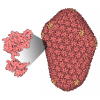
 emd_72221.png
 https://data.pdbj.org/pub/emdb/structures/EMD-72221


 Z
Z Y
Y X
X


 Sample components
 Escherichia coli 'BL21-Gold(DE3)pLysS AG' (bacteria)
 Processing
 Electron microscopy
 FIELD EMISSION GUN
