 Movie
Movie Controller


+ Open data

- Basic information
| Entry | Database: PDB / ID: 9q33 | |||||||||||||||||||||||||||||||||
|---|---|---|---|---|---|---|---|---|---|---|---|---|---|---|---|---|---|---|---|---|---|---|---|---|---|---|---|---|---|---|---|---|---|---|
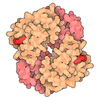
| Title | Cereblon Ternary Complex with Blimp1 and compound 5 | |||||||||||||||||||||||||||||||||
 Components Components |
| |||||||||||||||||||||||||||||||||
 Keywords Keywords | LIGASE / Liganded Cereblon Ligase Substrate | |||||||||||||||||||||||||||||||||
| Function / homology |  Function and homology information Function and homology informationregulation of extrathymic T cell differentiation / regulation of NK T cell differentiation / regulation of natural killer cell differentiation / Specification of primordial germ cells / histone methyltransferase binding / negative regulation of monoatomic ion transmembrane transport / STAT3 nuclear events downstream of ALK signaling / Regulation of TP53 Expression / cell fate commitment / locomotory exploration behavior ...regulation of extrathymic T cell differentiation / regulation of NK T cell differentiation / regulation of natural killer cell differentiation / Specification of primordial germ cells / histone methyltransferase binding / negative regulation of monoatomic ion transmembrane transport / STAT3 nuclear events downstream of ALK signaling / Regulation of TP53 Expression / cell fate commitment / locomotory exploration behavior / Cul4A-RING E3 ubiquitin ligase complex / Cul4B-RING E3 ubiquitin ligase complex / limb development / positive regulation of Wnt signaling pathway / negative regulation of protein-containing complex assembly / Transferases; Transferring one-carbon groups; Methyltransferases / gene expression / promoter-specific chromatin binding / positive regulation of protein-containing complex assembly / DNA-binding transcription repressor activity, RNA polymerase II-specific / sequence-specific double-stranded DNA binding / Potential therapeutics for SARS / proteasome-mediated ubiquitin-dependent protein catabolic process / transmembrane transporter binding / protein ubiquitination / RNA polymerase II cis-regulatory region sequence-specific DNA binding / DNA-binding transcription factor activity / regulation of transcription by RNA polymerase II / nucleolus / negative regulation of transcription by RNA polymerase II / perinuclear region of cytoplasm / nucleoplasm / membrane / nucleus / cytosol / cytoplasm Similarity search - Function | |||||||||||||||||||||||||||||||||
| Biological species |  Homo sapiens (human) Homo sapiens (human) | |||||||||||||||||||||||||||||||||
| Method | ELECTRON MICROSCOPY / single particle reconstruction / cryo EM / Resolution: 3.2 Å | |||||||||||||||||||||||||||||||||
 Authors Authors | Watson, E.R. | |||||||||||||||||||||||||||||||||
| Funding support |  United States, 1items United States, 1items
| |||||||||||||||||||||||||||||||||
 Citation Citation | Journal: J Med Chem / Year: 2025 Title: Discovery and Characterization of Novel BLIMP-1 Heterobifunctional Ligand-Directed Degraders. Authors: Bryan J Simmons / Lynda Groocock / Jesus Moreno / David S Peters / Meredith E Hughes / Vijay Veeravalli / Jennifer M Crawford / Matthew Chalkley / Mark Griffith / Melissa Plooster / Bo Hu / ...Authors: Bryan J Simmons / Lynda Groocock / Jesus Moreno / David S Peters / Meredith E Hughes / Vijay Veeravalli / Jennifer M Crawford / Matthew Chalkley / Mark Griffith / Melissa Plooster / Bo Hu / Jim Gamez / Jim Leisten / Michael J Barnes / Jason Chinn / Gauri Deb / Hardik Modi / Madhu Katepalli / Dahlia Weiss / Walter Won / Zhenghang Sun / Shan Yu / Cameron Reid / Andrew F Donnell / Ling Li / Edmond R Watson / Sophie Perrin-Ninkovic / Lihong Shi / Rama Krishna Narla / Christoph W Zapf / Neil Bence / Antonia Lopez-Girona / Jennifer R Riggs / Abstract: B-lymphocyte-induced maturation protein 1 (BLIMP-1/PRDM1) is a master transcriptional repressor essential for terminal differentiation of activated B-cells into bone-marrow resident plasma cells. ...B-lymphocyte-induced maturation protein 1 (BLIMP-1/PRDM1) is a master transcriptional repressor essential for terminal differentiation of activated B-cells into bone-marrow resident plasma cells. Multiple myeloma (MM) is a plasma cell malignancy wherein the BLIMP-1 regulon remains critical to support basal cell functions, such as an elevated metabolic state and immunoglobulin production that underlie disease manifestation and tumor cell proliferation. It is predicted that perturbation of BLIMP-1 will significantly impact tumor cell homeostasis and ultimately reduce MM cell survival. Herein, we describe the discovery and optimization of the first orally bioavailable BLIMP-1 heterobifunctional ligand-directed degrader (LDD) and demonstration of the expected antitumor response and immunomodulatory biology following BLIMP-1 degradation using preclinical in vivo MM models. | |||||||||||||||||||||||||||||||||
| History |
|
- Structure visualization
| Structure viewer | Molecule: MolmilJmol/JSmol |
|---|
- Downloads & links
-Download
| PDBx/mmCIF format | 9q33.cif.gz | 115 KB | Display | PDBx/mmCIF format |
|---|---|---|---|---|
| PDB format | pdb9q33.ent.gz | Display | PDB format | |
| PDBx/mmJSON format | 9q33.json.gz | Tree view | PDBx/mmJSON format | |
| Others |  Other downloads Other downloads |
-Validation report
| Arichive directory | https://data.pdbj.org/pub/pdb/validation_reports/q3/9q33ftp://data.pdbj.org/pub/pdb/validation_reports/q3/9q33 | HTTPS FTP |
|---|
-Related structure data
| Related structure data |  72178MC  9q1gC M: map data used to model this data C: citing same article ( |
|---|---|
| Similar structure data |
-Links
 PDBj
PDBj

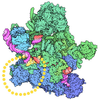
- Assembly
| Deposited unit | 
|
|---|---|
| 1 | 
|
| 2 | 
|
-Components
| #1: Protein | Mass: 21865.510 Da / Num. of mol.: 1 Source method: isolated from a genetically manipulated source Details: 37-222 / Source: (gene. exp.) Homo sapiens (human) / Gene: PRDM1, BLIMP1Production host:   Escherichia coli 'BL21-Gold(DE3)pLysS AG' (bacteria) Escherichia coli 'BL21-Gold(DE3)pLysS AG' (bacteria)References: UniProt: O75626, Transferases; Transferring one-carbon groups; Methyltransferases |
|---|---|
| #2: Protein | Mass: 50603.676 Da / Num. of mol.: 1 Source method: isolated from a genetically manipulated source Source: (gene. exp.) Homo sapiens (human) / Gene: CRBN, AD-006 / Production host:   Spodoptera frugiperda (fall armyworm) / References: UniProt: Q96SW2 Spodoptera frugiperda (fall armyworm) / References: UniProt: Q96SW2 |
| #3: Chemical | ChemComp-ZN /   Mass: 65.409 Da / Num. of mol.: 1 / Source method: obtained synthetically / Formula: Zn Mass: 65.409 Da / Num. of mol.: 1 / Source method: obtained synthetically / Formula: Zn |
| #4: Chemical | ChemComp-A1CN1 / Mass: 776.805 Da / Num. of mol.: 1 / Source method: obtained synthetically / Formula: C40H54BrN7O4 / Feature type: SUBJECT OF INVESTIGATION |
| Has ligand of interest | Y |
| Has protein modification | Y |
-Experimental details
-Experiment
| Experiment | Method: ELECTRON MICROSCOPY |
|---|---|
| EM experiment | Aggregation state: PARTICLE / 3D reconstruction method: single particle reconstruction |
- Sample preparation
| Component | Name: Cereblon Ternary Complex with Blimp1 and compound 5 / Type: COMPLEX / Entity ID: #1-#2 / Source: RECOMBINANT |
|---|---|
| Molecular weight | Experimental value: NO |
| Source (natural) | Organism: Homo sapiens (human) |
| Source (recombinant) | Organism: Spodoptera frugiperda (fall armyworm) |
| Buffer solution | pH: 7 |
| Specimen | Conc.: 0.5 mg/ml / Embedding applied: NO / Shadowing applied: NO / Staining applied: NO / Vitrification applied: YES |
| Vitrification | Cryogen name: NITROGEN |
- Electron microscopy imaging
| Experimental equipment |  Model: Titan Krios / Image courtesy: FEI Company |
|---|---|
| Microscopy | Model: TFS KRIOS |
| Electron gun | Electron source:  FIELD EMISSION GUN / Accelerating voltage: 300 kV / Illumination mode: FLOOD BEAM FIELD EMISSION GUN / Accelerating voltage: 300 kV / Illumination mode: FLOOD BEAM |
| Electron lens | Mode: BRIGHT FIELD / Nominal defocus max: 2000 nm / Nominal defocus min: 500 nm |
| Image recording | Electron dose: 40 e/Å2 / Film or detector model: GATAN K3 BIOQUANTUM (6k x 4k) |
- Processing
| EM software |
| ||||||||||||||||||||||||
|---|---|---|---|---|---|---|---|---|---|---|---|---|---|---|---|---|---|---|---|---|---|---|---|---|---|
| CTF correction | Type: PHASE FLIPPING AND AMPLITUDE CORRECTION | ||||||||||||||||||||||||
| 3D reconstruction | Resolution: 3.2 Å / Resolution method: FSC 0.143 CUT-OFF / Num. of particles: 174443 / Symmetry type: POINT | ||||||||||||||||||||||||
| Refinement | Highest resolution: 3.2 Å Stereochemistry target values: REAL-SPACE (WEIGHTED MAP SUM AT ATOM CENTERS) | ||||||||||||||||||||||||
| Refine LS restraints |
|
