 Movie
Movie Controller

[English] 日本語
 Yorodumi
- PDB-9pwe: Menthol-bound mouse TRPM8 in complex with AITC and PIP2 in a clos... -
+ Open data

- Basic information
| Entry | Database: PDB / ID: 9pwe | |||||||||
|---|---|---|---|---|---|---|---|---|---|---|
| Title | Menthol-bound mouse TRPM8 in complex with AITC and PIP2 in a closed (C1M') state | |||||||||
 Components Components | Transient receptor potential cation channel subfamily M member 8 | |||||||||
 Keywords Keywords | MEMBRANE PROTEIN / TRPM8 / Menthol / Cold / Channel opening | |||||||||
| Function / homology |  Function and homology information Function and homology informationTRP channels / thermoception / ligand-gated calcium channel activity / response to temperature stimulus / plasma membrane raft / monoatomic ion channel activity / response to cold / intracellular calcium ion homeostasis / calcium channel activity / calcium ion transmembrane transport ...TRP channels / thermoception / ligand-gated calcium channel activity / response to temperature stimulus / plasma membrane raft / monoatomic ion channel activity / response to cold / intracellular calcium ion homeostasis / calcium channel activity / calcium ion transmembrane transport / calcium ion transport / positive regulation of cold-induced thermogenesis / membrane raft / external side of plasma membrane / membrane / identical protein binding / plasma membrane Similarity search - Function | |||||||||
| Biological species |   Mus musculus (house mouse) Mus musculus (house mouse) | |||||||||
| Method | ELECTRON MICROSCOPY / single particle reconstruction / cryo EM / Resolution: 3.4 Å | |||||||||
 Authors Authors | Lee, H.J. / Lee, S.Y. | |||||||||
| Funding support |  United States, 2items United States, 2items
| |||||||||
 Citation Citation | Journal: Nat Commun / Year: 2026 Title: Molecular basis for cold and menthol sensing by mammalian TRPM8. Authors: Hyuk-Joon Lee / Cheon-Gyu Park / Justin G Fedor / Wyatt A Peele / Mario J Borgnia / Seok-Yong Lee / Abstract: The transient receptor potential melastatin member 8 (TRPM8) is a polymodal ion channel that senses cold and menthol in mammals. Despite prior structural studies, the mechanisms by which cold and ...The transient receptor potential melastatin member 8 (TRPM8) is a polymodal ion channel that senses cold and menthol in mammals. Despite prior structural studies, the mechanisms by which cold and menthol activate TRPM8 remain unresolved. Here, we present cryo-EM structures and extensive functional analyses to reveal cold- and menthol-dependent activation mechanisms. We observe that cold-sensing residues are widespread and that snapshots of cooling-dependent opening reveal dramatic pore rearrangement which suggest a mechanism for cold sensing. Menthol binds dynamically to drive channel activation toward a common gate with cold, but with specific outer pore conformations. Finally, we show how TRPM8 integrates cold and menthol modalities through overlapping but non-identical networks, revealing a coldspot that is central to cold activation of TRPM8 and is the location of allyl isothiocyanate (AITC) binding. These findings enhance our understanding of the molecular basis of physically and chemically induced cool sensation in mammals. | |||||||||
| History |
|
- Structure visualization
| Structure viewer | Molecule: MolmilJmol/JSmol |
|---|
- Downloads & links
-Download
| PDBx/mmCIF format | 9pwe.cif.gz | 1.3 MB | Display | PDBx/mmCIF format |
|---|---|---|---|---|
| PDB format | pdb9pwe.ent.gz | 1.1 MB | Display | PDB format |
| PDBx/mmJSON format | 9pwe.json.gz | Tree view | PDBx/mmJSON format | |
| Others |  Other downloads Other downloads |
-Validation report
| Arichive directory | https://data.pdbj.org/pub/pdb/validation_reports/pw/9pweftp://data.pdbj.org/pub/pdb/validation_reports/pw/9pwe | HTTPS FTP |
|---|
-Related structure data
| Related structure data |  71916MC  9pwfC  9pwgC  9pwhC  9y69C  9y6aC  9zyrC M: map data used to model this data C: citing same article ( |
|---|---|
| Similar structure data |


-Links
 PDBj
PDBj- Assembly
| Deposited unit | 
|
|---|---|
| 1 |
|
-Components
| #1: Protein | Mass: 127855.500 Da / Num. of mol.: 4 Source method: isolated from a genetically manipulated source Source: (gene. exp.) Mus musculus (house mouse) / Gene: Trpm8, Ltrpc6, Trpp8 / Production host:  Homo sapiens (human) / References: UniProt: Q8R4D5 Homo sapiens (human) / References: UniProt: Q8R4D5#2: Chemical | ChemComp-PIO / [( 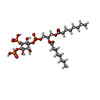  Mass: 746.566 Da / Num. of mol.: 4 / Source method: obtained synthetically / Formula: C25H49O19P3 / Feature type: SUBJECT OF INVESTIGATION Mass: 746.566 Da / Num. of mol.: 4 / Source method: obtained synthetically / Formula: C25H49O19P3 / Feature type: SUBJECT OF INVESTIGATION#3: Chemical | ChemComp-C14 /  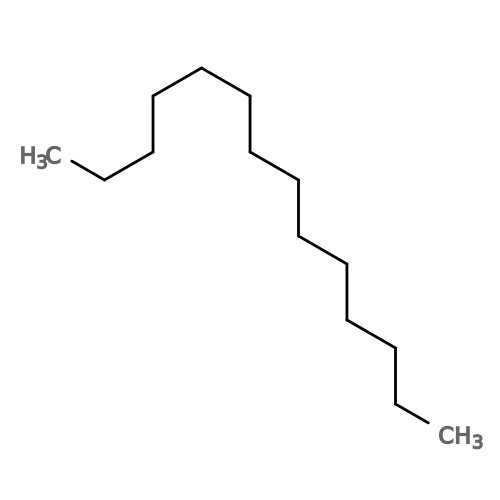 Mass: 198.388 Da / Num. of mol.: 12 / Source method: obtained synthetically / Formula: C14H30 / Feature type: SUBJECT OF INVESTIGATION Mass: 198.388 Da / Num. of mol.: 12 / Source method: obtained synthetically / Formula: C14H30 / Feature type: SUBJECT OF INVESTIGATION#4: Chemical | ChemComp-UL9 / 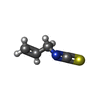 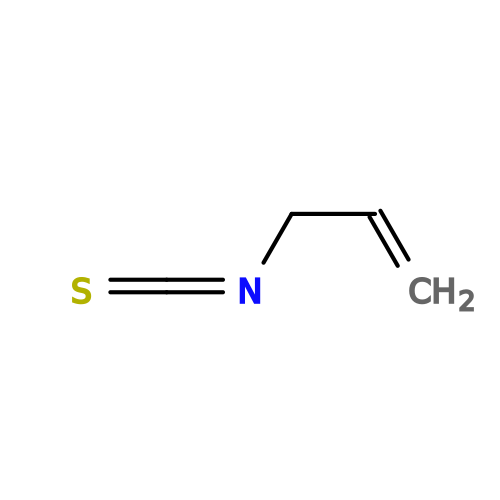 Mass: 99.154 Da / Num. of mol.: 4 / Source method: obtained synthetically / Formula: C4H5NS / Feature type: SUBJECT OF INVESTIGATION Mass: 99.154 Da / Num. of mol.: 4 / Source method: obtained synthetically / Formula: C4H5NS / Feature type: SUBJECT OF INVESTIGATION#5: Chemical | ChemComp-XUQ / ( Mass: 156.265 Da / Num. of mol.: 4 / Source method: obtained synthetically / Formula: C10H20O / Feature type: SUBJECT OF INVESTIGATION Has ligand of interest | Y | Has protein modification | N | |
|---|
-Experimental details
-Experiment
| Experiment | Method: ELECTRON MICROSCOPY |
|---|---|
| EM experiment | Aggregation state: PARTICLE / 3D reconstruction method: single particle reconstruction |
- Sample preparation
| Component | Name: Tetrameric complex of mouse TRPM8 in domain-swapped architecture Type: COMPLEX Details: Menthol-bound mouse TRPM8 in complex with AITC and PIP2 in a closed (C1-2M) state Entity ID: #1 / Source: RECOMBINANT |
|---|---|
| Source (natural) | Organism: Mus musculus (house mouse) |
| Source (recombinant) | Organism: Homo sapiens (human) |
| Buffer solution | pH: 8 |
| Specimen | Embedding applied: NO / Shadowing applied: NO / Staining applied: NO / Vitrification applied: YES |
| Specimen support | Grid material: COPPER / Grid mesh size: 300 divisions/in. / Grid type: Quantifoil R1.2/1.3 |
| Vitrification | Cryogen name: ETHANE |
- Electron microscopy imaging
| Experimental equipment |  Model: Titan Krios / Image courtesy: FEI Company |
|---|---|
| Microscopy | Model: TFS KRIOS |
| Electron gun | Electron source:  FIELD EMISSION GUN / Accelerating voltage: 300 kV / Illumination mode: FLOOD BEAM FIELD EMISSION GUN / Accelerating voltage: 300 kV / Illumination mode: FLOOD BEAM |
| Electron lens | Mode: BRIGHT FIELD / Nominal defocus max: 2100 nm / Nominal defocus min: 800 nm |
| Image recording | Electron dose: 60 e/Å2 / Film or detector model: GATAN K3 BIOQUANTUM (6k x 4k) |
- Processing
| EM software |
| |||||||||
|---|---|---|---|---|---|---|---|---|---|---|
| CTF correction | Type: PHASE FLIPPING AND AMPLITUDE CORRECTION | |||||||||
| 3D reconstruction | Resolution: 3.4 Å / Resolution method: FSC 0.143 CUT-OFF / Num. of particles: 39702 / Symmetry type: POINT | |||||||||
| Refinement | Highest resolution: 3.4 Å Stereochemistry target values: REAL-SPACE (WEIGHTED MAP SUM AT ATOM CENTERS) |
