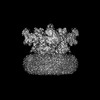
Movie
Movie Controller


+ Open data

- Basic information
| Entry |  | |||||||||
|---|---|---|---|---|---|---|---|---|---|---|
| Title | Menthol-and PIP2-bound mouse TRPM8 in a closed (C1M) state | |||||||||
 Map data Map data | Sharpened map | |||||||||
 Sample Sample |
| |||||||||
 Keywords Keywords | TRPM8 / Menthol / Cold / Channel opening / MEMBRANE PROTEIN | |||||||||
| Function / homology |  Function and homology information Function and homology informationTRP channels / thermoception / ligand-gated calcium channel activity / response to temperature stimulus / plasma membrane raft / monoatomic ion channel activity / response to cold / intracellular calcium ion homeostasis / calcium channel activity / calcium ion transmembrane transport ...TRP channels / thermoception / ligand-gated calcium channel activity / response to temperature stimulus / plasma membrane raft / monoatomic ion channel activity / response to cold / intracellular calcium ion homeostasis / calcium channel activity / calcium ion transmembrane transport / calcium ion transport / positive regulation of cold-induced thermogenesis / membrane raft / external side of plasma membrane / membrane / identical protein binding / plasma membrane Similarity search - Function | |||||||||
| Biological species |   Mus musculus (house mouse) Mus musculus (house mouse) | |||||||||
| Method | single particle reconstruction / cryo EM / Resolution: 3.6 Å | |||||||||
 Authors Authors | Lee HJ / Lee SY | |||||||||
| Funding support |  United States, 2 items United States, 2 items
| |||||||||
 Citation Citation | Journal: Nat Commun / Year: 2026 Title: Molecular basis for cold and menthol sensing by mammalian TRPM8. Authors: Hyuk-Joon Lee / Cheon-Gyu Park / Justin G Fedor / Wyatt A Peele / Mario J Borgnia / Seok-Yong Lee / Abstract: The transient receptor potential melastatin member 8 (TRPM8) is a polymodal ion channel that senses cold and menthol in mammals. Despite prior structural studies, the mechanisms by which cold and ...The transient receptor potential melastatin member 8 (TRPM8) is a polymodal ion channel that senses cold and menthol in mammals. Despite prior structural studies, the mechanisms by which cold and menthol activate TRPM8 remain unresolved. Here, we present cryo-EM structures and extensive functional analyses to reveal cold- and menthol-dependent activation mechanisms. We observe that cold-sensing residues are widespread and that snapshots of cooling-dependent opening reveal dramatic pore rearrangement which suggest a mechanism for cold sensing. Menthol binds dynamically to drive channel activation toward a common gate with cold, but with specific outer pore conformations. Finally, we show how TRPM8 integrates cold and menthol modalities through overlapping but non-identical networks, revealing a coldspot that is central to cold activation of TRPM8 and is the location of allyl isothiocyanate (AITC) binding. These findings enhance our understanding of the molecular basis of physically and chemically induced cool sensation in mammals. | |||||||||
| History |
|
- Structure visualization
| Supplemental images |
|---|

- Downloads & links
-EMDB archive
| Map data | emd_74963.map.gz | 167.7 MB | EMDB map data format | |
|---|---|---|---|---|
| Header (meta data) | emd-74963-v30.xmlemd-74963.xml | 17 KB 17 KB | Display Display | EMDB header |
| FSC (resolution estimation) | emd_74963_fsc.xml | 11.9 KB | Display | FSC data file |
| Images |  emd_74963.png emd_74963.png | 153 KB | ||
| Filedesc metadata | emd-74963.cif.gz | 6.6 KB | ||
| Others | emd_74963_half_map_1.map.gzemd_74963_half_map_2.map.gz | 164.7 MB 164.7 MB | ||
| Archive directory |  https://data.pdbj.org/pub/emdb/structures/EMD-74963ftp://data.pdbj.org/pub/emdb/structures/EMD-74963 https://data.pdbj.org/pub/emdb/structures/EMD-74963ftp://data.pdbj.org/pub/emdb/structures/EMD-74963 | HTTPS FTP |
-Related structure data
| Related structure data |  9zyrMC  9pweC  9pwfC  9pwgC  9pwhC  9y69C  9y6aC M: atomic model generated by this map C: citing same article ( |
|---|---|
| Similar structure data |


-Links
| EMDB pages | EMDB (EBI/PDBe) / EMDataResource |
|---|
-Map
| File | Download / File: emd_74963.map.gz / Format: CCP4 / Size: 178 MB / Type: IMAGE STORED AS FLOATING POINT NUMBER (4 BYTES) | ||||||||||||||||||||||||||||||||||||
|---|---|---|---|---|---|---|---|---|---|---|---|---|---|---|---|---|---|---|---|---|---|---|---|---|---|---|---|---|---|---|---|---|---|---|---|---|---|
| Annotation | Sharpened map | ||||||||||||||||||||||||||||||||||||
| Projections & slices | Image control
Images are generated by Spider. | ||||||||||||||||||||||||||||||||||||
| Voxel size | X=Y=Z: 0.855 Å | ||||||||||||||||||||||||||||||||||||
| Density |
| ||||||||||||||||||||||||||||||||||||
| Symmetry | Space group: 1 | ||||||||||||||||||||||||||||||||||||
| Details | EMDB XML:
|
 Z (Sec.)
 Y (Row.)
 X (Col.)


-Supplemental data
-Half map: Half map B
| File | emd_74963_half_map_1.map | ||||||||||||
|---|---|---|---|---|---|---|---|---|---|---|---|---|---|
| Annotation | Half map B | ||||||||||||
| Projections & Slices |
| ||||||||||||
| Density Histograms |


-Half map: Half map A
| File | emd_74963_half_map_2.map | ||||||||||||
|---|---|---|---|---|---|---|---|---|---|---|---|---|---|
| Annotation | Half map A | ||||||||||||
| Projections & Slices |
| ||||||||||||
| Density Histograms |


- Sample components
-Entire : Tetrameric complex of mouse TRPM8 in domain-swapped architecture
| Entire | Name: Tetrameric complex of mouse TRPM8 in domain-swapped architecture |
|---|---|
| Components |
|
-Supramolecule #1: Tetrameric complex of mouse TRPM8 in domain-swapped architecture
| Supramolecule | Name: Tetrameric complex of mouse TRPM8 in domain-swapped architecture type: complex / ID: 1 / Parent: 0 / Macromolecule list: #1 Details: Menthol-and PIP2-bound mouse TRPM8 in a closed (C1M) state |
|---|---|
| Source (natural) | Organism: Mus musculus (house mouse) |
-Macromolecule #1: Transient receptor potential cation channel subfamily M member 8
| Macromolecule | Name: Transient receptor potential cation channel subfamily M member 8 type: protein_or_peptide / ID: 1 / Number of copies: 4 / Enantiomer: LEVO |
|---|---|
| Source (natural) | Organism: Mus musculus (house mouse) |
| Molecular weight | Theoretical: 127.8555 KDa |
| Recombinant expression | Organism:  Homo sapiens (human) Homo sapiens (human) |
| Sequence | String: MSFEGARLSM RSRRNGTMGS TRTLYSSVSR STDVSYSDSD LVNFIQANFK KRECVFFTRD SKAMENICKC GYAQSQHIEG TQINQNEKW NYKKHTKEFP TDAFGDIQFE TLGKKGKYLR LSCDTDSETL YELLTQHWHL KTPNLVISVT GGAKNFALKP R MRKIFSRL ...String: MSFEGARLSM RSRRNGTMGS TRTLYSSVSR STDVSYSDSD LVNFIQANFK KRECVFFTRD SKAMENICKC GYAQSQHIEG TQINQNEKW NYKKHTKEFP TDAFGDIQFE TLGKKGKYLR LSCDTDSETL YELLTQHWHL KTPNLVISVT GGAKNFALKP R MRKIFSRL IYIAQSKGAW ILTGGTHYGL MKYIGEVVRD NTISRNSEEN IVAIGIAAWG MVSNRDTLIR SCDDEGHFSA QY IMDDFTR DPLYILDNNH THLLLVDNGC HGHPTVEAKL RNQLEKYISE RTSQDSNYGG KIPIVCFAQG GGRETLKAIN TSV KSKIPC VVVEGSGQIA DVIASLVEVE DVLTSSMVKE KLVRFLPRTV SRLPEEEIES WIKWLKEILE SSHLLTVIKM EEAG DEIVS NAISYALYKA FSTNEQDKDN WNGQLKLLLE WNQLDLASDE IFTNDRRWES ADLQEVMFTA LIKDRPKFVR LFLEN GLNL QKFLTNEVLT ELFSTHFSTL VYRNLQIAKN SYNDALLTFV WKLVANFRRS FWKEDRSSRE DLDVELHDAS LTTRHP LQA LFIWAILQNK KELSKVIWEQ TKGCTLAALG ASKLLKTLAK VKNDINAAGE SEELANEYET RAVELFTECY SNDEDLA EQ LLVYSCEAWG GSNCLELAVE ATDQHFIAQP GVQNFLSKQW YGEISRDTKN WKIILCLFII PLVGCGLVSF RKKPIDKH K KLLWYYVAFF TSPFVVFSWN VVFYIAFLLL FAYVLLMDFH SVPHTPELIL YALVFVLFCD EVRQWYMNGV NYFTDLWNV MDTLGLFYFI AGIVFRLHSS NKSSLYSGRV IFCLDYIIFT LRLIHIFTVS RNLGPKIIML QRMLIDVFFF LFLFAVWMVA FGVARQGIL RQNEQRWRWI FRSVIYEPYL AMFGQVPSDV DSTTYDFSHC TFSGNESKPL CVELDEHNLP RFPEWITIPL V CIYMLSTN ILLVNLLVAM FGYTVGIVQE NNDQVWKFQR YFLVQEYCNR LNIPFPFVVF AYFYMVVKKC FKCCCKEKNM ES NACCFRN EDNETLAWEG VMKENYLVKI NTKANDNSEE MRHRFRQLDS KLNDLKSLLK EIANNIK UniProtKB: Transient receptor potential cation channel subfamily M member 8 |
-Macromolecule #2: [(2R)-2-octanoyloxy-3-[oxidanyl-[(1R,2R,3S,4R,5R,6S)-2,3,6-tris(o...
| Macromolecule | Name: [(2R)-2-octanoyloxy-3-[oxidanyl-[(1R,2R,3S,4R,5R,6S)-2,3,6-tris(oxidanyl)-4,5-diphosphonooxy-cyclohexyl]oxy-phosphoryl]oxy-propyl] octanoate type: ligand / ID: 2 / Number of copies: 4 / Formula: PIO |
|---|---|
| Molecular weight | Theoretical: 746.566 Da |
| Chemical component information | 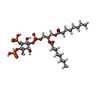 ChemComp-PIO: |
-Macromolecule #3: (1R,2S,5R)-5-methyl-2-(propan-2-yl)cyclohexan-1-ol
| Macromolecule | Name: (1R,2S,5R)-5-methyl-2-(propan-2-yl)cyclohexan-1-ol / type: ligand / ID: 3 / Number of copies: 4 / Formula: XUQ |
|---|---|
| Molecular weight | Theoretical: 156.265 Da |
-Experimental details
-Structure determination
| Method | cryo EM |
|---|---|
 Processing Processing | single particle reconstruction |
| Aggregation state | particle |
-Sample preparation
| Buffer | pH: 8 |
|---|---|
| Grid | Model: Quantifoil R1.2/1.3 / Material: COPPER / Support film - Material: CARBON / Support film - topology: CONTINUOUS / Support film - Film thickness: 2 |
| Vitrification | Cryogen name: ETHANE |
- Electron microscopy
| Microscope | TFS KRIOS |
|---|---|
| Image recording | Film or detector model: GATAN K3 BIOQUANTUM (6k x 4k) / Average electron dose: 50.0 e/Å2 |
| Electron beam | Acceleration voltage: 300 kV / Electron source:  FIELD EMISSION GUN FIELD EMISSION GUN |
| Electron optics | Illumination mode: FLOOD BEAM / Imaging mode: BRIGHT FIELD / Nominal defocus max: 1.6 µm / Nominal defocus min: 0.8 µm |
| Experimental equipment |  Model: Titan Krios / Image courtesy: FEI Company |