 Movie
Movie Controller


+ Open data

- Basic information
| Entry | Database: PDB / ID: 9p9u | |||||||||||||||||||||
|---|---|---|---|---|---|---|---|---|---|---|---|---|---|---|---|---|---|---|---|---|---|---|
| Title | EGFR-KDD with compound2 | |||||||||||||||||||||
 Components Components | Epidermal growth factor receptor | |||||||||||||||||||||
 Keywords Keywords | ONCOPROTEIN / Receptor tyrosine kinases / epidermal growth factor receptor / growth factor signaling / dimerization | |||||||||||||||||||||
| Function / homology |  Function and homology information Function and homology informationmultivesicular body, internal vesicle lumen / negative regulation of cardiocyte differentiation / Shc-EGFR complex / positive regulation of protein kinase C signaling / Inhibition of Signaling by Overexpressed EGFR / EGFR interacts with phospholipase C-gamma / epidermal growth factor receptor activity / epidermal growth factor binding / response to UV-A / regulation of peptidyl-tyrosine phosphorylation ...multivesicular body, internal vesicle lumen / negative regulation of cardiocyte differentiation / Shc-EGFR complex / positive regulation of protein kinase C signaling / Inhibition of Signaling by Overexpressed EGFR / EGFR interacts with phospholipase C-gamma / epidermal growth factor receptor activity / epidermal growth factor binding / response to UV-A / regulation of peptidyl-tyrosine phosphorylation / PLCG1 events in ERBB2 signaling / ERBB2-EGFR signaling pathway / ERBB2 Activates PTK6 Signaling / PTK6 promotes HIF1A stabilization / Signaling by EGFR / intracellular vesicle / negative regulation of epidermal growth factor receptor signaling pathway / ERBB2 Regulates Cell Motility / Developmental Lineage of Mammary Gland Myoepithelial Cells / protein insertion into membrane / Respiratory syncytial virus (RSV) attachment and entry / Signaling by ERBB4 / PI3K events in ERBB2 signaling / positive regulation of phosphorylation / ossification / positive regulation of peptidyl-serine phosphorylation / Estrogen-dependent nuclear events downstream of ESR-membrane signaling / MAP kinase kinase kinase activity / GAB1 signalosome / protein tyrosine kinase activator activity / positive regulation of G1/S transition of mitotic cell cycle / Signaling by ERBB2 / TFAP2 (AP-2) family regulates transcription of growth factors and their receptors / transmembrane receptor protein tyrosine kinase activity / positive regulation of epithelial cell proliferation / GRB2 events in EGFR signaling / SHC1 events in EGFR signaling / EGFR Transactivation by Gastrin / GRB2 events in ERBB2 signaling / positive regulation of fibroblast proliferation / cellular response to epidermal growth factor stimulus / SHC1 events in ERBB2 signaling / basal plasma membrane / positive regulation of DNA replication / positive regulation of DNA repair / cellular response to amino acid stimulus / phosphatidylinositol 3-kinase/protein kinase B signal transduction / Signal transduction by L1 / cellular response to estradiol stimulus / negative regulation of protein catabolic process / positive regulation of protein localization to plasma membrane / clathrin-coated endocytic vesicle membrane / cell-cell adhesion / NOTCH3 Activation and Transmission of Signal to the Nucleus / Signaling by ERBB2 TMD/JMD mutants / EGFR downregulation / receptor protein-tyrosine kinase / Constitutive Signaling by EGFRvIII / Signaling by ERBB2 ECD mutants / Signaling by ERBB2 KD Mutants / positive regulation of miRNA transcription / cell junction / positive regulation of protein phosphorylation / virus receptor activity / epidermal growth factor receptor signaling pathway / ruffle membrane / kinase binding / Downregulation of ERBB2 signaling / Constitutive Signaling by Aberrant PI3K in Cancer / HCMV Early Events / positive regulation of canonical Wnt signaling pathway / actin filament binding / transmembrane signaling receptor activity / neuron differentiation / PIP3 activates AKT signaling / positive regulation of cell growth / Cargo recognition for clathrin-mediated endocytosis / Constitutive Signaling by Ligand-Responsive EGFR Cancer Variants / nuclear membrane / Clathrin-mediated endocytosis / ATPase binding / PI5P, PP2A and IER3 Regulate PI3K/AKT Signaling / RAF/MAP kinase cascade / protein tyrosine kinase activity / double-stranded DNA binding / early endosome membrane / protein phosphatase binding / positive regulation of phosphatidylinositol 3-kinase/protein kinase B signal transduction / basolateral plasma membrane / positive regulation of MAPK cascade / learning or memory / positive regulation of ERK1 and ERK2 cascade / cell surface receptor signaling pathway / signaling receptor complex / endosome / Extra-nuclear estrogen signaling / endosome membrane / positive regulation of cell migration / cadherin binding / membrane raft Similarity search - Function | |||||||||||||||||||||
| Biological species |  Homo sapiens (human) Homo sapiens (human) | |||||||||||||||||||||
| Method | ELECTRON MICROSCOPY / single particle reconstruction / cryo EM / Resolution: 3.27 Å | |||||||||||||||||||||
 Authors Authors | Han, L. / Petrova, Z.O. / Lemmon, M.A. | |||||||||||||||||||||
| Funding support |  United States, 3items United States, 3items
| |||||||||||||||||||||
 Citation Citation | Journal: Structure / Year: 2026 Title: The role of kinase domain dimerization in EGFR activation. Authors: Zaritza O Petrova / Long Han / Yuko Tsutsui / Joshua B Sheetz / Kumar D Ashtekar / Mark A Lemmon / Abstract: The epidermal growth factor receptor (EGFR) was among the first receptor tyrosine kinases (RTKs) shown to be activated by ligand-induced dimerization. Structural studies explain how ligand binding ...The epidermal growth factor receptor (EGFR) was among the first receptor tyrosine kinases (RTKs) shown to be activated by ligand-induced dimerization. Structural studies explain how ligand binding induces the dimerization of EGFR's extracellular region. Unlike other RTKs, EGFR's intracellular tyrosine kinase domain (TKD) is activated allosterically in an asymmetric dimer that is observed crystallographically, but not in cryo-EM studies of intact EGFR. Here, we show that this asymmetric TKD dimer forms only transiently - explaining its lack of definition by cryo-EM. By engineering an asymmetric TKD dimer and studying a TKD-duplicated lung cancer EGFR variant, we show that TKD dimerization increases kinase activity by several hundred-fold. We were also able to stabilize and visualize discrete asymmetric EGFR TKD dimers at high resolution using cryo-EM. Our findings argue that oncogenic mutations activate EGFR primarily by promoting TKD dimerization, and suggest that the transient nature of EGFR TKD dimers may allow biased EGFR signaling. | |||||||||||||||||||||
| History |
|
- Structure visualization
| Structure viewer | Molecule: MolmilJmol/JSmol |
|---|
- Downloads & links
-Download
| PDBx/mmCIF format | 9p9u.cif.gz | 113.8 KB | Display | PDBx/mmCIF format |
|---|---|---|---|---|
| PDB format | pdb9p9u.ent.gz | 82.2 KB | Display | PDB format |
| PDBx/mmJSON format | 9p9u.json.gz | Tree view | PDBx/mmJSON format | |
| Others |  Other downloads Other downloads |
-Validation report
| Arichive directory | https://data.pdbj.org/pub/pdb/validation_reports/p9/9p9uftp://data.pdbj.org/pub/pdb/validation_reports/p9/9p9u | HTTPS FTP |
|---|
-Related structure data
| Related structure data |  71423MC M: map data used to model this data C: citing same article ( |
|---|---|
| Similar structure data |
-Links
 PDBj
PDBj

- Assembly
| Deposited unit | 
|
|---|---|
| 1 |
|
-Components
| #1: Protein | Mass: 77137.133 Da / Num. of mol.: 1 Source method: isolated from a genetically manipulated source Source: (gene. exp.) Homo sapiens (human) / Gene: EGFR, ERBB, ERBB1, HER1 / Production host:  Insect BA phytoplasma (bacteria) Insect BA phytoplasma (bacteria)References: UniProt: P00533, receptor protein-tyrosine kinase | ||||
|---|---|---|---|---|---|
| #2: Chemical | 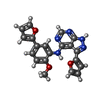 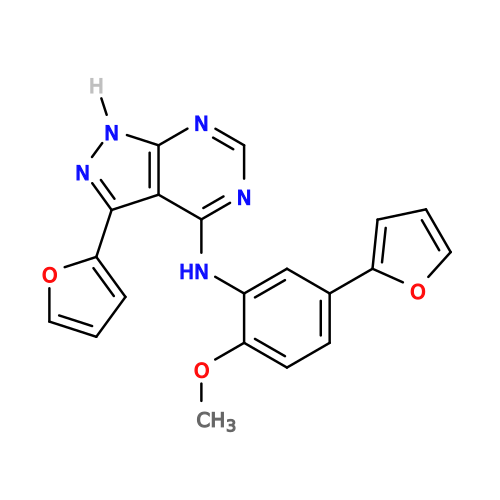 Mass: 373.365 Da / Num. of mol.: 2 / Source method: obtained synthetically / Formula: C20H15N5O3 / Feature type: SUBJECT OF INVESTIGATION Mass: 373.365 Da / Num. of mol.: 2 / Source method: obtained synthetically / Formula: C20H15N5O3 / Feature type: SUBJECT OF INVESTIGATIONHas ligand of interest | Y | Has protein modification | N | |
-Experimental details
-Experiment
| Experiment | Method: ELECTRON MICROSCOPY |
|---|---|
| EM experiment | Aggregation state: PARTICLE / 3D reconstruction method: single particle reconstruction |
- Sample preparation
| Component | Name: EGFR-KDD and compound 2 / Type: COMPLEX Details: epidermal growth factor receptor kinase domain duplicated and compound 2 Entity ID: #1 / Source: RECOMBINANT |
|---|---|
| Source (natural) | Organism: Homo sapiens (human) |
| Source (recombinant) | Organism: Insect BA phytoplasma (bacteria) |
| Buffer solution | pH: 7.5 |
| Specimen | Conc.: 1.1 mg/ml / Embedding applied: NO / Shadowing applied: NO / Staining applied: NO / Vitrification applied: YES |
| Specimen support | Grid material: GOLD / Grid mesh size: 300 divisions/in. / Grid type: Quantifoil R2/1 |
| Vitrification | Cryogen name: ETHANE |
- Electron microscopy imaging
| Experimental equipment |  Model: Titan Krios / Image courtesy: FEI Company |
|---|---|
| Microscopy | Model: TFS KRIOS |
| Electron gun | Electron source:  FIELD EMISSION GUN / Accelerating voltage: 300 kV / Illumination mode: FLOOD BEAM FIELD EMISSION GUN / Accelerating voltage: 300 kV / Illumination mode: FLOOD BEAM |
| Electron lens | Mode: BRIGHT FIELD / Nominal defocus max: 2500 nm / Nominal defocus min: 1000 nm / Cs: 2.7 mm / C2 aperture diameter: 50 µm |
| Image recording | Electron dose: 45 e/Å2 / Film or detector model: GATAN K3 (6k x 4k) |
- Processing
| EM software |
| ||||||||||||||||||||||||
|---|---|---|---|---|---|---|---|---|---|---|---|---|---|---|---|---|---|---|---|---|---|---|---|---|---|
| CTF correction | Type: NONE | ||||||||||||||||||||||||
| Particle selection | Num. of particles selected: 16778798 | ||||||||||||||||||||||||
| 3D reconstruction | Resolution: 3.27 Å / Resolution method: FSC 0.143 CUT-OFF / Num. of particles: 337652 / Symmetry type: POINT | ||||||||||||||||||||||||
| Refinement | Highest resolution: 3.27 Å Stereochemistry target values: REAL-SPACE (WEIGHTED MAP SUM AT ATOM CENTERS) | ||||||||||||||||||||||||
| Refine LS restraints |
|
