National Institutes of Health/National Institute of General Medical Sciences (NIH/NIGMS)
R35-GM122485
United States
National Institutes of Health/National Cancer Institute (NIH/NCI)
R01-CA198164
United States
National Institutes of Health/National Institute of Dental and Craniofacial Research (NIH/NIDCR)
P50-DE030707
United States
Citation
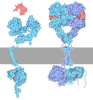
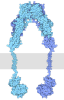
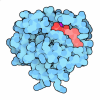
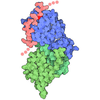
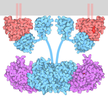
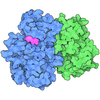
Journal: Structure / Year: 2026 Title: The role of kinase domain dimerization in EGFR activation. Authors: Zaritza O Petrova / Long Han / Yuko Tsutsui / Joshua B Sheetz / Kumar D Ashtekar / Mark A Lemmon / Abstract: The epidermal growth factor receptor (EGFR) was among the first receptor tyrosine kinases (RTKs) shown to be activated by ligand-induced dimerization. Structural studies explain how ligand binding ...The epidermal growth factor receptor (EGFR) was among the first receptor tyrosine kinases (RTKs) shown to be activated by ligand-induced dimerization. Structural studies explain how ligand binding induces the dimerization of EGFR's extracellular region. Unlike other RTKs, EGFR's intracellular tyrosine kinase domain (TKD) is activated allosterically in an asymmetric dimer that is observed crystallographically, but not in cryo-EM studies of intact EGFR. Here, we show that this asymmetric TKD dimer forms only transiently - explaining its lack of definition by cryo-EM. By engineering an asymmetric TKD dimer and studying a TKD-duplicated lung cancer EGFR variant, we show that TKD dimerization increases kinase activity by several hundred-fold. We were also able to stabilize and visualize discrete asymmetric EGFR TKD dimers at high resolution using cryo-EM. Our findings argue that oncogenic mutations activate EGFR primarily by promoting TKD dimerization, and suggest that the transient nature of EGFR TKD dimers may allow biased EGFR signaling.
In the structure databanks used in Yorodumi, some data are registered as the other names, "COVID-19 virus" and "2019-nCoV". Here are the details of the virus and the list of structure data.
Jan 31, 2019. EMDB accession codes are about to change! (news from PDBe EMDB page)
EMDB accession codes are about to change! (news from PDBe EMDB page)
The allocation of 4 digits for EMDB accession codes will soon come to an end. Whilst these codes will remain in use, new EMDB accession codes will include an additional digit and will expand incrementally as the available range of codes is exhausted. The current 4-digit format prefixed with “EMD-” (i.e. EMD-XXXX) will advance to a 5-digit format (i.e. EMD-XXXXX), and so on. It is currently estimated that the 4-digit codes will be depleted around Spring 2019, at which point the 5-digit format will come into force.
The EM Navigator/Yorodumi systems omit the EMD- prefix.
Related info.:Q: What is EMD? / ID/Accession-code notation in Yorodumi/EM Navigator
Yorodumi is a browser for structure data from EMDB, PDB, SASBDB, etc.
This page is also the successor to EM Navigator detail page, and also detail information page/front-end page for Omokage search.
The word "yorodu" (or yorozu) is an old Japanese word meaning "ten thousand". "mi" (miru) is to see.
Related info.:EMDB / PDB / SASBDB / Comparison of 3 databanks / Yorodumi Search / Aug 31, 2016. New EM Navigator & Yorodumi / Yorodumi Papers / Jmol/JSmol / Function and homology information / Changes in new EM Navigator and Yorodumi
 Movie
Movie Controller


 Open data
 Basic information
 Map data
 Sample
 Keywords
 Function and homology information
 Homo sapiens (human)
 Authors
 United States, 3 items
  Citation
 Structure visualization
 Downloads & links
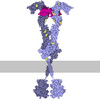
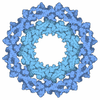
 emd_71423.png
 https://data.pdbj.org/pub/emdb/structures/EMD-71423


 Z (Sec.)
 Y (Row.)
 X (Col.)


 Sample components
 Insect BA phytoplasma (bacteria)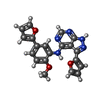
 Processing
 Electron microscopy
 FIELD EMISSION GUN
