 Movie
Movie Controller


+ Open data

- Basic information
| Entry | Database: PDB / ID: 9opj | ||||||||||||||||||||||||
|---|---|---|---|---|---|---|---|---|---|---|---|---|---|---|---|---|---|---|---|---|---|---|---|---|---|
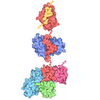
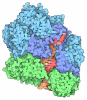
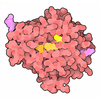
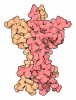
| Title | cryoEM structure of IRAK4:KT-474:CRBN-DDB1 ternary complex | ||||||||||||||||||||||||
 Components Components |
| ||||||||||||||||||||||||
 Keywords Keywords | Transferase/DNA-Binding Protein / Kinase / E3 ligase / IRAK4 / CRBN / DDB1 / heterobifunctional degrader / Transferase-DNA-Binding Protein complex | ||||||||||||||||||||||||
| Function / homology |  Function and homology information Function and homology informationIRAK4 deficiency (TLR5) / MyD88 dependent cascade initiated on endosome / TRAF6 mediated induction of NFkB and MAP kinases upon TLR7/8 or 9 activation / MyD88 cascade initiated on plasma membrane / Toll signaling pathway / interleukin-33-mediated signaling pathway / regulation of MAP kinase activity / neutrophil migration / NLRP3 inflammasome complex assembly / negative regulation of monoatomic ion transmembrane transport ...IRAK4 deficiency (TLR5) / MyD88 dependent cascade initiated on endosome / TRAF6 mediated induction of NFkB and MAP kinases upon TLR7/8 or 9 activation / MyD88 cascade initiated on plasma membrane / Toll signaling pathway / interleukin-33-mediated signaling pathway / regulation of MAP kinase activity / neutrophil migration / NLRP3 inflammasome complex assembly / negative regulation of monoatomic ion transmembrane transport / toll-like receptor 9 signaling pathway / neutrophil mediated immunity / interleukin-1 receptor binding / positive regulation by virus of viral protein levels in host cell / interleukin-1-mediated signaling pathway / spindle assembly involved in female meiosis / toll-like receptor 4 signaling pathway / epigenetic programming in the zygotic pronuclei / IRAK4 deficiency (TLR2/4) / serine/threonine protein kinase complex / extrinsic component of plasma membrane / MyD88:MAL(TIRAP) cascade initiated on plasma membrane / MyD88-dependent toll-like receptor signaling pathway / UV-damage excision repair / toll-like receptor signaling pathway / biological process involved in interaction with symbiont / regulation of mitotic cytokinesis / regulation of mitotic cell cycle phase transition / regulation of miRNA-mediated gene silencing / regulation of natural killer cell activation / WD40-repeat domain binding / regulation of cell cycle phase transition / locomotory exploration behavior / Cul4-RING E3 ubiquitin ligase complex / regulation of stem cell population maintenance / Cul4A-RING E3 ubiquitin ligase complex / Cul4B-RING E3 ubiquitin ligase complex / ubiquitin ligase complex scaffold activity / negative regulation of adipose tissue development / regulation of cellular response to stress / limb development / viral release from host cell / lipopolysaccharide-mediated signaling pathway / JNK cascade / cullin family protein binding / positive regulation of Wnt signaling pathway / negative regulation of protein-containing complex assembly / regulation of DNA-templated DNA replication initiation / positive regulation of viral genome replication / positive regulation of gluconeogenesis / canonical NF-kappaB signal transduction / positive regulation of smooth muscle cell proliferation / rhythmic process / regulation of embryonic development / replication fork processing / TRAF6 mediated IRF7 activation in TLR7/8 or 9 signaling / proteasomal protein catabolic process / epigenetic regulation of gene expression / positive regulation of protein-containing complex assembly / nucleotide-excision repair / regulation of autophagy / Recognition of DNA damage by PCNA-containing replication complex / kinase activity / regulation of circadian rhythm / DNA Damage Recognition in GG-NER / cell population proliferation / cytokine-mediated signaling pathway / Dual Incision in GG-NER / Transcription-Coupled Nucleotide Excision Repair (TC-NER) / Formation of TC-NER Pre-Incision Complex / Formation of Incision Complex in GG-NER / Interleukin-1 signaling / cellular response to UV / positive regulation of protein catabolic process / Dual incision in TC-NER / Gap-filling DNA repair synthesis and ligation in TC-NER / PIP3 activates AKT signaling / regulation of cell population proliferation / site of double-strand break / PI5P, PP2A and IER3 Regulate PI3K/AKT Signaling / Neddylation / spermatogenesis / ubiquitin-dependent protein catabolic process / Potential therapeutics for SARS / damaged DNA binding / proteasome-mediated ubiquitin-dependent protein catabolic process / regulation of apoptotic process / transmembrane transporter binding / innate immune response / positive regulation of canonical NF-kappaB signal transduction / chromosome, telomeric region / non-specific serine/threonine protein kinase / protein-macromolecule adaptor activity / intracellular signal transduction / protein ubiquitination / endosome membrane / DNA repair / protein serine kinase activity / protein serine/threonine kinase activity / DNA damage response Similarity search - Function | ||||||||||||||||||||||||
| Biological species |  Homo sapiens (human) Homo sapiens (human) | ||||||||||||||||||||||||
| Method | ELECTRON MICROSCOPY / single particle reconstruction / cryo EM / Resolution: 3.2 Å | ||||||||||||||||||||||||
 Authors Authors | Fei, X. / Ramanathan, A. / Diagle, C. / Ford, M. / Campbell, V. / Zheng, X. / Li, H. / Sintchak, M. / Kamadurai, H. / Miller, R. ...Fei, X. / Ramanathan, A. / Diagle, C. / Ford, M. / Campbell, V. / Zheng, X. / Li, H. / Sintchak, M. / Kamadurai, H. / Miller, R. / Kazmirski, S. / Huang, X. / Weiss, M. / Manolfi, N. / Zhu, X. | ||||||||||||||||||||||||
| Funding support |  United States, 1items United States, 1items
| ||||||||||||||||||||||||
 Citation Citation | Journal: Nat Commun / Year: 2026 Title: Structural basis for selective and potent degradation of IRAK4 by KT-474. Authors: Xue Fei / Anand Ramanathan / Caroline A Daigle / Melissa Ford / Veronica Campbell / Xiaozhang Zheng / Mike Sintchak / Haoran Li / Hari Kamadurai / Richard Miller / Steven Kazmirski / Xin ...Authors: Xue Fei / Anand Ramanathan / Caroline A Daigle / Melissa Ford / Veronica Campbell / Xiaozhang Zheng / Mike Sintchak / Haoran Li / Hari Kamadurai / Richard Miller / Steven Kazmirski / Xin Huang / Matthew M Weiss / Nello Mainolfi / Xiao Zhu / Abstract: Targeted protein degradation has emerged as a promising drug modality, with potential applications across many immuno-inflammatory diseases. KT-474 is an orally bioavailable interleukin-1 receptor- ...Targeted protein degradation has emerged as a promising drug modality, with potential applications across many immuno-inflammatory diseases. KT-474 is an orally bioavailable interleukin-1 receptor-associated kinase 4 (IRAK4) heterobifunctional degrader evaluated in clinical trials for atopic dermatitis and hidradenitis suppurativa. Here we present structural, biophysical, and computational characterization of an IRAK4:KT-474:CRBN/DDB1 complex. Cryo-EM structure of the complex reveals a unique and non-native protein-protein interaction (PPI) surface mediated by a network of polar and apolar contacts, including key hydrophobic engagements mediated by CRBN Phe150. This complex exhibits negative cooperativity, arising from an interplay between weakly favorable PPI and conformational flexibility of the degrader. Moreover, the structure provides insight into the selective degradation profile of KT-474. Our results offer important insights into the mechanism of action of KT-474 and highlight the value of cryo-EM structures in the optimization of protein degraders. | ||||||||||||||||||||||||
| History |
|
- Structure visualization
| Structure viewer | Molecule: MolmilJmol/JSmol |
|---|
- Downloads & links
-Download
| PDBx/mmCIF format | 9opj.cif.gz | 319.9 KB | Display | PDBx/mmCIF format |
|---|---|---|---|---|
| PDB format | pdb9opj.ent.gz | Display | PDB format | |
| PDBx/mmJSON format | 9opj.json.gz | Tree view | PDBx/mmJSON format | |
| Others |  Other downloads Other downloads |
-Validation report
| Arichive directory | https://data.pdbj.org/pub/pdb/validation_reports/op/9opjftp://data.pdbj.org/pub/pdb/validation_reports/op/9opj | HTTPS FTP |
|---|
-Related structure data
| Related structure data |  70719MC  9opkC M: map data used to model this data C: citing same article ( |
|---|---|
| Similar structure data |
-Links
 PDBj
PDBj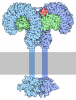

- Assembly
| Deposited unit | 
|
|---|---|
| 1 |
|
-Components
| #1: Protein | Mass: 128139.578 Da / Num. of mol.: 1 Source method: isolated from a genetically manipulated source Source: (gene. exp.) Homo sapiens (human) / Gene: DDB1, XAP1 / Production host:   Spodoptera frugiperda (fall armyworm) / References: UniProt: Q16531 Spodoptera frugiperda (fall armyworm) / References: UniProt: Q16531 |
|---|---|
| #2: Protein | Mass: 46465.375 Da / Num. of mol.: 1 Source method: isolated from a genetically manipulated source Source: (gene. exp.) Homo sapiens (human) / Gene: CRBN, AD-006 / Production host: Spodoptera frugiperda (fall armyworm) / References: UniProt: Q96SW2 |
| #3: Protein | Mass: 51676.633 Da / Num. of mol.: 1 Source method: isolated from a genetically manipulated source Source: (gene. exp.) Homo sapiens (human) / Gene: IRAK4 / Production host: Spodoptera frugiperda (fall armyworm)References: UniProt: Q9NWZ3, non-specific serine/threonine protein kinase |
| #4: Chemical | ChemComp-ZN /   Mass: 65.409 Da / Num. of mol.: 1 / Source method: obtained synthetically / Formula: Zn Mass: 65.409 Da / Num. of mol.: 1 / Source method: obtained synthetically / Formula: Zn |
| #5: Chemical | ChemComp-A1CDC / ( Mass: 865.927 Da / Num. of mol.: 1 / Source method: obtained synthetically / Formula: C44H49F2N11O6 / Feature type: SUBJECT OF INVESTIGATION |
| Has ligand of interest | Y |
| Has protein modification | N |
-Experimental details
-Experiment
| Experiment | Method: ELECTRON MICROSCOPY |
|---|---|
| EM experiment | Aggregation state: PARTICLE / 3D reconstruction method: single particle reconstruction |
- Sample preparation
| Component | Name: IRAK4:KT-474:CRBN-DDB1 ternary complex / Type: COMPLEX / Entity ID: #1-#3 / Source: RECOMBINANT |
|---|---|
| Molecular weight | Experimental value: NO |
| Source (natural) | Organism: Homo sapiens (human) |
| Source (recombinant) | Organism: Spodoptera frugiperda (fall armyworm) |
| Buffer solution | pH: 7.5 |
| Specimen | Embedding applied: NO / Shadowing applied: NO / Staining applied: NO / Vitrification applied: YES |
| Vitrification | Cryogen name: ETHANE |
- Electron microscopy imaging
| Experimental equipment |  Model: Titan Krios / Image courtesy: FEI Company |
|---|---|
| Microscopy | Model: TFS KRIOS |
| Electron gun | Electron source:  FIELD EMISSION GUN / Accelerating voltage: 300 kV / Illumination mode: FLOOD BEAM FIELD EMISSION GUN / Accelerating voltage: 300 kV / Illumination mode: FLOOD BEAM |
| Electron lens | Mode: BRIGHT FIELD / Nominal defocus max: 2000 nm / Nominal defocus min: 800 nm |
| Image recording | Electron dose: 48 e/Å2 / Film or detector model: GATAN K3 BIOQUANTUM (6k x 4k) |
- Processing
| CTF correction | Type: PHASE FLIPPING AND AMPLITUDE CORRECTION |
|---|---|
| 3D reconstruction | Resolution: 3.2 Å / Resolution method: FSC 0.143 CUT-OFF / Num. of particles: 200067 / Symmetry type: POINT |
