[English] 日本語
Yorodumi
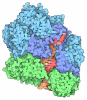
- EMDB-70719: cryoEM structure of IRAK4:KT-474:CRBN-DDB1 ternary complex -

+
Open data


ID or keywords:

Loading...

-
Basic information

Entry
Database: EMDB / ID: EMD-70719
TitlecryoEM structure of IRAK4:KT-474:CRBN-DDB1 ternary complex
Map data3Dflex reconstructed map
Sample
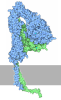
  • Complex: IRAK4:KT-474:CRBN-DDB1 ternary complex
    • Protein or peptide: DNA damage-binding protein 1
    • Protein or peptide: Protein cereblon
    • Protein or peptide: Interleukin-1 receptor-associated kinase 4
  • Ligand: ZINC ION
  • Ligand: (8R)-N-{3-(difluoromethyl)-1-[(1S,4R)-4-({4-[(3-{1-[(3S)-2,6-dioxopiperidin-3-yl]-3-methyl-2-oxo-2,3-dihydro-1H-1,3-benzimidazol-4-yl}prop-2-yn-1-yl)oxy]piperidin-1-yl}methyl)cyclohexyl]-1H-pyrazol-4-yl}-5-[(1R,4R)-2-oxa-5-azabicyclo[2.2.1]heptan-5-yl]pyrazolo[1,5-a]pyrimidine-3-carboxamide
KeywordsKinase / E3 ligase / IRAK4 / CRBN / DDB1 / heterobifunctional degrader / Transferase-DNA-Binding Protein complex
Function / homology
Function and homology information


IRAK4 deficiency (TLR5) / MyD88 dependent cascade initiated on endosome / TRAF6 mediated induction of NFkB and MAP kinases upon TLR7/8 or 9 activation / MyD88 cascade initiated on plasma membrane / Toll signaling pathway / interleukin-33-mediated signaling pathway / neutrophil migration / regulation of MAP kinase activity / negative regulation of monoatomic ion transmembrane transport / NLRP3 inflammasome complex assembly ...IRAK4 deficiency (TLR5) / MyD88 dependent cascade initiated on endosome / TRAF6 mediated induction of NFkB and MAP kinases upon TLR7/8 or 9 activation / MyD88 cascade initiated on plasma membrane / Toll signaling pathway / interleukin-33-mediated signaling pathway / neutrophil migration / regulation of MAP kinase activity / negative regulation of monoatomic ion transmembrane transport / NLRP3 inflammasome complex assembly / toll-like receptor 9 signaling pathway / neutrophil mediated immunity / interleukin-1 receptor binding / positive regulation by virus of viral protein levels in host cell / spindle assembly involved in female meiosis / interleukin-1-mediated signaling pathway / epigenetic programming in the zygotic pronuclei / toll-like receptor 4 signaling pathway / IRAK4 deficiency (TLR2/4) / extrinsic component of plasma membrane / MyD88:MAL(TIRAP) cascade initiated on plasma membrane / UV-damage excision repair / MyD88-dependent toll-like receptor signaling pathway / toll-like receptor signaling pathway / biological process involved in interaction with symbiont / regulation of mitotic cell cycle phase transition / WD40-repeat domain binding / limb development / Cul4A-RING E3 ubiquitin ligase complex / Cul4-RING E3 ubiquitin ligase complex / negative regulation of reproductive process / negative regulation of developmental process / Cul4B-RING E3 ubiquitin ligase complex / ectopic germ cell programmed cell death / ubiquitin ligase complex scaffold activity / locomotory exploration behavior / viral release from host cell / JNK cascade / cullin family protein binding / positive regulation of Wnt signaling pathway / negative regulation of protein-containing complex assembly / positive regulation of viral genome replication / canonical NF-kappaB signal transduction / lipopolysaccharide-mediated signaling pathway / positive regulation of gluconeogenesis / positive regulation of smooth muscle cell proliferation / TRAF6 mediated IRF7 activation in TLR7/8 or 9 signaling / sperm end piece / sperm principal piece / nucleotide-excision repair / proteasomal protein catabolic process / positive regulation of protein-containing complex assembly / Recognition of DNA damage by PCNA-containing replication complex / regulation of circadian rhythm / Wnt signaling pathway / DNA Damage Recognition in GG-NER / cytokine-mediated signaling pathway / Dual Incision in GG-NER / Transcription-Coupled Nucleotide Excision Repair (TC-NER) / Formation of TC-NER Pre-Incision Complex / Formation of Incision Complex in GG-NER / Interleukin-1 signaling / kinase activity / positive regulation of protein catabolic process / cellular response to UV / Dual incision in TC-NER / Gap-filling DNA repair synthesis and ligation in TC-NER / PIP3 activates AKT signaling / rhythmic process / sperm midpiece / site of double-strand break / PI5P, PP2A and IER3 Regulate PI3K/AKT Signaling / Neddylation / Potential therapeutics for SARS / damaged DNA binding / ubiquitin-dependent protein catabolic process / proteasome-mediated ubiquitin-dependent protein catabolic process / transmembrane transporter binding / positive regulation of canonical NF-kappaB signal transduction / protein-macromolecule adaptor activity / chromosome, telomeric region / non-specific serine/threonine protein kinase / endosome membrane / intracellular signal transduction / protein ubiquitination / innate immune response / protein serine kinase activity / DNA repair / protein serine/threonine kinase activity / apoptotic process / DNA damage response / nucleolus / negative regulation of apoptotic process / protein kinase binding / protein-containing complex binding / perinuclear region of cytoplasm / magnesium ion binding / cell surface / protein-containing complex / DNA binding
Similarity search - Function
Interleukin-1 receptor-associated kinase 4 / IRAK4, Death domain / : / Yippee/Mis18/Cereblon / Yippee zinc-binding/DNA-binding /Mis18, centromere assembly / CULT domain / CULT domain profile. / Lon N-terminal domain profile. / Lon protease, N-terminal domain / Lon protease, N-terminal domain superfamily ...Interleukin-1 receptor-associated kinase 4 / IRAK4, Death domain / : / Yippee/Mis18/Cereblon / Yippee zinc-binding/DNA-binding /Mis18, centromere assembly / CULT domain / CULT domain profile. / Lon N-terminal domain profile. / Lon protease, N-terminal domain / Lon protease, N-terminal domain superfamily / ATP-dependent protease La (LON) substrate-binding domain / Found in ATP-dependent protease La (LON) / : / RSE1/DDB1/CPSF1 second beta-propeller / Cleavage/polyadenylation specificity factor, A subunit, C-terminal / Cleavage/polyadenylation specificity factor, A subunit, N-terminal / : / CPSF A subunit region / RSE1/DDB1/CPSF1 first beta-propeller / PUA-like superfamily / Death-like domain superfamily / Protein tyrosine and serine/threonine kinase / Serine-threonine/tyrosine-protein kinase, catalytic domain / Serine/Threonine protein kinases, catalytic domain / WD40-repeat-containing domain superfamily / WD40/YVTN repeat-like-containing domain superfamily / Protein kinase domain profile. / Protein kinase domain / Protein kinase-like domain superfamily
Similarity search - Domain/homology
DNA damage-binding protein 1 / Protein cereblon / Interleukin-1 receptor-associated kinase 4
Similarity search - Component
Biological speciesHomo sapiens (human)
Methodsingle particle reconstruction / cryo EM / Resolution: 3.2 Å
AuthorsFei X / Ramanathan A / Diagle C / Ford M / Campbell V / Zheng X / Li H / Sintchak M / Kamadurai H / Miller R ...Fei X / Ramanathan A / Diagle C / Ford M / Campbell V / Zheng X / Li H / Sintchak M / Kamadurai H / Miller R / Kazmirski S / Huang X / Weiss M / Manolfi N / Zhu X
Funding support United States, 1 items
OrganizationGrant numberCountry
Other private United States
CitationJournal: Nat Commun / Year: 2026
Title: Structural basis for selective and potent degradation of IRAK4 by KT-474.
Authors: Xue Fei / Anand Ramanathan / Caroline A Daigle / Melissa Ford / Veronica Campbell / Xiaozhang Zheng / Mike Sintchak / Haoran Li / Hari Kamadurai / Richard Miller / Steven Kazmirski / Xin ...Authors: Xue Fei / Anand Ramanathan / Caroline A Daigle / Melissa Ford / Veronica Campbell / Xiaozhang Zheng / Mike Sintchak / Haoran Li / Hari Kamadurai / Richard Miller / Steven Kazmirski / Xin Huang / Matthew M Weiss / Nello Mainolfi / Xiao Zhu /
Abstract: Targeted protein degradation has emerged as a promising drug modality, with potential applications across many immuno-inflammatory diseases. KT-474 is an orally bioavailable interleukin-1 receptor- ...Targeted protein degradation has emerged as a promising drug modality, with potential applications across many immuno-inflammatory diseases. KT-474 is an orally bioavailable interleukin-1 receptor-associated kinase 4 (IRAK4) heterobifunctional degrader evaluated in clinical trials for atopic dermatitis and hidradenitis suppurativa. Here we present structural, biophysical, and computational characterization of an IRAK4:KT-474:CRBN/DDB1 complex. Cryo-EM structure of the complex reveals a unique and non-native protein-protein interaction (PPI) surface mediated by a network of polar and apolar contacts, including key hydrophobic engagements mediated by CRBN Phe150. This complex exhibits negative cooperativity, arising from an interplay between weakly favorable PPI and conformational flexibility of the degrader. Moreover, the structure provides insight into the selective degradation profile of KT-474. Our results offer important insights into the mechanism of action of KT-474 and highlight the value of cryo-EM structures in the optimization of protein degraders.
History
DepositionMay 19, 2025-
Header (metadata) releaseJul 29, 2026-
Map releaseJul 29, 2026-
UpdateJul 29, 2026-
Current statusJul 29, 2026Processing site: RCSB / Status: Released

-
Structure visualization

Supplemental images

Downloads & links

-
Map

FileDownload / File: emd_70719.map.gz / Format: CCP4 / Size: 103 MB / Type: IMAGE STORED AS FLOATING POINT NUMBER (4 BYTES)
Annotation3Dflex reconstructed map
Projections & slices

Image control

Size
Brightness
Contrast
Others
AxesZ (Sec.)Y (Row.)X (Col.)
0.82 Å/pix.
x 300 pix.
= 246. Å
0.82 Å/pix.
x 300 pix.
= 246. Å
0.82 Å/pix.
x 300 pix.
= 246. Å

Surface

Projections

Slices (1/3)

Slices (1/2)

Slices (2/3)

Images are generated by Spider.

Voxel sizeX=Y=Z: 0.82 Å
Density
Contour LevelBy AUTHOR: 0.00347
Minimum - Maximum-0.017159116 - 0.031226423
Average (Standard dev.)0.000040000356 (±0.0007526176)
SymmetrySpace group: 1
Details

EMDB XML:

Map geometry
Axis orderXYZ
Origin000
Dimensions300300300
Spacing300300300
CellA=B=C: 246.0 Å
α=β=γ: 90.0 °

-
Supplemental data

-
Additional map: deepEMhancer processed map

Fileemd_70719_additional_1.map
AnnotationdeepEMhancer processed map
Projections & Slices
AxesZYX

Projections

Slices (1/2)
Density Histograms

-
Half map: 3Dflex reconstructed half map1

Fileemd_70719_half_map_1.map
Annotation3Dflex reconstructed half map1
Projections & Slices
AxesZYX

Projections

Slices (1/2)
Density Histograms

-
Half map: 3Dflex reconstructed half map2

Fileemd_70719_half_map_2.map
Annotation3Dflex reconstructed half map2
Projections & Slices
AxesZYX

Projections

Slices (1/2)
Density Histograms

-
Sample components

-
Entire : IRAK4:KT-474:CRBN-DDB1 ternary complex

EntireName: IRAK4:KT-474:CRBN-DDB1 ternary complex
Components
  • Complex: IRAK4:KT-474:CRBN-DDB1 ternary complex
    • Protein or peptide: DNA damage-binding protein 1
    • Protein or peptide: Protein cereblon
    • Protein or peptide: Interleukin-1 receptor-associated kinase 4
  • Ligand: ZINC ION
  • Ligand: (8R)-N-{3-(difluoromethyl)-1-[(1S,4R)-4-({4-[(3-{1-[(3S)-2,6-dioxopiperidin-3-yl]-3-methyl-2-oxo-2,3-dihydro-1H-1,3-benzimidazol-4-yl}prop-2-yn-1-yl)oxy]piperidin-1-yl}methyl)cyclohexyl]-1H-pyrazol-4-yl}-5-[(1R,4R)-2-oxa-5-azabicyclo[2.2.1]heptan-5-yl]pyrazolo[1,5-a]pyrimidine-3-carboxamide

-
Supramolecule #1: IRAK4:KT-474:CRBN-DDB1 ternary complex

SupramoleculeName: IRAK4:KT-474:CRBN-DDB1 ternary complex / type: complex / ID: 1 / Parent: 0 / Macromolecule list: #1-#3
Source (natural)Organism: Homo sapiens (human)

-
Macromolecule #1: DNA damage-binding protein 1

MacromoleculeName: DNA damage-binding protein 1 / type: protein_or_peptide / ID: 1 / Number of copies: 1 / Enantiomer: LEVO
Source (natural)Organism: Homo sapiens (human)
Molecular weightTheoretical: 128.139578 KDa
Recombinant expressionOrganism: Spodoptera frugiperda (fall armyworm)
SequenceString: MSYNYVVTAQ KPTAVNGCVT GHFTSAEDLN LLIAKNTRLE IYVVTAEGLR PVKEVGMYGK IAVMELFRPK GESKDLLFIL TAKYNACIL EYKQSGESID IITRAHGNVQ DRIGRPSETG IIGIIDPECR MIGLRLYDGL FKVIPLDRDN KELKAFNIRL E ELHVIDVK ...String:
MSYNYVVTAQ KPTAVNGCVT GHFTSAEDLN LLIAKNTRLE IYVVTAEGLR PVKEVGMYGK IAVMELFRPK GESKDLLFIL TAKYNACIL EYKQSGESID IITRAHGNVQ DRIGRPSETG IIGIIDPECR MIGLRLYDGL FKVIPLDRDN KELKAFNIRL E ELHVIDVK FLYGCQAPTI CFVYQDPQGR HVKTYEVSLR EKEFNKGPWK QENVEAEASM VIAVPEPFGG AIIIGQESIT YH NGDKYLA IAPPIIKQST IVCHNRVDPN GSRYLLGDME GRLFMLLLEK EEQMDGTVTL KDLRVELLGE TSIAECLTYL DNG VVFVGS RLGDSQLVKL NVDSNEQGSY VVAMETFTNL GPIVDMCVVD LERQGQGQLV TCSGAFKEGS LRIIRNGIGI HEHA SIDLP GIKGLWPLRS DPNRETDDTL VLSFVGQTRV LMLNGEEVEE TELMGFVDDQ QTFFCGNVAH QQLIQITSAS VRLVS QEPK ALVSEWKEPQ AKNISVASCN SSQVVVAVGR ALYYLQIHPQ ELRQISHTEM EHEVACLDIT PLGDSNGLSP LCAIGL WTD ISARILKLPS FELLHKEMLG GEIIPRSILM TTFESSHYLL CALGDGALFY FGLNIETGLL SDRKKVTLGT QPTVLRT FR SLSTTNVFAC SDRPTVIYSS NHKLVFSNVN LKEVNYMCPL NSDGYPDSLA LANNSTLTIG TIDEIQKLHI RTVPLYES P RKICYQEVSQ CFGVLSSRIE VQDTSGGTTA LRPSASTQAL SSSVSSSKLF SSSTAPHETS FGEEVEVHNL LIIDQHTFE VLHAHQFLQN EYALSLVSCK LGKDPNTYFI VGTAMVYPEE AEPKQGRIVV FQYSDGKLQT VAEKEVKGAV YSMVEFNGKL LASINSTVR LYEWTTEKEL RTECNHYNNI MALYLKTKGD FILVGDLMRS VLLLAYKPME GNFEEIARDF NPNWMSAVEI L DDDNFLGA ENAFNLFVCQ KDSAATTDEE RQHLQEVGLF HLGEFVNVFC HGSLVMQNLG ETSTPTQGSV LFGTVNGMIG LV TSLSESW YNLLLDMQNR LNKVIKSVGK IEHSFWRSFH TERKTEPATG FIDGDLIESF LDISRPKMQE VVANLQYDDG SGM KREATA DDLIKVVEEL TRIHWSHPQF EK

UniProtKB: DNA damage-binding protein 1

-
Macromolecule #2: Protein cereblon

MacromoleculeName: Protein cereblon / type: protein_or_peptide / ID: 2 / Number of copies: 1 / Enantiomer: LEVO
Source (natural)Organism: Homo sapiens (human)
Molecular weightTheoretical: 46.465375 KDa
Recombinant expressionOrganism: Spodoptera frugiperda (fall armyworm)
SequenceString: GSEAKKPNII NFDTSLPTSH TYLGADMEEF HGRTLHDDDS CQVIPVLPQV MMILIPGQTL PLQLFHPQEV SMVRNLIQKD RTFAVLAYS NVQEREAQFG TTAEIYAYRE EQDFGIEIVK VKAIGRQRFK VLELRTQSDG IQQAKVQILP ECVLPSTMSA V QLESLNKC ...String:
GSEAKKPNII NFDTSLPTSH TYLGADMEEF HGRTLHDDDS CQVIPVLPQV MMILIPGQTL PLQLFHPQEV SMVRNLIQKD RTFAVLAYS NVQEREAQFG TTAEIYAYRE EQDFGIEIVK VKAIGRQRFK VLELRTQSDG IQQAKVQILP ECVLPSTMSA V QLESLNKC QIFPSKPVSR EDQCSYKWWQ KYQKRKFHCA NLTSWPRWLY SLYDAETLMD RIKKQLREWD ENLKDDSLPS NP IDFSYRV AACLPIDDVL RIQLLKIGSA IQRLRCELDI MNKCTSLCCK QCQETEITTK NEIFSLSLCG PMAAYVNPHG YVH ETLTVY KACNLNLIGR PSTEHSWFPG YAWTVAQCKI CASHIGWKFT ATKKDMSPQK FWGLTRSALL PTIPDTEDEI SPDK VILCL

UniProtKB: Protein cereblon

-
Macromolecule #3: Interleukin-1 receptor-associated kinase 4

MacromoleculeName: Interleukin-1 receptor-associated kinase 4 / type: protein_or_peptide / ID: 3 / Number of copies: 1 / Enantiomer: LEVO / EC number: non-specific serine/threonine protein kinase
Source (natural)Organism: Homo sapiens (human)
Molecular weightTheoretical: 51.676633 KDa
Recombinant expressionOrganism: Spodoptera frugiperda (fall armyworm)
SequenceString: SMNKPITPST YVRCLNVGLI RKLSDFIDPQ EGWKKLAVAI KKPSGDDRYN QFHIRRFEAL LQTGKSPTSE LLFDWGTTNC TVGDLVDLL IQNEFFAPAS LLLPDAVPKT ANTLPSKEAI TVQQKQMPFC DKDRTLMTPV QNLEQSYMPP DSSSPENKSL E VSDTRFHS ...String:
SMNKPITPST YVRCLNVGLI RKLSDFIDPQ EGWKKLAVAI KKPSGDDRYN QFHIRRFEAL LQTGKSPTSE LLFDWGTTNC TVGDLVDLL IQNEFFAPAS LLLPDAVPKT ANTLPSKEAI TVQQKQMPFC DKDRTLMTPV QNLEQSYMPP DSSSPENKSL E VSDTRFHS FSFYELKNVT NNFDERPISV GGNKMGEGGF GVVYKGYVNN TTVAVKKLAA MVDITTEELK QQFDQEIKVM AK CQHENLV ELLGFSSDGD DLCLVYVYMP NGSLLDRLSC LDGTPPLSWH MRCKIAQGAA NGINFLHENH HIHRDIKSAN ILL DEAFTA KISDFGLARA SEKFAQTVMT SRIVGTTAYM APEALRGEIT PKSDIYSFGV VLLEIITGLP AVDEHREPQL LLDI KEEIE DEEKTIEDYI DKKMNDADST SVEAMYSVAS QCLHEKKNKR PDIKKVQQLL QEMTAS

UniProtKB: Interleukin-1 receptor-associated kinase 4

-
Macromolecule #4: ZINC ION

MacromoleculeName: ZINC ION / type: ligand / ID: 4 / Number of copies: 1 / Formula: ZN
Molecular weightTheoretical: 65.409 Da

-
Macromolecule #5: (8R)-N-{3-(difluoromethyl)-1-[(1S,4R)-4-({4-[(3-{1-[(3S)-2,6-diox...

MacromoleculeName: (8R)-N-{3-(difluoromethyl)-1-[(1S,4R)-4-({4-[(3-{1-[(3S)-2,6-dioxopiperidin-3-yl]-3-methyl-2-oxo-2,3-dihydro-1H-1,3-benzimidazol-4-yl}prop-2-yn-1-yl)oxy]piperidin-1-yl}methyl)cyclohexyl]-1H- ...Name: (8R)-N-{3-(difluoromethyl)-1-[(1S,4R)-4-({4-[(3-{1-[(3S)-2,6-dioxopiperidin-3-yl]-3-methyl-2-oxo-2,3-dihydro-1H-1,3-benzimidazol-4-yl}prop-2-yn-1-yl)oxy]piperidin-1-yl}methyl)cyclohexyl]-1H-pyrazol-4-yl}-5-[(1R,4R)-2-oxa-5-azabicyclo[2.2.1]heptan-5-yl]pyrazolo[1,5-a]pyrimidine-3-carboxamide
type: ligand / ID: 5 / Number of copies: 1 / Formula: A1CDC
Molecular weightTheoretical: 865.927 Da

-
Experimental details

-
Structure determination

Methodcryo EM
Processingsingle particle reconstruction
Aggregation stateparticle

-
Sample preparation

BufferpH: 7.5
VitrificationCryogen name: ETHANE

-
Electron microscopy

MicroscopeTFS KRIOS
Image recordingFilm or detector model: GATAN K3 BIOQUANTUM (6k x 4k) / Average electron dose: 48.0 e/Å2
Electron beamAcceleration voltage: 300 kV / Electron source: FIELD EMISSION GUN
Electron opticsIllumination mode: FLOOD BEAM / Imaging mode: BRIGHT FIELD / Nominal defocus max: 2.0 µm / Nominal defocus min: 0.8 µm
Experimental equipment
Model: Titan Krios / Image courtesy: FEI Company

+
Image processing

CTF correctionType: PHASE FLIPPING AND AMPLITUDE CORRECTION
Startup modelType of model: NONE
Final reconstructionResolution.type: BY AUTHOR / Resolution: 3.2 Å / Resolution method: FSC 0.143 CUT-OFF / Number images used: 200067
Initial angle assignmentType: RANDOM ASSIGNMENT
Final angle assignmentType: MAXIMUM LIKELIHOOD

+
About Yorodumi

-
News

-
Feb 9, 2022. New format data for meta-information of EMDB entries

New format data for meta-information of EMDB entries

  • Version 3 of the EMDB header file is now the official format.
  • The previous official version 1.9 will be removed from the archive.

Related info.:EMDB header

External links:wwPDB to switch to version 3 of the EMDB data model

-
Aug 12, 2020. Covid-19 info

Covid-19 info

URL: https://pdbj.org/emnavi/covid19.php

New page: Covid-19 featured information page in EM Navigator.

Related info.:Covid-19 info / Mar 5, 2020. Novel coronavirus structure data

+
Mar 5, 2020. Novel coronavirus structure data

Novel coronavirus structure data

Related info.:Yorodumi Speices / Aug 12, 2020. Covid-19 info

External links:COVID-19 featured content - PDBj / Molecule of the Month (242):Coronavirus Proteases

+
Jan 31, 2019. EMDB accession codes are about to change! (news from PDBe EMDB page)

EMDB accession codes are about to change! (news from PDBe EMDB page)

  • The allocation of 4 digits for EMDB accession codes will soon come to an end. Whilst these codes will remain in use, new EMDB accession codes will include an additional digit and will expand incrementally as the available range of codes is exhausted. The current 4-digit format prefixed with “EMD-” (i.e. EMD-XXXX) will advance to a 5-digit format (i.e. EMD-XXXXX), and so on. It is currently estimated that the 4-digit codes will be depleted around Spring 2019, at which point the 5-digit format will come into force.
  • The EM Navigator/Yorodumi systems omit the EMD- prefix.

Related info.:Q: What is EMD? / ID/Accession-code notation in Yorodumi/EM Navigator

External links:EMDB Accession Codes are Changing Soon! / Contact to PDBj

+
Jul 12, 2017. Major update of PDB

Major update of PDB

  • wwPDB released updated PDB data conforming to the new PDBx/mmCIF dictionary.
  • This is a major update changing the version number from 4 to 5, and with Remediation, in which all the entries are updated.
  • In this update, many items about electron microscopy experimental information are reorganized (e.g. em_software).
  • Now, EM Navigator and Yorodumi are based on the updated data.

External links:wwPDB Remediation / Enriched Model Files Conforming to OneDep Data Standards Now Available in the PDB FTP Archive

-
Yorodumi

Thousand views of thousand structures

  • Yorodumi is a browser for structure data from EMDB, PDB, SASBDB, etc.
  • This page is also the successor to EM Navigator detail page, and also detail information page/front-end page for Omokage search.
  • The word "yorodu" (or yorozu) is an old Japanese word meaning "ten thousand". "mi" (miru) is to see.

Related info.:EMDB / PDB / SASBDB / Comparison of 3 databanks / Yorodumi Search / Aug 31, 2016. New EM Navigator & Yorodumi / Yorodumi Papers / Jmol/JSmol / Function and homology information / Changes in new EM Navigator and Yorodumi

Read more