 Movie
Movie Controller


+ Open data

- Basic information
| Entry | Database: PDB / ID: 9oby | ||||||||||||||||||||||||
|---|---|---|---|---|---|---|---|---|---|---|---|---|---|---|---|---|---|---|---|---|---|---|---|---|---|
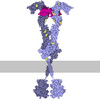
| Title | Ca2+-bound GluN1a/2B NMDAR (S1) | ||||||||||||||||||||||||
 Components Components |
| ||||||||||||||||||||||||
 Keywords Keywords | MEMBRANE PROTEIN / Ion Channels / NMDAR | ||||||||||||||||||||||||
| Function / homology |  Function and homology information Function and homology informationcellular response to corticosterone stimulus / cellular response to magnesium starvation / sensory organ development / sensitization / cellular response to curcumin / auditory behavior / pons maturation / regulation of cAMP/PKA signal transduction / fear response / response to carbohydrate ...cellular response to corticosterone stimulus / cellular response to magnesium starvation / sensory organ development / sensitization / cellular response to curcumin / auditory behavior / pons maturation / regulation of cAMP/PKA signal transduction / fear response / response to carbohydrate / EPHB-mediated forward signaling / positive regulation of Schwann cell migration / Assembly and cell surface presentation of NMDA receptors / regulation of cell communication / protein localization to postsynaptic membrane / conditioned taste aversion / response to other organism / response to methylmercury / suckling behavior / olfactory learning / response to hydrogen sulfide / dendritic branch / regulation of ARF protein signal transduction / response to manganese ion / response to glycoside / apical dendrite / transmitter-gated monoatomic ion channel activity / interleukin-1 receptor binding / cellular response to dsRNA / cellular response to lipid / regulation of respiratory gaseous exchange / response to growth hormone / propylene metabolic process / response to glycine / positive regulation of inhibitory postsynaptic potential / heterocyclic compound binding / RAF/MAP kinase cascade / negative regulation of dendritic spine maintenance / neuromuscular process / neurotransmitter receptor complex / response to amine / Synaptic adhesion-like molecules / NMDA glutamate receptor activity / regulation of monoatomic cation transmembrane transport / NMDA selective glutamate receptor complex / glutamate binding / regulation of axonogenesis / behavioral fear response / ligand-gated sodium channel activity / startle response / positive regulation of glutamate secretion / voltage-gated monoatomic cation channel activity / response to morphine / calcium ion transmembrane import into cytosol / positive regulation of reactive oxygen species biosynthetic process / male mating behavior / regulation of synapse assembly / protein heterotetramerization / regulation of dendrite morphogenesis / small molecule binding / behavioral response to pain / receptor clustering / glycine binding / positive regulation of calcium ion transport into cytosol / parallel fiber to Purkinje cell synapse / social behavior / associative learning / regulation of neuronal synaptic plasticity / regulation of postsynaptic membrane potential / neuron development / regulation of MAPK cascade / response to electrical stimulus / extracellularly glutamate-gated ion channel activity / multicellular organismal response to stress / action potential / detection of mechanical stimulus involved in sensory perception of pain / positive regulation of dendritic spine maintenance / monoatomic cation transmembrane transport / cellular response to glycine / response to magnesium ion / Unblocking of NMDA receptors, glutamate binding and activation / response to mechanical stimulus / glutamate receptor binding / monoatomic cation transport / ligand-gated monoatomic ion channel activity / prepulse inhibition / phosphatase binding / long-term memory / adult locomotory behavior / regulation of long-term neuronal synaptic plasticity / calcium ion homeostasis / postsynaptic density, intracellular component / response to fungicide / monoatomic cation channel activity / sensory perception of pain / glutamate-gated receptor activity / cellular response to manganese ion / response to cytokine / regulation of long-term synaptic depression / response to amphetamine Similarity search - Function | ||||||||||||||||||||||||
| Biological species |   Rattus norvegicus (Norway rat) Rattus norvegicus (Norway rat) | ||||||||||||||||||||||||
| Method | ELECTRON MICROSCOPY / single particle reconstruction / cryo EM / Resolution: 3.6 Å | ||||||||||||||||||||||||
 Authors Authors | Steigerwald, R. / Furukawa, H. | ||||||||||||||||||||||||
| Funding support |  United States, 2items United States, 2items
| ||||||||||||||||||||||||
 Citation Citation | Journal: Nat Neurosci / Year: 2026 Title: Molecular mechanism of calcium permeability and magnesium block in NMDA receptors. Authors: Ruben Steigerwald / Max Epstein / Tsung-Han Chou / Noriko Simorowski / Hiro Furukawa / Abstract: Hebbian neuroplasticity, which is thought to be a cellular substrate of learning and memory, can occur by means of coincidental detection of presynaptic neurotransmitter release and Ca influx upon ...Hebbian neuroplasticity, which is thought to be a cellular substrate of learning and memory, can occur by means of coincidental detection of presynaptic neurotransmitter release and Ca influx upon postsynaptic depolarization. This is mediated at a molecular level by N-methyl-D-aspartate-type glutamate receptors, which bind glutamate and glycine and facilitate Ca influx upon relief of Mg channel block during membrane depolarization. However, the structural mechanism underlying Ca permeability and Mg blockade in N-methyl-D-aspartate-type glutamate receptors has yet to be fully elucidated. Here we demonstrate using single-particle cryo-electron microscopy that Ca permeation through the narrow constriction of the cation selectivity filter involves partial dehydration, as evidenced by several Ca binding sites. In contrast, Mg binds outside of the selectivity filter through a water network and remains hydrated, thereby acting as a channel blocker. Furthermore, the lipid network around the selectivity filter influences the stability of Mg binding in a voltage-dependent manner. Our study details the transmembrane chemistry essential for initiating neuroplasticity. | ||||||||||||||||||||||||
| History |
|
- Structure visualization
| Structure viewer | Molecule: MolmilJmol/JSmol |
|---|
- Downloads & links
-Download
| PDBx/mmCIF format | 9oby.cif.gz | 151 KB | Display | PDBx/mmCIF format |
|---|---|---|---|---|
| PDB format | pdb9oby.ent.gz | 82.3 KB | Display | PDB format |
| PDBx/mmJSON format | 9oby.json.gz | Tree view | PDBx/mmJSON format | |
| Others |  Other downloads Other downloads |
-Validation report
| Arichive directory | https://data.pdbj.org/pub/pdb/validation_reports/ob/9obyftp://data.pdbj.org/pub/pdb/validation_reports/ob/9oby | HTTPS FTP |
|---|
-Related structure data
| Related structure data |  70303MC  9obsC  9obtC  9obuC  9obvC  9obwC  9obxC  9obzC  9oc0C  9oc1C  9oc2C M: map data used to model this data C: citing same article ( |
|---|---|
| Similar structure data |


-Links
 PDBj
PDBj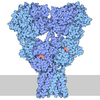
- Assembly
| Deposited unit | 
|
|---|---|
| 1 |
|
-Components
| #1: Protein | Mass: 95225.883 Da / Num. of mol.: 2 Source method: isolated from a genetically manipulated source Source: (gene. exp.) Rattus norvegicus (Norway rat) / Gene: Grin1, Nmdar1 / Production host:   Spodoptera frugiperda (fall armyworm) / References: UniProt: P35439 Spodoptera frugiperda (fall armyworm) / References: UniProt: P35439#2: Protein | Mass: 96498.977 Da / Num. of mol.: 2 Source method: isolated from a genetically manipulated source Source: (gene. exp.) Rattus norvegicus (Norway rat) / Gene: Grin2b / Production host: Spodoptera frugiperda (fall armyworm) / References: UniProt: Q00960#3: Chemical | ChemComp-CA / |   Mass: 40.078 Da / Num. of mol.: 1 / Source method: obtained synthetically / Formula: Ca Mass: 40.078 Da / Num. of mol.: 1 / Source method: obtained synthetically / Formula: Ca#4: Water | ChemComp-HOH / |  Mass: 18.015 Da / Num. of mol.: 9 / Source method: isolated from a natural source / Formula: H2O Mass: 18.015 Da / Num. of mol.: 9 / Source method: isolated from a natural source / Formula: H2OHas ligand of interest | N | Has protein modification | N | |
|---|
-Experimental details
-Experiment
| Experiment | Method: ELECTRON MICROSCOPY |
|---|---|
| EM experiment | Aggregation state: CELL / 3D reconstruction method: single particle reconstruction |
- Sample preparation
| Component | Name: Di-heteromeric GluN1a-2B NMDA receptor / Type: CELL / Entity ID: #1-#2 / Source: NATURAL |
|---|---|
| Source (natural) | Organism: Rattus norvegicus (Norway rat) |
| Buffer solution | pH: 7.5 |
| Specimen | Embedding applied: NO / Shadowing applied: NO / Staining applied: NO / Vitrification applied: YES |
| Vitrification | Cryogen name: ETHANE |
- Electron microscopy imaging
| Experimental equipment |  Model: Titan Krios / Image courtesy: FEI Company |
|---|---|
| Microscopy | Model: TFS KRIOS |
| Electron gun | Electron source:  FIELD EMISSION GUN / Accelerating voltage: 300 kV / Illumination mode: FLOOD BEAM FIELD EMISSION GUN / Accelerating voltage: 300 kV / Illumination mode: FLOOD BEAM |
| Electron lens | Mode: BRIGHT FIELD / Nominal defocus max: 2200 nm / Nominal defocus min: 600 nm |
| Image recording | Electron dose: 58.4 e/Å2 / Film or detector model: GATAN K3 BIOQUANTUM (6k x 4k) |
- Processing
| EM software |
| ||||||||||||||||
|---|---|---|---|---|---|---|---|---|---|---|---|---|---|---|---|---|---|
| CTF correction | Type: PHASE FLIPPING AND AMPLITUDE CORRECTION | ||||||||||||||||
| Symmetry | Point symmetry: C1 (asymmetric) | ||||||||||||||||
| 3D reconstruction | Resolution: 3.6 Å / Resolution method: FSC 0.143 CUT-OFF / Num. of particles: 55995 / Symmetry type: POINT | ||||||||||||||||
| Refinement | Highest resolution: 3.6 Å Stereochemistry target values: REAL-SPACE (WEIGHTED MAP SUM AT ATOM CENTERS) |
