Movie
Movie Controller


+ Open data

- Basic information
| Entry | Database: PDB / ID: 9o1n | ||||||||||||||||||||||||||||||
|---|---|---|---|---|---|---|---|---|---|---|---|---|---|---|---|---|---|---|---|---|---|---|---|---|---|---|---|---|---|---|---|
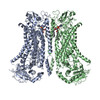
| Title | TMEM16F in liposomes in the presence of Ca2+ (active state) | ||||||||||||||||||||||||||||||
 Components Components | Anoctamin-6 | ||||||||||||||||||||||||||||||
 Keywords Keywords | LIPID TRANSPORT / membrane protein / lipid scramblase / TMEM16 / liposome | ||||||||||||||||||||||||||||||
| Function / homology |  Function and homology information Function and homology informationcalcium activated galactosylceramide scrambling / phosphatidylserine exposure on blood platelet / calcium activated phosphatidylserine scrambling / calcium activated phosphatidylcholine scrambling / positive regulation of potassium ion export across plasma membrane / positive regulation of monoatomic ion transmembrane transport / plasma membrane phospholipid scrambling / calcium activated phospholipid scrambling / activation of blood coagulation via clotting cascade / purinergic nucleotide receptor signaling pathway ...calcium activated galactosylceramide scrambling / phosphatidylserine exposure on blood platelet / calcium activated phosphatidylserine scrambling / calcium activated phosphatidylcholine scrambling / positive regulation of potassium ion export across plasma membrane / positive regulation of monoatomic ion transmembrane transport / plasma membrane phospholipid scrambling / calcium activated phospholipid scrambling / activation of blood coagulation via clotting cascade / purinergic nucleotide receptor signaling pathway / bone mineralization involved in bone maturation / phospholipid scramblase activity / cholinergic synapse / intracellularly calcium-gated chloride channel activity / bleb assembly / pore complex assembly / negative regulation of cell volume / voltage-gated monoatomic ion channel activity / positive regulation of phagocytosis, engulfment / Stimuli-sensing channels / voltage-gated chloride channel activity / positive regulation of monocyte chemotaxis / calcium-activated cation channel activity / phospholipid translocation / chloride transport / dendritic cell chemotaxis / positive regulation of bone mineralization / regulation of postsynaptic membrane potential / positive regulation of endothelial cell apoptotic process / chloride channel complex / Neutrophil degranulation / chloride transmembrane transport / synaptic membrane / sodium ion transmembrane transport / blood coagulation / calcium ion transmembrane transport / positive regulation of apoptotic process / protein homodimerization activity / metal ion binding / identical protein binding / plasma membrane / cytosol Similarity search - Function | ||||||||||||||||||||||||||||||
| Biological species |   Mus musculus (house mouse) Mus musculus (house mouse) | ||||||||||||||||||||||||||||||
| Method | ELECTRON MICROSCOPY / single particle reconstruction / cryo EM / Resolution: 3.56 Å | ||||||||||||||||||||||||||||||
 Authors Authors | Feng, Z. / Accardi, A. | ||||||||||||||||||||||||||||||
| Funding support |  United States, 1items United States, 1items
| ||||||||||||||||||||||||||||||
 Citation Citation | Journal: Nat Struct Mol Biol / Year: 2026 Title: Calcium dependent activation of the TMEM16F scramblase and ion channel. Authors: Zhang Feng / Omar E Alvarenga / Eleonora Di Zanni / Sangyun Lee / George Khelashvili / Alessio Accardi / Abstract: The ubiquitous transmembrane protein 16F (TMEM16F) Ca-activated channel and scramblase catalyzes phosphatidylserine externalization to enable blood coagulation, membrane fusion and brain immune ...The ubiquitous transmembrane protein 16F (TMEM16F) Ca-activated channel and scramblase catalyzes phosphatidylserine externalization to enable blood coagulation, membrane fusion and brain immune surveillance. Despite its importance, the molecular mechanisms underlying TMEM16F activation remain poorly understood. Here, we obtained high-resolution cryo-electron microscopy structures of TMEM16F active in liposomes. In high-activity conditions, TMEM16F adopts two conformations, the canonical Ca-bound closed state and one where the upward rotation of the cytosolic domain leads to an X-shaped groove that forms a transmembrane pore and locally thins the membrane. Using mutagenesis, functional assays and molecular dynamics simulations, we show that the X-shaped groove is active and mediates nonselective ion flux and lipid scrambling through distinct pathways; ions move within the protein-delimited pore, whereas lipids skirt the X-shaped groove. Our findings provide a complete picture of TMEM16F Ca-dependent gating and demonstrate that imaging membrane proteins in a native-like environment can allow capturing otherwise inaccessible active states. | ||||||||||||||||||||||||||||||
| History |
|
- Structure visualization
| Structure viewer | Molecule: MolmilJmol/JSmol |
|---|
- Downloads & links
-Download
| PDBx/mmCIF format | 9o1n.cif.gz | 283.5 KB | Display | PDBx/mmCIF format |
|---|---|---|---|---|
| PDB format | pdb9o1n.ent.gz | 224.4 KB | Display | PDB format |
| PDBx/mmJSON format | 9o1n.json.gz | Tree view | PDBx/mmJSON format | |
| Others |  Other downloads Other downloads |
-Validation report
| Arichive directory | https://data.pdbj.org/pub/pdb/validation_reports/o1/9o1nftp://data.pdbj.org/pub/pdb/validation_reports/o1/9o1n | HTTPS FTP |
|---|
-Related structure data
| Related structure data |  70013MC  9o1iC  9o1lC  9o1mC  9o1oC  9o1pC  9o1qC M: map data used to model this data C: citing same article ( |
|---|---|
| Similar structure data |


-Links
 PDBj
PDBj
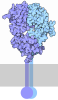
- Assembly
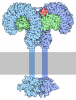
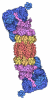
| Deposited unit | 
|
|---|---|
| 1 |
|
-Components
| #1: Protein | Mass: 106367.727 Da / Num. of mol.: 2 Source method: isolated from a genetically manipulated source Source: (gene. exp.) Mus musculus (house mouse) / Gene: Ano6, Tmem16f / Production host:  Homo sapiens (human) / References: UniProt: Q6P9J9 Homo sapiens (human) / References: UniProt: Q6P9J9#2: Chemical | ChemComp-CA /   Mass: 40.078 Da / Num. of mol.: 6 / Source method: obtained synthetically / Formula: Ca Mass: 40.078 Da / Num. of mol.: 6 / Source method: obtained synthetically / Formula: CaHas ligand of interest | N | Has protein modification | Y | |
|---|
-Experimental details
-Experiment
| Experiment | Method: ELECTRON MICROSCOPY |
|---|---|
| EM experiment | Aggregation state: PARTICLE / 3D reconstruction method: single particle reconstruction |
- Sample preparation
| Component | Name: Dimeric lipid scramblase and ion channel mTMEM16F / Type: COMPLEX / Entity ID: #1 / Source: RECOMBINANT | ||||||||||||||||||||
|---|---|---|---|---|---|---|---|---|---|---|---|---|---|---|---|---|---|---|---|---|---|
| Molecular weight | Value: 0.21 MDa / Experimental value: NO | ||||||||||||||||||||
| Source (natural) | Organism: Mus musculus (house mouse) | ||||||||||||||||||||
| Source (recombinant) | Organism: Homo sapiens (human) | ||||||||||||||||||||
| Buffer solution | pH: 7.4 | ||||||||||||||||||||
| Buffer component |
| ||||||||||||||||||||
| Specimen | Embedding applied: NO / Shadowing applied: NO / Staining applied: NO / Vitrification applied: YES | ||||||||||||||||||||
| Specimen support | Grid material: GOLD / Grid mesh size: 300 divisions/in. / Grid type: Quantifoil R1.2/1.3 | ||||||||||||||||||||
| Vitrification | Instrument: FEI VITROBOT MARK IV / Cryogen name: ETHANE / Humidity: 100 % / Chamber temperature: 295 K |
- Electron microscopy imaging
| Experimental equipment |  Model: Titan Krios / Image courtesy: FEI Company |
|---|---|
| Microscopy | Model: TFS KRIOS |
| Electron gun | Electron source:  FIELD EMISSION GUN / Accelerating voltage: 300 kV / Illumination mode: OTHER FIELD EMISSION GUN / Accelerating voltage: 300 kV / Illumination mode: OTHER |
| Electron lens | Mode: OTHER / Nominal defocus max: 2800 nm / Nominal defocus min: 800 nm |
| Image recording | Electron dose: 50.02 e/Å2 / Film or detector model: GATAN K3 (6k x 4k) |
| EM imaging optics | Energyfilter name: GIF Bioquantum / Energyfilter slit width: 15 eV |
- Processing
| EM software | Name: PHENIX / Version: 1.20.1_4487: / Category: model refinement | ||||||||||||||||||||||||
|---|---|---|---|---|---|---|---|---|---|---|---|---|---|---|---|---|---|---|---|---|---|---|---|---|---|
| CTF correction | Type: PHASE FLIPPING AND AMPLITUDE CORRECTION | ||||||||||||||||||||||||
| Particle selection | Num. of particles selected: 4330881 | ||||||||||||||||||||||||
| 3D reconstruction | Resolution: 3.56 Å / Resolution method: FSC 0.143 CUT-OFF / Num. of particles: 120777 / Symmetry type: POINT | ||||||||||||||||||||||||
| Atomic model building | Protocol: AB INITIO MODEL | ||||||||||||||||||||||||
| Atomic model building | PDB-ID: 6QP6 Accession code: 6QP6 / Source name: PDB / Type: experimental model | ||||||||||||||||||||||||
| Refine LS restraints |
|