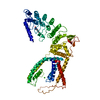
Movie
Movie Controller

[English] 日本語
 Yorodumi
- PDB-9nvr: Structure of Nanchung-Inactive-Calmodulin in complex with Afidopy... -
+ Open data

- Basic information
| Entry | Database: PDB / ID: 9nvr | |||||||||||||||||||||
|---|---|---|---|---|---|---|---|---|---|---|---|---|---|---|---|---|---|---|---|---|---|---|
| Title | Structure of Nanchung-Inactive-Calmodulin in complex with Afidopyropen, EDTA | |||||||||||||||||||||
 Components Components |
| |||||||||||||||||||||
 Keywords Keywords | TRANSPORT PROTEIN / Membrane protein / membrane channel | |||||||||||||||||||||
| Function / homology |  Function and homology information Function and homology informationCaM pathway / Cam-PDE 1 activation / Sodium/Calcium exchangers / Calmodulin induced events / Reduction of cytosolic Ca++ levels / Activation of Ca-permeable Kainate Receptor / CREB1 phosphorylation through the activation of CaMKII/CaMKK/CaMKIV cascasde / Loss of phosphorylation of MECP2 at T308 / CREB1 phosphorylation through the activation of Adenylate Cyclase / PKA activation ...CaM pathway / Cam-PDE 1 activation / Sodium/Calcium exchangers / Calmodulin induced events / Reduction of cytosolic Ca++ levels / Activation of Ca-permeable Kainate Receptor / CREB1 phosphorylation through the activation of CaMKII/CaMKK/CaMKIV cascasde / Loss of phosphorylation of MECP2 at T308 / CREB1 phosphorylation through the activation of Adenylate Cyclase / PKA activation / CaMK IV-mediated phosphorylation of CREB / CASP4 inflammasome assembly / Glycogen breakdown (glycogenolysis) / negative regulation of ryanodine-sensitive calcium-release channel activity / Activation of RAC1 downstream of NMDARs / organelle localization by membrane tethering / CLEC7A (Dectin-1) induces NFAT activation / : / negative regulation of high voltage-gated calcium channel activity / autophagosome membrane docking / negative regulation of calcium ion export across plasma membrane / regulation of cardiac muscle cell action potential / presynaptic endocytosis / Synthesis of IP3 and IP4 in the cytosol / Phase 0 - rapid depolarisation / Negative regulation of NMDA receptor-mediated neuronal transmission / Unblocking of NMDA receptors, glutamate binding and activation / calcineurin-mediated signaling / RHO GTPases activate PAKs / regulation of cell communication by electrical coupling involved in cardiac conduction / calcium ion import across plasma membrane / Uptake and function of anthrax toxins / Ion transport by P-type ATPases / protein phosphatase activator activity / Long-term potentiation / Calcineurin activates NFAT / regulation of ryanodine-sensitive calcium-release channel activity / DARPP-32 events / Regulation of MECP2 expression and activity / Smooth Muscle Contraction / detection of calcium ion / regulation of cardiac muscle contraction / cellular response to interferon-beta / presynaptic cytosol / RHO GTPases activate IQGAPs / calcium channel inhibitor activity / catalytic complex / eNOS activation / regulation of release of sequestered calcium ion into cytosol by sarcoplasmic reticulum / Tetrahydrobiopterin (BH4) synthesis, recycling, salvage and regulation / Activation of AMPK downstream of NMDARs / regulation of heart rate / Ion homeostasis / Protein methylation / titin binding / regulation of cardiac muscle contraction by regulation of the release of sequestered calcium ion / voltage-gated potassium channel complex / FCERI mediated Ca+2 mobilization / calcium channel complex / substantia nigra development / FCGR3A-mediated IL10 synthesis / sperm midpiece / protein serine/threonine kinase activator activity / Antigen activates B Cell Receptor (BCR) leading to generation of second messengers / calyx of Held / positive regulation of receptor signaling pathway via JAK-STAT / Ras activation upon Ca2+ influx through NMDA receptor / adenylate cyclase activator activity / regulation of cytokinesis / VEGFR2 mediated cell proliferation / spindle microtubule / VEGFR2 mediated vascular permeability / sarcomere / calcium channel regulator activity / Translocation of SLC2A4 (GLUT4) to the plasma membrane / Transcriptional activation of mitochondrial biogenesis / cellular response to type II interferon / long-term synaptic potentiation / Enterobacterial factors antagonize host defense / response to calcium ion / RAF activation / calcium channel activity / Stimuli-sensing channels / calcium-dependent protein binding / Signaling by RAF1 mutants / Signaling by moderate kinase activity BRAF mutants / Paradoxical activation of RAF signaling by kinase inactive BRAF / Signaling downstream of RAS mutants / RAS processing / Signaling by BRAF and RAF1 fusions / Platelet degranulation / myelin sheath / Inactivation, recovery and regulation of the phototransduction cascade / spindle pole / RAF/MAP kinase cascade / Ca2+ pathway / High laminar flow shear stress activates signaling by PIEZO1 and PECAM1:CDH5:KDR in endothelial cells / vesicle / transmembrane transporter binding / Extra-nuclear estrogen signaling Similarity search - Function | |||||||||||||||||||||
| Biological species |  Halyomorpha halys (brown marmorated stink bug) Halyomorpha halys (brown marmorated stink bug) Homo sapiens (human) Homo sapiens (human) | |||||||||||||||||||||
| Method | ELECTRON MICROSCOPY / single particle reconstruction / cryo EM / Resolution: 3.13 Å | |||||||||||||||||||||
 Authors Authors | Fedor, J.G. / Lee, S.-Y. | |||||||||||||||||||||
| Funding support |  United States, 1items United States, 1items
| |||||||||||||||||||||
 Citation Citation | Journal: Nat Commun / Year: 2025 Title: Visualizing insecticide control of insect TRP channel function and assembly. Authors: Justin G Fedor / Ramani Kandasamy / Cheon-Gyu Park / Yang Suo / Martin Weisel / Nancy B Rankl / Alexandre Nesterov / Seok-Yong Lee /  Abstract: Insecticides are vital to combating world food shortages and transmission of vector-borne human diseases. Increasing insecticide resistance necessitates discovery of novel compounds against ...Insecticides are vital to combating world food shortages and transmission of vector-borne human diseases. Increasing insecticide resistance necessitates discovery of novel compounds against underutilized targets. Nanchung (Nan) and Inactive (Iav), the transient receptor potential vanilloid-type (TRPV) channels in insects, likely form a heteromeric channel (Nan-Iav) and are localized in mechanosensory chordotonal organs which confer gravitaxis, hearing and proprioception. Several insecticides, such as afidopyropen (AP), target Nan-Iav through unknown mechanisms. Effective against piercing-sucking (hemipteran) insects, AP disrupts chordotonal functions preventing feeding. AP can bind to Nan alone, but only Nan-Iav exhibits channel activity with agonists including endogenous nicotinamide (NAM). Despite its importance as an insecticide target, much is unknown about Nan-Iav, such as channel assembly, modulator binding sites, and Ca-dependent regulation, hampering further insecticide development. Here we present the cryo-electron microscopy structures of hemipteran Nan-Iav with calmodulin bound in the apo state and with AP and NAM bound to cytosolic ankyrin repeat domain (ARD) interfaces. Unexpectedly, we found that Nan alone can form a pentamer, stabilized through AP-mediated ARD interactions. Our study provides molecular insights into insecticide and agonist interactions with Nan-Iav, highlighting the importance of the ARD on channel function and assembly, while also probing regulation by Ca. | |||||||||||||||||||||
| History |
|
- Structure visualization
| Structure viewer | Molecule: MolmilJmol/JSmol |
|---|
- Downloads & links
-Download
| PDBx/mmCIF format | 9nvr.cif.gz | 1 MB | Display | PDBx/mmCIF format |
|---|---|---|---|---|
| PDB format | pdb9nvr.ent.gz | Display | PDB format | |
| PDBx/mmJSON format | 9nvr.json.gz | Tree view | PDBx/mmJSON format | |
| Others |  Other downloads Other downloads |
-Validation report
| Arichive directory | https://data.pdbj.org/pub/pdb/validation_reports/nv/9nvrftp://data.pdbj.org/pub/pdb/validation_reports/nv/9nvr | HTTPS FTP |
|---|
-Related structure data
| Related structure data |  49848MC  9nvnC  9nvoC  9nvpC  9nvqC 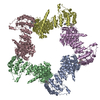 9nvsC M: map data used to model this data C: citing same article ( |
|---|---|
| Similar structure data |


-Links
 PDBj
PDBj
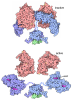

- Assembly
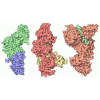
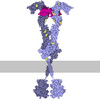
| Deposited unit | 
|
|---|---|
| 1 |
|
-Components
-Protein , 3 types, 6 molecules BDEFAC
| #1: Protein | Mass: 109381.992 Da / Num. of mol.: 2 Source method: isolated from a genetically manipulated source Details: The 30-N-terminal residues are MGIIWGSGASSVNAGTVLDRVISQASNKDE. The authors were not able to assign the register of the residues in this region Source: (gene. exp.) Halyomorpha halys (brown marmorated stink bug)Gene: NEZAVI_LOCUS11040, NEZAVI_LOCUS11038 / Production host: Homo sapiens (human) / References: UniProt: A0A9P0MRC5, UniProt: A0A9P0HI19#2: Protein | Mass: 16852.545 Da / Num. of mol.: 2 Source method: isolated from a genetically manipulated source Source: (gene. exp.) Homo sapiens (human) / Gene: CALM1, CALM, CAM, CAM1 / Production host: Homo sapiens (human) / References: UniProt: P0DP23#3: Protein | Mass: 101194.867 Da / Num. of mol.: 2 Source method: isolated from a genetically manipulated source Source: (gene. exp.) Halyomorpha halys (brown marmorated stink bug)Production host: Homo sapiens (human) |
|---|
-Non-polymers , 4 types, 14 molecules 
| #4: Chemical | ChemComp-6OU / [(  Mass: 717.996 Da / Num. of mol.: 8 / Source method: obtained synthetically / Formula: C39H76NO8P / Comment: phospholipid*YM Mass: 717.996 Da / Num. of mol.: 8 / Source method: obtained synthetically / Formula: C39H76NO8P / Comment: phospholipid*YM#5: Chemical |  Mass: 760.076 Da / Num. of mol.: 2 / Source method: obtained synthetically / Formula: C42H82NO8P / Comment: phospholipid*YM Mass: 760.076 Da / Num. of mol.: 2 / Source method: obtained synthetically / Formula: C42H82NO8P / Comment: phospholipid*YM#6: Chemical | Mass: 593.664 Da / Num. of mol.: 2 / Source method: obtained synthetically / Formula: C33H39NO9 #7: Chemical |  Mass: 762.006 Da / Num. of mol.: 2 / Source method: obtained synthetically / Formula: C40H76NO10P Mass: 762.006 Da / Num. of mol.: 2 / Source method: obtained synthetically / Formula: C40H76NO10P |
|---|
-Details
| Has ligand of interest | Y |
|---|---|
| Has protein modification | Y |
-Experimental details
-Experiment
| Experiment | Method: ELECTRON MICROSCOPY |
|---|---|
| EM experiment | Aggregation state: PARTICLE / 3D reconstruction method: single particle reconstruction |
- Sample preparation
| Component | Name: Nanchung-Inactive-Calmodulin / Type: COMPLEX / Entity ID: #2 / Source: RECOMBINANT | |||||||||||||||||||||||||||||||||||
|---|---|---|---|---|---|---|---|---|---|---|---|---|---|---|---|---|---|---|---|---|---|---|---|---|---|---|---|---|---|---|---|---|---|---|---|---|
| Molecular weight | Value: 0.7 MDa / Experimental value: NO | |||||||||||||||||||||||||||||||||||
| Source (natural) | Organism: Homo sapiens (human) | |||||||||||||||||||||||||||||||||||
| Source (recombinant) | Organism: Homo sapiens (human) | |||||||||||||||||||||||||||||||||||
| Buffer solution | pH: 8 | |||||||||||||||||||||||||||||||||||
| Buffer component |
| |||||||||||||||||||||||||||||||||||
| Specimen | Conc.: 2.3 mg/ml / Embedding applied: NO / Shadowing applied: NO / Staining applied: NO / Vitrification applied: YES / Details: Monodisperse sample | |||||||||||||||||||||||||||||||||||
| Specimen support | Grid material: COPPER / Grid mesh size: 300 divisions/in. / Grid type: Quantifoil R1.2/1.3 | |||||||||||||||||||||||||||||||||||
| Vitrification | Instrument: FEI VITROBOT MARK IV / Cryogen name: ETHANE / Humidity: 100 % / Chamber temperature: 280 K |
- Electron microscopy imaging
| Experimental equipment |  Model: Titan Krios / Image courtesy: FEI Company |
|---|---|
| Microscopy | Model: TFS KRIOS |
| Electron gun | Electron source:  FIELD EMISSION GUN / Accelerating voltage: 300 kV / Illumination mode: FLOOD BEAM FIELD EMISSION GUN / Accelerating voltage: 300 kV / Illumination mode: FLOOD BEAM |
| Electron lens | Mode: BRIGHT FIELD / Nominal magnification: 81000 X / Nominal defocus max: 2200 nm / Nominal defocus min: 1000 nm / Cs: 2.7 mm / C2 aperture diameter: 100 µm / Alignment procedure: COMA FREE |
| Specimen holder | Cryogen: NITROGEN / Specimen holder model: FEI TITAN KRIOS AUTOGRID HOLDER / Temperature (max): 70 K |
| Image recording | Average exposure time: 2.4 sec. / Electron dose: 60 e/Å2 / Film or detector model: GATAN K3 (6k x 4k) / Num. of grids imaged: 1 / Num. of real images: 7211 |
| EM imaging optics | Energyfilter name: GIF Bioquantum / Energyfilter slit width: 20 eV |
| Image scans | Width: 5760 / Height: 4092 |
- Processing
| EM software |
| ||||||||||||||||||||||||||||||||||||
|---|---|---|---|---|---|---|---|---|---|---|---|---|---|---|---|---|---|---|---|---|---|---|---|---|---|---|---|---|---|---|---|---|---|---|---|---|---|
| CTF correction | Type: PHASE FLIPPING AND AMPLITUDE CORRECTION | ||||||||||||||||||||||||||||||||||||
| Particle selection | Num. of particles selected: 798366 | ||||||||||||||||||||||||||||||||||||
| Symmetry | Point symmetry: C2 (2 fold cyclic) | ||||||||||||||||||||||||||||||||||||
| 3D reconstruction | Resolution: 3.13 Å / Resolution method: FSC 0.143 CUT-OFF / Num. of particles: 58231 / Algorithm: FOURIER SPACE / Num. of class averages: 1 / Symmetry type: POINT | ||||||||||||||||||||||||||||||||||||
| Atomic model building | B value: 80 / Protocol: FLEXIBLE FIT / Space: REAL | ||||||||||||||||||||||||||||||||||||
| Atomic model building | PDB-ID: 5wo7 Pdb chain-ID: A / Accession code: 5wo7 / Source name: PDB / Type: experimental model | ||||||||||||||||||||||||||||||||||||
| Refinement | Highest resolution: 3.13 Å Stereochemistry target values: REAL-SPACE (WEIGHTED MAP SUM AT ATOM CENTERS) | ||||||||||||||||||||||||||||||||||||
| Refine LS restraints |
|