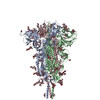
Movie
Movie Controller


+ Open data

- Basic information
| Entry | Database: PDB / ID: 9mr2 | ||||||
|---|---|---|---|---|---|---|---|
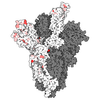
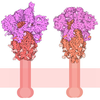
| Title | SARS-CoV-2 S2 monomer in complex with NICA01A-1401 Fab | ||||||
 Components Components |
| ||||||
 Keywords Keywords | VIRUS / SARS-CoV-2 / Spike / S2 / COVID / monoclonal antibody / complex / Viral protein / Viral protein-immune system complex | ||||||
| Function / homology |  Function and homology information Function and homology informationsymbiont-mediated disruption of host tissue / Maturation of spike protein / host cell surface / Translation of Structural Proteins / Virion Assembly and Release / Lectin pathway of complement activation / host extracellular region / symbiont-mediated-mediated suppression of host tetherin activity / structural constituent of virion / Induction of Cell-Cell Fusion ...symbiont-mediated disruption of host tissue / Maturation of spike protein / host cell surface / Translation of Structural Proteins / Virion Assembly and Release / Lectin pathway of complement activation / host extracellular region / symbiont-mediated-mediated suppression of host tetherin activity / structural constituent of virion / Induction of Cell-Cell Fusion / positive regulation of viral entry into host cell / Initial triggering of complement / membrane fusion / host cell endoplasmic reticulum-Golgi intermediate compartment membrane / Attachment and Entry / entry receptor-mediated virion attachment to host cell / receptor-mediated virion attachment to host cell / host cell surface receptor binding / symbiont-mediated suppression of host innate immune response / endocytosis involved in viral entry into host cell / receptor ligand activity / fusion of virus membrane with host plasma membrane / fusion of virus membrane with host endosome membrane / viral envelope / symbiont entry into host cell / virion attachment to host cell / host cell plasma membrane / SARS-CoV-2 activates/modulates innate and adaptive immune responses / virion membrane / membrane / identical protein binding / plasma membrane Similarity search - Function | ||||||
| Biological species |  Homo sapiens (human) Homo sapiens (human)  Severe acute respiratory syndrome coronavirus 2 Severe acute respiratory syndrome coronavirus 2 | ||||||
| Method | ELECTRON MICROSCOPY / single particle reconstruction / cryo EM / Resolution: 3.79 Å | ||||||
 Authors Authors | Park, S. / Bangaru, B. / Ward, A.B. | ||||||
| Funding support |  United States, 1items United States, 1items
| ||||||
 Citation Citation | Journal: J Exp Med / Year: 2025 Title: Common cold embecovirus imprinting primes broadly neutralizing antibody responses to SARS-CoV-2 S2. Authors: Siriruk Changrob / Atsuhiro Yasuhara / Suncheol Park / Sandhya Bangaru / Lei Li / Chloe A Troxell / Peter J Halfmann / Steven A Erickson / Nicholas J Catanzaro / Meng Yuan / Panpan Zhou / ...Authors: Siriruk Changrob / Atsuhiro Yasuhara / Suncheol Park / Sandhya Bangaru / Lei Li / Chloe A Troxell / Peter J Halfmann / Steven A Erickson / Nicholas J Catanzaro / Meng Yuan / Panpan Zhou / Min Huang / G Dewey Wilbanks / Joshua J C McGrath / Gagandeep Singh / Sean A Nelson / Yanbin Fu / Nai-Ying Zheng / Sofia M Carayannopoulos / Haley L Dugan / Dustin G Shaw / Christopher T Stamper / Maria Lucia L Madariaga / Florian Krammer / Raiees Andrabi / Dennis R Burton / Andrew B Ward / Ian A Wilson / Yoshihiro Kawaoka / Patrick C Wilson /   Abstract: The S2 subunit of the severe acute respiratory syndrome coronavirus 2 (SARS-CoV-2) spike is highly conserved across coronavirus strains and therefore is a potential pan-coronavirus vaccine target. ...The S2 subunit of the severe acute respiratory syndrome coronavirus 2 (SARS-CoV-2) spike is highly conserved across coronavirus strains and therefore is a potential pan-coronavirus vaccine target. However, antibodies targeting this region are typically non-neutralizing. We report herein that S2-targeting antibodies from patients who recovered from SARS-CoV-2 infection bound only closely related sarbecovirus subgenus strains and, like most known S2 antibodies, none of these were neutralizing. In contrast, first-exposure, severe acutely infected COVID-19 patients predominantly induced back-boosted antibody-secreting cells imprinted against past common cold coronavirus strain OC43 that were cross-reactive to as many as five subgenera of betacoronavirus strains and gave rise to antibodies that were neutralizing and protective. The antibodies targeted two different sites: one defined by competition with stem helix antibodies, and the second to an underdescribed epitope at the apex of S2. These findings suggest that S2-targeted vaccines could strategically exploit controlled OC43 priming followed by SARS-CoV-2 boosting to enhance the breadth and quality of protective antibody responses. | ||||||
| History |
|
- Structure visualization
| Structure viewer | Molecule: MolmilJmol/JSmol |
|---|
- Downloads & links
-Download
| PDBx/mmCIF format | 9mr2.cif.gz | 103.5 KB | Display | PDBx/mmCIF format |
|---|---|---|---|---|
| PDB format | pdb9mr2.ent.gz | 61.6 KB | Display | PDB format |
| PDBx/mmJSON format | 9mr2.json.gz | Tree view | PDBx/mmJSON format | |
| Others |  Other downloads Other downloads |
-Validation report
| Arichive directory | https://data.pdbj.org/pub/pdb/validation_reports/mr/9mr2ftp://data.pdbj.org/pub/pdb/validation_reports/mr/9mr2 | HTTPS FTP |
|---|
-Related structure data
| Related structure data |  48550MC  9mr1C M: map data used to model this data C: citing same article ( |
|---|---|
| Similar structure data |


-Links
 PDBj
PDBj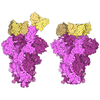
- Assembly
| Deposited unit | 
|
|---|---|
| 1 |
|
-Components
| #1: Antibody | Mass: 13621.221 Da / Num. of mol.: 1 Source method: isolated from a genetically manipulated source Source: (gene. exp.) Homo sapiens (human) / Cell line (production host): HEK293F / Production host: Homo sapiens (human) |
|---|---|
| #2: Antibody | Mass: 11453.561 Da / Num. of mol.: 1 Source method: isolated from a genetically manipulated source Source: (gene. exp.) Homo sapiens (human) / Cell line (production host): HEK293F / Production host: Homo sapiens (human) |
| #3: Protein | Mass: 52069.832 Da / Num. of mol.: 1 Mutation: F817P, G880C, F888C, A892P, A899P, A942P, T912P, K986P, V987P, T1117C, D1139C Source method: isolated from a genetically manipulated source Source: (gene. exp.) Severe acute respiratory syndrome coronavirus 2Gene: S, 2 / Cell line (production host): HEK293F / Production host: Homo sapiens (human) / References: UniProt: P0DTC2 |
| Has protein modification | Y |
-Experimental details
-Experiment
| Experiment | Method: ELECTRON MICROSCOPY |
|---|---|
| EM experiment | Aggregation state: PARTICLE / 3D reconstruction method: single particle reconstruction |
- Sample preparation
| Component | Name: Structure of SARS-CoV-2 S2 monomer in complex with NICA01A-1401 Fab Type: COMPLEX / Entity ID: all / Source: RECOMBINANT | |||||||||||||||
|---|---|---|---|---|---|---|---|---|---|---|---|---|---|---|---|---|
| Molecular weight | Experimental value: NO | |||||||||||||||
| Source (natural) | Organism: Homo sapiens (human) | |||||||||||||||
| Source (recombinant) | Organism: Homo sapiens (human) | |||||||||||||||
| Buffer solution | pH: 8 | |||||||||||||||
| Buffer component |
| |||||||||||||||
| Specimen | Conc.: 1 mg/ml / Embedding applied: NO / Shadowing applied: NO / Staining applied: NO / Vitrification applied: YES | |||||||||||||||
| Specimen support | Grid material: GOLD / Grid mesh size: 300 divisions/in. / Grid type: UltrAuFoil R1.2/1.3 | |||||||||||||||
| Vitrification | Instrument: FEI VITROBOT MARK IV / Cryogen name: ETHANE / Humidity: 100 % / Chamber temperature: 277 K |
- Electron microscopy imaging
| Microscopy | Model: TFS GLACIOS |
|---|---|
| Electron gun | Electron source:  FIELD EMISSION GUN / Accelerating voltage: 200 kV / Illumination mode: FLOOD BEAM FIELD EMISSION GUN / Accelerating voltage: 200 kV / Illumination mode: FLOOD BEAM |
| Electron lens | Mode: BRIGHT FIELD / Nominal magnification: 190000 X / Nominal defocus max: 1800 nm / Nominal defocus min: 800 nm / Cs: 2.7 mm / Alignment procedure: COMA FREE |
| Specimen holder | Cryogen: NITROGEN / Specimen holder model: FEI TITAN KRIOS AUTOGRID HOLDER |
| Image recording | Electron dose: 45 e/Å2 / Film or detector model: FEI FALCON IV (4k x 4k) |
- Processing
| EM software |
| |||||||||||||||||||||||||||||||||
|---|---|---|---|---|---|---|---|---|---|---|---|---|---|---|---|---|---|---|---|---|---|---|---|---|---|---|---|---|---|---|---|---|---|---|
| CTF correction | Type: PHASE FLIPPING AND AMPLITUDE CORRECTION | |||||||||||||||||||||||||||||||||
| Symmetry | Point symmetry: C1 (asymmetric) | |||||||||||||||||||||||||||||||||
| 3D reconstruction | Resolution: 3.79 Å / Resolution method: FSC 0.143 CUT-OFF / Num. of particles: 115033 / Symmetry type: POINT | |||||||||||||||||||||||||||||||||
| Atomic model building | Space: REAL | |||||||||||||||||||||||||||||||||
| Atomic model building | PDB-ID: 6XR8 Accession code: 6XR8 / Source name: PDB / Type: experimental model | |||||||||||||||||||||||||||||||||
| Refinement | Cross valid method: NONE Stereochemistry target values: GeoStd + Monomer Library + CDL v1.2 | |||||||||||||||||||||||||||||||||
| Displacement parameters | Biso mean: 51.68 Å2 | |||||||||||||||||||||||||||||||||
| Refine LS restraints |
|