 Movie
Movie Controller

[English] 日本語
 Yorodumi
- PDB-9m2w: The cryo-EM structure of 26S proteasome-Midnolin complex in the M... -
+ Open data

- Basic information
| Entry | Database: PDB / ID: 9m2w | |||||||||||||||||||||
|---|---|---|---|---|---|---|---|---|---|---|---|---|---|---|---|---|---|---|---|---|---|---|
| Title | The cryo-EM structure of 26S proteasome-Midnolin complex in the MD state | |||||||||||||||||||||
 Components Components |
| |||||||||||||||||||||
 Keywords Keywords | HYDROLASE / midnolin / 26S proteasome / complex / MD state | |||||||||||||||||||||
| Function / homology |  Function and homology information Function and homology informationnegative regulation of glucokinase activity / positive regulation of inclusion body assembly / thyrotropin-releasing hormone receptor binding / nuclear proteasome complex / host-mediated perturbation of viral transcription / Impaired BRCA2 translocation to the nucleus / Impaired BRCA2 binding to SEM1 (DSS1) / proteasome accessory complex / purine ribonucleoside triphosphate binding / integrator complex ...negative regulation of glucokinase activity / positive regulation of inclusion body assembly / thyrotropin-releasing hormone receptor binding / nuclear proteasome complex / host-mediated perturbation of viral transcription / Impaired BRCA2 translocation to the nucleus / Impaired BRCA2 binding to SEM1 (DSS1) / proteasome accessory complex / purine ribonucleoside triphosphate binding / integrator complex / proteasome regulatory particle / CD8-positive, alpha-beta T cell differentiation / thymic T cell selection / cytosolic proteasome complex / CD8-positive, alpha-beta T cell homeostasis / positive regulation of proteasomal protein catabolic process / proteasome-activating activity / Antigen processing: Ub, ATP-independent proteasomal degradation / proteasome regulatory particle, lid subcomplex / proteasome regulatory particle, base subcomplex / negative regulation of programmed cell death / T-helper 1 cell differentiation / negative regulation of regulatory T cell differentiation / protein K63-linked deubiquitination / metal-dependent deubiquitinase activity / cellular response to type I interferon / Regulation of ornithine decarboxylase (ODC) / proteasome core complex / Proteasome assembly / T-helper 17 cell differentiation / retrograde vesicle-mediated transport, Golgi to endoplasmic reticulum / Cross-presentation of soluble exogenous antigens (endosomes) / transcription factor binding / Somitogenesis / flagellated sperm motility / K63-linked deubiquitinase activity / Homologous DNA Pairing and Strand Exchange / Defective homologous recombination repair (HRR) due to BRCA1 loss of function / Defective HDR through Homologous Recombination Repair (HRR) due to PALB2 loss of BRCA1 binding function / Defective HDR through Homologous Recombination Repair (HRR) due to PALB2 loss of BRCA2/RAD51/RAD51C binding function / Resolution of D-loop Structures through Synthesis-Dependent Strand Annealing (SDSA) / Resolution of D-loop Structures through Holliday Junction Intermediates / proteasome binding / Impaired BRCA2 binding to RAD51 / myofibril / negative regulation of insulin secretion / positive regulation of RNA polymerase II transcription preinitiation complex assembly / proteasomal ubiquitin-independent protein catabolic process / general transcription initiation factor binding / Presynaptic phase of homologous DNA pairing and strand exchange / proteasome storage granule / protein deubiquitination / AMPK-induced ERAD and lysosome mediated degradation of PD-L1(CD274) / polyubiquitin modification-dependent protein binding / proteasome endopeptidase complex / NF-kappaB binding / proteasome core complex, beta-subunit complex / endopeptidase activator activity / threonine-type endopeptidase activity / proteasome core complex, alpha-subunit complex / proteasome assembly / mRNA export from nucleus / GSK3B-mediated proteasomal degradation of PD-L1(CD274) / SARS-CoV-1 targets host intracellular signalling and regulatory pathways / SPOP-mediated proteasomal degradation of PD-L1(CD274) / regulation of G1/S transition of mitotic cell cycle / immune system process / enzyme regulator activity / regulation of macroautophagy / positive regulation of interleukin-2 production / ERAD pathway / ciliary tip / Ribosome Quality Control (RQC) complex extracts and degrades nascent peptide / response to type II interferon / inclusion body / TBP-class protein binding / stem cell differentiation / proteasome complex / : / regulation of proteasomal protein catabolic process / sarcomere / sperm end piece / Regulation of activated PAK-2p34 by proteasome mediated degradation / ubiquitin binding / proteasomal protein catabolic process / Autodegradation of Cdh1 by Cdh1:APC/C / negative regulation of inflammatory response to antigenic stimulus / APC/C:Cdc20 mediated degradation of Securin / N-glycan trimming in the ER and Calnexin/Calreticulin cycle / Asymmetric localization of PCP proteins / Ubiquitin-dependent degradation of Cyclin D / lipopolysaccharide binding / SCF-beta-TrCP mediated degradation of Emi1 / NIK-->noncanonical NF-kB signaling / AUF1 (hnRNP D0) binds and destabilizes mRNA / TNFR2 non-canonical NF-kB pathway / Assembly of the pre-replicative complex / Vpu mediated degradation of CD4 / P-body / Cdc20:Phospho-APC/C mediated degradation of Cyclin A Similarity search - Function | |||||||||||||||||||||
| Biological species |  Homo sapiens (human) Homo sapiens (human) | |||||||||||||||||||||
| Method | ELECTRON MICROSCOPY / single particle reconstruction / cryo EM / Resolution: 3.31 Å | |||||||||||||||||||||
 Authors Authors | Wang, H.Y. / Xu, W.Q. | |||||||||||||||||||||
| Funding support |  China, 4items China, 4items
| |||||||||||||||||||||
 Citation Citation | Journal: Protein Cell / Year: 2026 Title: Structure-based engineering of the midnolin-proteasome pathway for targeted protein degradation. Authors: Hongyang Wang / Ying Zheng / Tiantian Wang / Xue Zhang / Peipei Wang / Chuancun Wei / Hongyue Li / Quan Wang / Lu Zhang / Xisong Ke / Wenqing Xu / | |||||||||||||||||||||
| History |
|
- Structure visualization
| Structure viewer | Molecule: MolmilJmol/JSmol |
|---|
- Downloads & links
-Download
| PDBx/mmCIF format | 9m2w.cif.gz | 2.4 MB | Display | PDBx/mmCIF format |
|---|---|---|---|---|
| PDB format | pdb9m2w.ent.gz | 1.9 MB | Display | PDB format |
| PDBx/mmJSON format | 9m2w.json.gz | Tree view | PDBx/mmJSON format | |
| Others |  Other downloads Other downloads |
-Validation report
| Arichive directory | https://data.pdbj.org/pub/pdb/validation_reports/m2/9m2wftp://data.pdbj.org/pub/pdb/validation_reports/m2/9m2w | HTTPS FTP |
|---|
-Related structure data
| Related structure data |  63592MC  9uf8C  9ug9C M: map data used to model this data C: citing same article ( |
|---|---|
| Similar structure data |


-Links
 PDBj
PDBj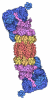

- Assembly
| Deposited unit | 
|
|---|---|
| 1 |
|
-Components
-26S proteasome regulatory subunit ... , 6 types, 6 molecules ABCDEF
| #1: Protein | Mass: 48700.805 Da / Num. of mol.: 1 / Source method: isolated from a natural source / Source: (natural) Homo sapiens (human) / References: UniProt: P35998 |
|---|---|
| #2: Protein | Mass: 49260.504 Da / Num. of mol.: 1 / Source method: isolated from a natural source / Source: (natural) Homo sapiens (human) / References: UniProt: P62191 |
| #3: Protein | Mass: 45694.047 Da / Num. of mol.: 1 / Source method: isolated from a natural source / Source: (natural) Homo sapiens (human) / References: UniProt: P62195 |
| #4: Protein | Mass: 47426.141 Da / Num. of mol.: 1 / Source method: isolated from a natural source / Source: (natural) Homo sapiens (human) / References: UniProt: P43686 |
| #5: Protein | Mass: 44241.008 Da / Num. of mol.: 1 / Source method: isolated from a natural source / Source: (natural) Homo sapiens (human) / References: UniProt: P62333 |
| #6: Protein | Mass: 49266.457 Da / Num. of mol.: 1 / Source method: isolated from a natural source / Source: (natural) Homo sapiens (human) / References: UniProt: P17980 |
-Proteasome subunit alpha type- ... , 7 types, 14 molecules GgHhIiJjKkLlMm
| #7: Protein | Mass: 27432.459 Da / Num. of mol.: 2 / Source method: isolated from a natural source / Source: (natural) Homo sapiens (human) / References: UniProt: P60900#8: Protein | Mass: 25927.535 Da / Num. of mol.: 2 / Source method: isolated from a natural source / Source: (natural) Homo sapiens (human) / References: UniProt: P25787#9: Protein | Mass: 29525.842 Da / Num. of mol.: 2 / Source method: isolated from a natural source / Source: (natural) Homo sapiens (human) / References: UniProt: P25789#10: Protein | Mass: 27929.891 Da / Num. of mol.: 2 / Source method: isolated from a natural source / Source: (natural) Homo sapiens (human) / References: UniProt: O14818#11: Protein | Mass: 26435.977 Da / Num. of mol.: 2 / Source method: isolated from a natural source / Source: (natural) Homo sapiens (human) / References: UniProt: P28066#12: Protein | Mass: 29595.627 Da / Num. of mol.: 2 / Source method: isolated from a natural source / Source: (natural) Homo sapiens (human) / References: UniProt: P25786#13: Protein | Mass: 28469.252 Da / Num. of mol.: 2 / Source method: isolated from a natural source / Source: (natural) Homo sapiens (human) / References: UniProt: P25788 |
|---|
-Proteasome subunit beta type- ... , 7 types, 14 molecules NnOoPpQqRrSsTt
| #14: Protein | Mass: 25377.652 Da / Num. of mol.: 2 / Source method: isolated from a natural source / Source: (natural) Homo sapiens (human)References: UniProt: P28072, proteasome endopeptidase complex #15: Protein | Mass: 30000.418 Da / Num. of mol.: 2 / Source method: isolated from a natural source / Source: (natural) Homo sapiens (human)References: UniProt: Q99436, proteasome endopeptidase complex #16: Protein | Mass: 22972.896 Da / Num. of mol.: 2 / Source method: isolated from a natural source / Source: (natural) Homo sapiens (human) / References: UniProt: P49720#17: Protein | Mass: 22864.277 Da / Num. of mol.: 2 / Source method: isolated from a natural source / Source: (natural) Homo sapiens (human) / References: UniProt: P49721#18: Protein | Mass: 28510.248 Da / Num. of mol.: 2 / Source method: isolated from a natural source / Source: (natural) Homo sapiens (human)References: UniProt: P28074, proteasome endopeptidase complex #19: Protein | Mass: 26522.396 Da / Num. of mol.: 2 / Source method: isolated from a natural source / Source: (natural) Homo sapiens (human) / References: UniProt: P20618#20: Protein | Mass: 29231.178 Da / Num. of mol.: 2 / Source method: isolated from a natural source / Source: (natural) Homo sapiens (human) / References: UniProt: P28070 |
|---|
-26S proteasome non-ATPase regulatory subunit ... , 11 types, 11 molecules UVWXYZabcdf
| #21: Protein | Mass: 105958.234 Da / Num. of mol.: 1 / Source method: isolated from a natural source / Source: (natural) Homo sapiens (human) / References: UniProt: Q99460 |
|---|---|
| #22: Protein | Mass: 61066.500 Da / Num. of mol.: 1 / Source method: isolated from a natural source / Source: (natural) Homo sapiens (human) / References: UniProt: O43242 |
| #23: Protein | Mass: 52979.359 Da / Num. of mol.: 1 / Source method: isolated from a natural source / Source: (natural) Homo sapiens (human) / References: UniProt: O00232 |
| #24: Protein | Mass: 47526.688 Da / Num. of mol.: 1 / Source method: isolated from a natural source / Source: (natural) Homo sapiens (human) / References: UniProt: O00231 |
| #25: Protein | Mass: 45592.285 Da / Num. of mol.: 1 / Source method: isolated from a natural source / Source: (natural) Homo sapiens (human) / References: UniProt: Q15008 |
| #26: Protein | Mass: 37086.441 Da / Num. of mol.: 1 / Source method: isolated from a natural source / Source: (natural) Homo sapiens (human) / References: UniProt: P51665 |
| #27: Protein | Mass: 42995.359 Da / Num. of mol.: 1 / Source method: isolated from a natural source / Source: (natural) Homo sapiens (human) / References: UniProt: Q9UNM6 |
| #28: Protein | Mass: 40781.590 Da / Num. of mol.: 1 / Source method: isolated from a natural source / Source: (natural) Homo sapiens (human) / References: UniProt: P55036 |
| #29: Protein | Mass: 34620.023 Da / Num. of mol.: 1 / Source method: isolated from a natural source / Source: (natural) Homo sapiens (human)References: UniProt: O00487, Hydrolases; Acting on peptide bonds (peptidases); Omega peptidases |
| #30: Protein | Mass: 39667.871 Da / Num. of mol.: 1 / Source method: isolated from a natural source / Source: (natural) Homo sapiens (human) / References: UniProt: P48556 |
| #32: Protein | Mass: 100313.625 Da / Num. of mol.: 1 / Source method: isolated from a natural source / Source: (natural) Homo sapiens (human) / References: UniProt: Q13200 |
-Protein , 2 types, 2 molecules eu
| #31: Protein | Mass: 8284.611 Da / Num. of mol.: 1 / Source method: isolated from a natural source / Source: (natural) Homo sapiens (human) / References: UniProt: P60896 |
|---|---|
| #34: Protein | Mass: 52076.520 Da / Num. of mol.: 1 Source method: isolated from a genetically manipulated source Source: (gene. exp.) Homo sapiens (human) / Gene: MIDN / Production host: Homo sapiens (human) / References: UniProt: Q504T8 |
-Protein/peptide , 1 types, 1 molecules v
| #33: Protein/peptide | Mass: 1294.587 Da / Num. of mol.: 1 Source method: isolated from a genetically manipulated source Details: Author stated: In the process of protein purification, we used full-length IRF4 (Uniprot: Q15306) and Midnolin (Uniprot: Q504T8) to pull down the endogenous 26S proteasome. However, since ...Details: Author stated: In the process of protein purification, we used full-length IRF4 (Uniprot: Q15306) and Midnolin (Uniprot: Q504T8) to pull down the endogenous 26S proteasome. However, since the 26S proteasome can unfold and proteolytic cleave both IRF4 and midnolin proteins, we are unable to determine which specific segment of these two proteins corresponds to the density of chain v, which appears to be undergoing unfolding within the AAA-ATPase ring. Therefore, we labeled it as UNK. Source: (gene. exp.) Homo sapiens (human) / Production host: Homo sapiens (human) |
|---|
-Non-polymers , 2 types, 5 molecules 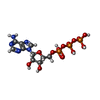
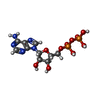
| #35: Chemical | ChemComp-ATP / 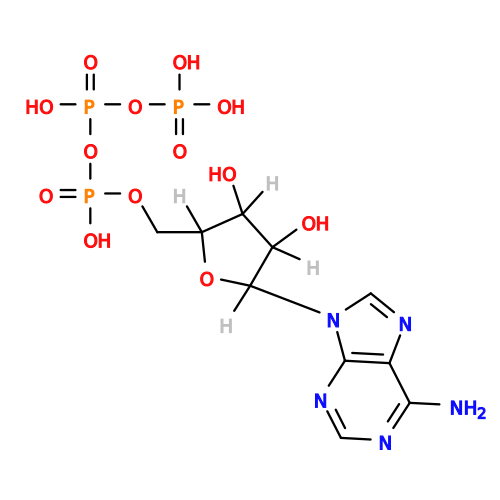 Mass: 507.181 Da / Num. of mol.: 4 / Source method: obtained synthetically / Formula: C10H16N5O13P3 / Feature type: SUBJECT OF INVESTIGATION / Comment: ATP, energy-carrying molecule*YM Mass: 507.181 Da / Num. of mol.: 4 / Source method: obtained synthetically / Formula: C10H16N5O13P3 / Feature type: SUBJECT OF INVESTIGATION / Comment: ATP, energy-carrying molecule*YM#36: Chemical | ChemComp-ADP / | 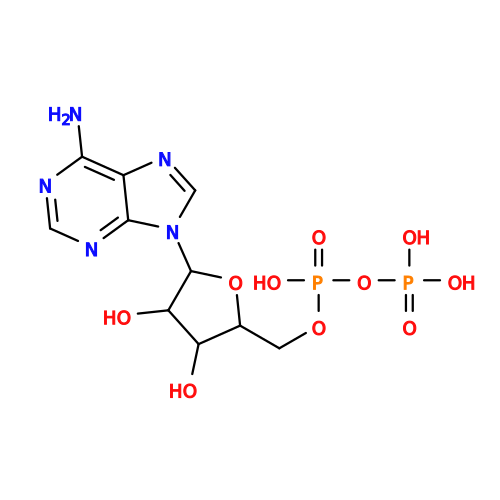 Mass: 427.201 Da / Num. of mol.: 1 / Source method: obtained synthetically / Formula: C10H15N5O10P2 / Feature type: SUBJECT OF INVESTIGATION / Comment: ADP, energy-carrying molecule*YM Mass: 427.201 Da / Num. of mol.: 1 / Source method: obtained synthetically / Formula: C10H15N5O10P2 / Feature type: SUBJECT OF INVESTIGATION / Comment: ADP, energy-carrying molecule*YM |
|---|
-Details
| Has ligand of interest | Y |
|---|---|
| Has protein modification | Y |
-Experimental details
-Experiment
| Experiment | Method: ELECTRON MICROSCOPY |
|---|---|
| EM experiment | Aggregation state: PARTICLE / 3D reconstruction method: single particle reconstruction |
- Sample preparation
| Component | Name: 26S proteasome degradation complex / Type: COMPLEX / Entity ID: #1-#34 / Source: RECOMBINANT |
|---|---|
| Molecular weight | Experimental value: NO |
| Source (natural) | Organism: Homo sapiens (human) |
| Source (recombinant) | Organism: Homo sapiens (human) |
| Buffer solution | pH: 8 |
| Specimen | Embedding applied: NO / Shadowing applied: NO / Staining applied: NO / Vitrification applied: YES |
| Vitrification | Cryogen name: ETHANE |
- Electron microscopy imaging
| Experimental equipment |  Model: Titan Krios / Image courtesy: FEI Company |
|---|---|
| Microscopy | Model: TFS KRIOS |
| Electron gun | Electron source:  FIELD EMISSION GUN / Accelerating voltage: 300 kV / Illumination mode: FLOOD BEAM FIELD EMISSION GUN / Accelerating voltage: 300 kV / Illumination mode: FLOOD BEAM |
| Electron lens | Mode: BRIGHT FIELD / Nominal defocus max: 2200 nm / Nominal defocus min: 1200 nm |
| Specimen holder | Cryogen: NITROGEN |
| Image recording | Electron dose: 60 e/Å2 / Film or detector model: GATAN K3 BIOQUANTUM (6k x 4k) |
- Processing
| EM software |
| |||||||||
|---|---|---|---|---|---|---|---|---|---|---|
| CTF correction | Type: NONE | |||||||||
| 3D reconstruction | Resolution: 3.31 Å / Resolution method: FSC 0.143 CUT-OFF / Num. of particles: 468422 / Symmetry type: POINT |
