[English] 日本語
Yorodumi
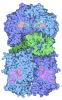
- PDB-9lkk: Crystal structure of C1ql1-gC1q hexamer -

+
Open data


ID or keywords:

Loading...

-
Basic information

Entry
Database: PDB / ID: 9lkk
TitleCrystal structure of C1ql1-gC1q hexamer
ComponentsC1q-related factor
KeywordsSIGNALING PROTEIN / C1ql1 / synapse / CF-PC / Calcium / secreted protein
Function / homology
Function and homology information


climbing fiber / motor learning / cerebellar climbing fiber to Purkinje cell synapse / maintenance of synapse structure / regulation of synapse pruning / collagen trimer / neuron remodeling / synaptic cleft / presynapse / signaling receptor binding / cytoplasm
Similarity search - Function
: / C1q domain / C1q domain / C1q domain profile. / Complement component C1q domain. / Tumour necrosis factor-like domain superfamily / Collagen triple helix repeat / Collagen triple helix repeat (20 copies)
Similarity search - Domain/homology
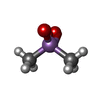
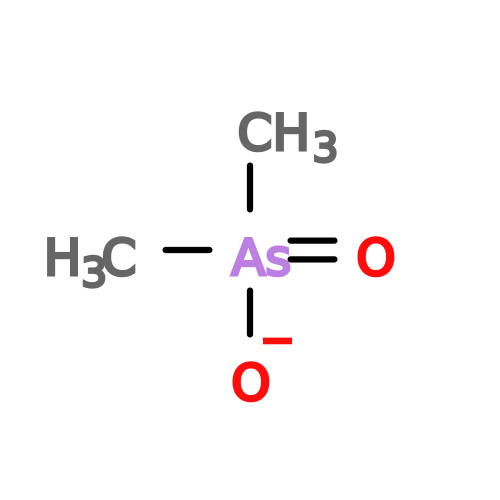
CACODYLATE ION / C1q-related factor
Similarity search - Component
Biological speciesMus musculus (house mouse)
MethodX-RAY DIFFRACTION / SYNCHROTRON / MOLECULAR REPLACEMENT / Resolution: 2.22 Å
AuthorsLiao, L. / Niu, F. / Wei, Z.
Funding support China, 2items
OrganizationGrant numberCountry
National Natural Science Foundation of China (NSFC)32471250 China
National Natural Science Foundation of China (NSFC)32471262 China
CitationJournal: Nat Commun / Year: 2025
Title: Structural basis of calcium-dependent C1ql1/BAI3 assemblies in synaptic connectivity.
Authors: Liangyu Liao / Ying Han / Fengfeng Niu / Yingjie Wang / Yang Lu / Shun Xu / Houming Zhu / Leishu Lin / Jinman Xiao / Hoi In Tou / Jiali Gao / Bo Zhang / Zhiyi Wei /
Abstract: Cell adhesion molecules (CAMs) are pivotal in establishing and maintaining synaptic connectivity. Emerging evidence indicates that some secreted factors within the synaptic cleft, including C1q-like ...Cell adhesion molecules (CAMs) are pivotal in establishing and maintaining synaptic connectivity. Emerging evidence indicates that some secreted factors within the synaptic cleft, including C1q-like proteins (C1qls), play a crucial role in bridging pre- and post-synapses by connecting the bilateral CAMs. However, the mechanisms of those secreted factors in synapse assembly remain incomplete. Here, we explore C1ql-mediated synaptic connectivity, focusing on the assembly of C1ql1 and its postsynaptic receptor brain-specific angiogenesis inhibitor 3 (BAI3, also called ADGRB3). Our biochemical, structural, and computational analyses reveal that the trimeric globular C1q (gC1q) domain of C1ql1 undergoes a calcium-modulated domain-swapping event to form a hexamer. Cryo-EM study manifests the stabilizing role of calcium ions on the C1ql1_gC1q hexamer in complex with the extended CUB domain of BAI3. Using the gC1q hexamer, full-length C1ql1 further assembles into linear clusters, possibly providing a scaffold to accumulate BAI3 receptors on the plasma membrane. Our cellular and in vivo studies support a role for the gC1q-mediated dynamic assembly of C1ql1 in receptor accumulation and synapse maintenance. Collectively, our findings provide a plausible mechanism of secreted factor-mediated synaptic connectivity, driven by the calcium-modulated assembly of C1qls and their interactions with CAMs.
History
DepositionJan 16, 2025Deposition site: PDBJ / Processing site: PDBC
Revision 1.0Dec 17, 2025Provider: repository / Type: Initial release
Revision 1.1Jan 14, 2026Group: Database references / Category: citation / citation_author
Item: _citation.journal_volume / _citation.page_first ..._citation.journal_volume / _citation.page_first / _citation.page_last / _citation_author.identifier_ORCID

-
Structure visualization

Structure viewerMolecule:
MolmilJmol/JSmol

Downloads & links

-
Assembly

Deposited unit
A: C1q-related factor
B: C1q-related factor
C: C1q-related factor
D: C1q-related factor
E: C1q-related factor
F: C1q-related factor
G: C1q-related factor
H: C1q-related factor
I: C1q-related factor
hetero molecules


Theoretical massNumber of molelcules
Total (without water)138,87347
Polymers136,6629
Non-polymers2,21138
Water8,953497
1
A: C1q-related factor
B: C1q-related factor
C: C1q-related factor
G: C1q-related factor
H: C1q-related factor
I: C1q-related factor
hetero molecules


Theoretical massNumber of molelcules
Total (without water)92,45130
Polymers91,1086
Non-polymers1,34324
Water1086
TypeNameSymmetry operationNumber
identity operation1_555x,y,z1
Buried area22110 Å2
ΔGint-248 kcal/mol
Surface area24870 Å2
MethodPISA
2
D: C1q-related factor
E: C1q-related factor
F: C1q-related factor
hetero molecules


Theoretical massNumber of molelcules
Total (without water)46,42317
Polymers45,5543
Non-polymers86914
Water543
TypeNameSymmetry operationNumber
identity operation1_555x,y,z1
Buried area7930 Å2
ΔGint-68 kcal/mol
Surface area12970 Å2
MethodPISA
Unit cell
Length a, b, c (Å)110.367, 110.634, 114.921
Angle α, β, γ (deg.)90.00, 90.00, 90.00
Int Tables number19
Space group name H-MP212121

-
Components

-
Protein , 1 types, 9 molecules ABCDEFGHI

#1: Protein
C1q-related factor / C1q and tumor necrosis factor-related protein 14 / C1q/TNF-related protein 14 / CTRP14 / Complement ...C1q and tumor necrosis factor-related protein 14 / C1q/TNF-related protein 14 / CTRP14 / Complement component 1 Q subcomponent-like 1


Mass: 15184.653 Da / Num. of mol.: 9
Source method: isolated from a genetically manipulated source
Source: (gene. exp.) Mus musculus (house mouse) / Gene: C1ql1, C1qrf, Crf, Ctrp14 / Production host: Escherichia coli BL21(DE3) (bacteria) / References: UniProt: O88992

-
Non-polymers , 5 types, 535 molecules

#2: Chemical...
ChemComp-CA / CALCIUM ION


Mass: 40.078 Da / Num. of mol.: 23 / Source method: obtained synthetically / Formula: Ca / Feature type: SUBJECT OF INVESTIGATION
#3: Chemical ChemComp-CAC / CACODYLATE ION / dimethylarsinate


Mass: 136.989 Da / Num. of mol.: 3 / Source method: obtained synthetically / Formula: C2H6AsO2
#4: Chemical
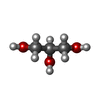
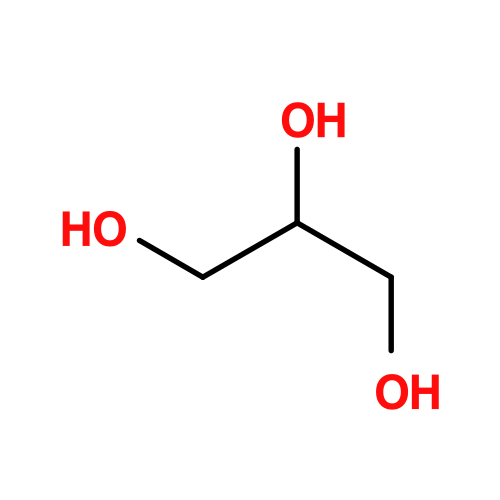
ChemComp-GOL / GLYCEROL / GLYCERIN / PROPANE-1,2,3-TRIOL


Mass: 92.094 Da / Num. of mol.: 8 / Source method: obtained synthetically / Formula: C3H8O3
#5: Chemical
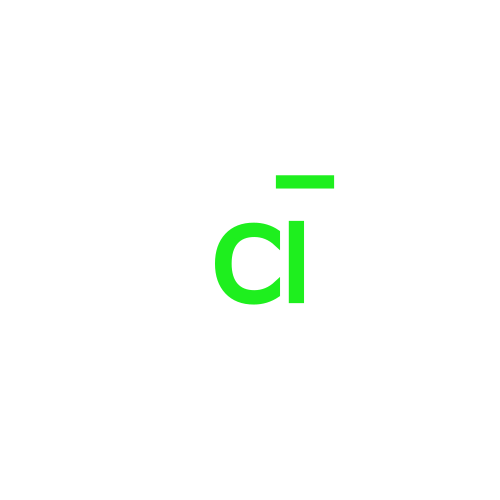
ChemComp-CL / CHLORIDE ION


Mass: 35.453 Da / Num. of mol.: 4 / Source method: obtained synthetically / Formula: Cl
#6: Water ChemComp-HOH / water


Mass: 18.015 Da / Num. of mol.: 497 / Source method: isolated from a natural source / Formula: H2O

-
Details

Has ligand of interestY
Has protein modificationN

-
Experimental details

-
Experiment

ExperimentMethod: X-RAY DIFFRACTION / Number of used crystals: 1

-
Sample preparation

CrystalDensity Matthews: 2.57 Å3/Da / Density % sol: 52.08 %
Crystal growTemperature: 289.15 K / Method: vapor diffusion, sitting drop
Details: protein solution: 50 mM Tris, pH 7.5, 500 mM NaCl; crystal solution: 0.1 M Na Cacodylate, pH 6.0, 25% MPD, and 0.05 M Ca acetate.

-
Data collection

DiffractionMean temperature: 100 K / Serial crystal experiment: N
Diffraction sourceSource: SYNCHROTRON / Site: SSRF / Beamline: BL10U2 / Wavelength: 0.9792 Å
DetectorType: DECTRIS EIGER X 16M / Detector: PIXEL / Date: Dec 24, 2022
RadiationProtocol: SINGLE WAVELENGTH / Monochromatic (M) / Laue (L): M / Scattering type: x-ray
Radiation wavelengthWavelength: 0.9792 Å / Relative weight: 1
ReflectionResolution: 2.22→57.46 Å / Num. obs: 70092 / % possible obs: 99.95 % / Redundancy: 2 % / CC1/2: 0.999 / Net I/σ(I): 14.48
Reflection shellResolution: 2.22→2.3 Å / Num. unique obs: 6923 / CC1/2: 0.725 / % possible all: 100

-
Processing

Software
NameVersionClassification
PHENIX(1.18.2_3874: ???)refinement
Aimlessdata scaling
XDSdata reduction
PHASERphasing
RefinementMethod to determine structure: MOLECULAR REPLACEMENT / Resolution: 2.22→57.46 Å / SU ML: 0.24 / Cross valid method: FREE R-VALUE / σ(F): 1.35 / Phase error: 21.64 / Stereochemistry target values: ML
RfactorNum. reflection% reflection
Rfree0.2105 3340 4.77 %
Rwork0.1718 --
obs0.1737 70091 99.96 %
Solvent computationShrinkage radii: 0.9 Å / VDW probe radii: 1.11 Å / Solvent model: FLAT BULK SOLVENT MODEL
Refinement stepCycle: LAST / Resolution: 2.22→57.46 Å
ProteinNucleic acidLigandSolventTotal
Num. atoms9084 0 27 497 9608
Refine LS restraints
Refine-IDTypeDev idealNumber
X-RAY DIFFRACTIONf_bond_d0.0079400
X-RAY DIFFRACTIONf_angle_d0.88912716
X-RAY DIFFRACTIONf_dihedral_angle_d7.2861304
X-RAY DIFFRACTIONf_chiral_restr0.0561318
X-RAY DIFFRACTIONf_plane_restr0.0051676
LS refinement shell
Resolution (Å)Rfactor RfreeNum. reflection RfreeRfactor RworkNum. reflection RworkRefine-ID% reflection obs (%)
2.22-2.250.31691460.2642747X-RAY DIFFRACTION100
2.25-2.290.2751690.24052663X-RAY DIFFRACTION100
2.29-2.320.2521610.22082733X-RAY DIFFRACTION100
2.32-2.360.23091310.21462779X-RAY DIFFRACTION100
2.36-2.40.23781100.21372784X-RAY DIFFRACTION100
2.4-2.440.30641170.2062765X-RAY DIFFRACTION100
2.44-2.490.27091320.19572759X-RAY DIFFRACTION100
2.49-2.540.22531260.19372758X-RAY DIFFRACTION100
2.54-2.60.26271470.18442744X-RAY DIFFRACTION100
2.6-2.660.25771430.19132785X-RAY DIFFRACTION100
2.66-2.720.27911180.18772754X-RAY DIFFRACTION100
2.72-2.80.25961270.182775X-RAY DIFFRACTION100
2.8-2.880.20721100.17492779X-RAY DIFFRACTION100
2.88-2.970.20661090.16592813X-RAY DIFFRACTION100
2.97-3.080.19311170.16762799X-RAY DIFFRACTION100
3.08-3.20.20451200.16182798X-RAY DIFFRACTION100
3.2-3.350.20531340.1582792X-RAY DIFFRACTION100
3.35-3.520.17371720.14892731X-RAY DIFFRACTION100
3.52-3.740.19811880.14732749X-RAY DIFFRACTION100
3.74-4.030.19711490.14622787X-RAY DIFFRACTION100
4.03-4.440.15721720.13842803X-RAY DIFFRACTION100
4.44-5.080.15731700.1392789X-RAY DIFFRACTION100
5.08-6.40.24981370.19032880X-RAY DIFFRACTION100
6.4-57.460.26841350.21342985X-RAY DIFFRACTION99

+
About Yorodumi

-
News

-
Feb 9, 2022. New format data for meta-information of EMDB entries

New format data for meta-information of EMDB entries

  • Version 3 of the EMDB header file is now the official format.
  • The previous official version 1.9 will be removed from the archive.

Related info.:EMDB header

External links:wwPDB to switch to version 3 of the EMDB data model

-
Aug 12, 2020. Covid-19 info

Covid-19 info

URL: https://pdbj.org/emnavi/covid19.php

New page: Covid-19 featured information page in EM Navigator.

Related info.:Covid-19 info / Mar 5, 2020. Novel coronavirus structure data

+
Mar 5, 2020. Novel coronavirus structure data

Novel coronavirus structure data

Related info.:Yorodumi Speices / Aug 12, 2020. Covid-19 info

External links:COVID-19 featured content - PDBj / Molecule of the Month (242):Coronavirus Proteases

+
Jan 31, 2019. EMDB accession codes are about to change! (news from PDBe EMDB page)

EMDB accession codes are about to change! (news from PDBe EMDB page)

  • The allocation of 4 digits for EMDB accession codes will soon come to an end. Whilst these codes will remain in use, new EMDB accession codes will include an additional digit and will expand incrementally as the available range of codes is exhausted. The current 4-digit format prefixed with “EMD-” (i.e. EMD-XXXX) will advance to a 5-digit format (i.e. EMD-XXXXX), and so on. It is currently estimated that the 4-digit codes will be depleted around Spring 2019, at which point the 5-digit format will come into force.
  • The EM Navigator/Yorodumi systems omit the EMD- prefix.

Related info.:Q: What is EMD? / ID/Accession-code notation in Yorodumi/EM Navigator

External links:EMDB Accession Codes are Changing Soon! / Contact to PDBj

+
Jul 12, 2017. Major update of PDB

Major update of PDB

  • wwPDB released updated PDB data conforming to the new PDBx/mmCIF dictionary.
  • This is a major update changing the version number from 4 to 5, and with Remediation, in which all the entries are updated.
  • In this update, many items about electron microscopy experimental information are reorganized (e.g. em_software).
  • Now, EM Navigator and Yorodumi are based on the updated data.

External links:wwPDB Remediation / Enriched Model Files Conforming to OneDep Data Standards Now Available in the PDB FTP Archive

-
Yorodumi

Thousand views of thousand structures

  • Yorodumi is a browser for structure data from EMDB, PDB, SASBDB, etc.
  • This page is also the successor to EM Navigator detail page, and also detail information page/front-end page for Omokage search.
  • The word "yorodu" (or yorozu) is an old Japanese word meaning "ten thousand". "mi" (miru) is to see.

Related info.:EMDB / PDB / SASBDB / Comparison of 3 databanks / Yorodumi Search / Aug 31, 2016. New EM Navigator & Yorodumi / Yorodumi Papers / Jmol/JSmol / Function and homology information / Changes in new EM Navigator and Yorodumi

Read more