 Movie
Movie Controller

[English] 日本語
 Yorodumi
- PDB-9l3f: Structure-Guided Design of Picomolar-level Macrocyclic TRPC5 Chan... -
+ Open data

- Basic information
| Entry | Database: PDB / ID: 9l3f | ||||||||||||||||||||||||
|---|---|---|---|---|---|---|---|---|---|---|---|---|---|---|---|---|---|---|---|---|---|---|---|---|---|
| Title | Structure-Guided Design of Picomolar-level Macrocyclic TRPC5 Channel Inhibitors with Antidepressant Activity | ||||||||||||||||||||||||
 Components Components | Short transient receptor potential channel 5 | ||||||||||||||||||||||||
 Keywords Keywords | MEMBRANE PROTEIN / Ion channel / TRPC5 / Inhibitor | ||||||||||||||||||||||||
| Function / homology |  Function and homology information Function and homology informationregulation of membrane hyperpolarization / phosphatidylserine exposure on apoptotic cell surface / negative regulation of dendrite morphogenesis / store-operated calcium channel activity / TRP channels / cation channel complex / inositol 1,4,5 trisphosphate binding / actinin binding / positive regulation of peptidyl-threonine phosphorylation / clathrin binding ...regulation of membrane hyperpolarization / phosphatidylserine exposure on apoptotic cell surface / negative regulation of dendrite morphogenesis / store-operated calcium channel activity / TRP channels / cation channel complex / inositol 1,4,5 trisphosphate binding / actinin binding / positive regulation of peptidyl-threonine phosphorylation / clathrin binding / positive regulation of axon extension / regulation of cytosolic calcium ion concentration / positive regulation of neuron differentiation / calcium channel complex / neuron apoptotic process / calcium ion transmembrane transport / calcium channel activity / neuron differentiation / positive regulation of cytosolic calcium ion concentration / ATPase binding / presynapse / growth cone / actin binding / positive regulation of cell population proliferation / neuronal cell body / dendrite / metal ion binding / plasma membrane Similarity search - Function | ||||||||||||||||||||||||
| Biological species |   Mus musculus (house mouse) Mus musculus (house mouse) | ||||||||||||||||||||||||
| Method | ELECTRON MICROSCOPY / single particle reconstruction / cryo EM / Resolution: 3.09 Å | ||||||||||||||||||||||||
 Authors Authors | Che, T. / Zhang, J. / Xiong, B. / Cheng, X.Y. | ||||||||||||||||||||||||
| Funding support |  China, 1items China, 1items
| ||||||||||||||||||||||||
 Citation Citation | Journal: Acta Pharm Sin B / Year: 2026 Title: Structure-guided design of picomolar-level macrocyclic TRPC5 channel inhibitors with antidepressant activity. Authors: Tong Che / Yixiang Chen / Xinyu Cheng / Han Hu / Xiaoyun Wu / Yuting Zhang / Xiaoqiang Yang / Yinzhen Liu / Hui Liu / Weiwei Nan / Shuangyan Wan / Mingxing Yang / Bo Zeng / Jian Li / Jin Zhang / Bing Xiong / Abstract: Recent advances in ion channel structural biology have enhanced structure-based drug design, yet lipid-occupied binding pockets-often large and flat-remain a major hurdle for developing selective ...Recent advances in ion channel structural biology have enhanced structure-based drug design, yet lipid-occupied binding pockets-often large and flat-remain a major hurdle for developing selective small molecules. TRPC5, a brain-enriched channel regulating depression and anxiety, is a promising therapeutic target, but current preclinical candidates suffer from moderate off-target effects. To address this, we designed macrocyclic TRPC5 inhibitors using structure-guided macrocyclization, overcoming lipid-binding site challenges. Among these, JDIC-127 exhibited unprecedented potency with IC of 374 pmol/L-200-fold more potent than HC-070-and exceptional selectivity. Its specificity arises from interactions with unique structural features near the S5 and S6 helices of TRPC5, minimizing activity against related TRPC channels and other ion channels. This selective inhibition aligns with preclinical evidence supporting JDIC-127's potential in treating neuropsychiatric disorders. The study demonstrates how macrocycles stabilize ligand conformations, enhance affinity, and achieve selectivity in lipid-dominated binding sites. It also highlights the synergy between macrocyclic design, cryo-EM, and computational modeling to address longstanding obstacles in ion channel drug discovery. JDIC-127 serves as a proof-of-concept for the application of macrocyclization in ion channel pharmacology, offering a roadmap for developing innovative therapeutics targeting TRP channels and beyond, with implications for a wide range of diseases. | ||||||||||||||||||||||||
| History |
|
- Structure visualization
| Structure viewer | Molecule: MolmilJmol/JSmol |
|---|
- Downloads & links
-Download
| PDBx/mmCIF format | 9l3f.cif.gz | 488.4 KB | Display | PDBx/mmCIF format |
|---|---|---|---|---|
| PDB format | pdb9l3f.ent.gz | Display | PDB format | |
| PDBx/mmJSON format | 9l3f.json.gz | Tree view | PDBx/mmJSON format | |
| Others |  Other downloads Other downloads |
-Validation report
| Arichive directory | https://data.pdbj.org/pub/pdb/validation_reports/l3/9l3fftp://data.pdbj.org/pub/pdb/validation_reports/l3/9l3f | HTTPS FTP |
|---|
-Related structure data
| Related structure data |  62784MC  9v6jC M: map data used to model this data C: citing same article ( |
|---|---|
| Similar structure data |

-Links
 PDBj
PDBj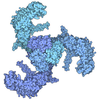
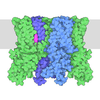
- Assembly
| Deposited unit | 
|
|---|---|
| 1 |
|
-Components
| #1: Protein | Mass: 88903.672 Da / Num. of mol.: 4 Source method: isolated from a genetically manipulated source Source: (gene. exp.) Mus musculus (house mouse) / Gene: Trpc5, Trp5, Trrp5 / Production host:  Homo sapiens (human) / References: UniProt: Q9QX29 Homo sapiens (human) / References: UniProt: Q9QX29#2: Chemical | ChemComp-ZN /   Mass: 65.409 Da / Num. of mol.: 4 / Source method: obtained synthetically / Formula: Zn / Feature type: SUBJECT OF INVESTIGATION Mass: 65.409 Da / Num. of mol.: 4 / Source method: obtained synthetically / Formula: Zn / Feature type: SUBJECT OF INVESTIGATION#3: Chemical | ChemComp-CA /   Mass: 40.078 Da / Num. of mol.: 4 / Source method: obtained synthetically / Formula: Ca / Feature type: SUBJECT OF INVESTIGATION Mass: 40.078 Da / Num. of mol.: 4 / Source method: obtained synthetically / Formula: Ca / Feature type: SUBJECT OF INVESTIGATION#4: Chemical | ChemComp-A1EH7 / ( Mass: 542.986 Da / Num. of mol.: 4 / Source method: obtained synthetically / Formula: C27H28ClFN4O5 / Feature type: SUBJECT OF INVESTIGATION Has ligand of interest | Y | Has protein modification | Y | |
|---|
-Experimental details
-Experiment
| Experiment | Method: ELECTRON MICROSCOPY |
|---|---|
| EM experiment | Aggregation state: PARTICLE / 3D reconstruction method: single particle reconstruction |
- Sample preparation
| Component | Name: Short transient receptor potential channel 5 / Type: CELL / Entity ID: #1 / Source: NATURAL |
|---|---|
| Source (natural) | Organism: Homo sapiens (human) |
| Buffer solution | pH: 7.5 |
| Specimen | Embedding applied: NO / Shadowing applied: NO / Staining applied: NO / Vitrification applied: YES |
| Vitrification | Cryogen name: ETHANE |
- Electron microscopy imaging
| Experimental equipment | 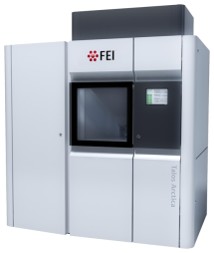 Model: Talos Arctica / Image courtesy: FEI Company |
|---|---|
| Microscopy | Model: FEI TECNAI ARCTICA |
| Electron gun | Electron source:  FIELD EMISSION GUN / Accelerating voltage: 300 kV / Illumination mode: FLOOD BEAM FIELD EMISSION GUN / Accelerating voltage: 300 kV / Illumination mode: FLOOD BEAM |
| Electron lens | Mode: BRIGHT FIELD / Nominal defocus max: 2000 nm / Nominal defocus min: 1000 nm |
| Image recording | Electron dose: 50.53 e/Å2 / Film or detector model: FEI FALCON IV (4k x 4k) |
- Processing
| EM software |
| ||||||||||||||||||||||||
|---|---|---|---|---|---|---|---|---|---|---|---|---|---|---|---|---|---|---|---|---|---|---|---|---|---|
| CTF correction | Type: PHASE FLIPPING AND AMPLITUDE CORRECTION | ||||||||||||||||||||||||
| 3D reconstruction | Resolution: 3.09 Å / Resolution method: FSC 0.143 CUT-OFF / Num. of particles: 128115 / Symmetry type: POINT | ||||||||||||||||||||||||
| Refinement | Stereochemistry target values: REAL-SPACE (WEIGHTED MAP SUM AT ATOM CENTERS) | ||||||||||||||||||||||||
| Refine LS restraints |
|
