 Movie
Movie Controller

[English] 日本語
 Yorodumi
- PDB-9l25: cryo-EM structure of Vitamin K-dependent gamma-carboxylase comple... -
+ Open data

- Basic information
| Entry | Database: PDB / ID: 9l25 | ||||||||||||||||||||||||
|---|---|---|---|---|---|---|---|---|---|---|---|---|---|---|---|---|---|---|---|---|---|---|---|---|---|
| Title | cryo-EM structure of Vitamin K-dependent gamma-carboxylase complexed with factor IX(Gla) | ||||||||||||||||||||||||
 Components Components |
| ||||||||||||||||||||||||
 Keywords Keywords | MEMBRANE PROTEIN | ||||||||||||||||||||||||
| Function / homology |  Function and homology information Function and homology informationpeptidyl-glutamate 4-carboxylase / gamma-glutamyl carboxylase activity / negative regulation of testosterone biosynthetic process / peptidyl-glutamic acid carboxylation / negative regulation of bone development / Defective F9 secretion / coagulation factor IXa / vitamin binding / vitamin K metabolic process / Defective gamma-carboxylation of F9 ...peptidyl-glutamate 4-carboxylase / gamma-glutamyl carboxylase activity / negative regulation of testosterone biosynthetic process / peptidyl-glutamic acid carboxylation / negative regulation of bone development / Defective F9 secretion / coagulation factor IXa / vitamin binding / vitamin K metabolic process / Defective gamma-carboxylation of F9 / FXIIa, PKa-dependent activation of coagulation pathway / Defective F9 activation / Amplification and propagation of coagulation cascade / Initiation of coagulation cascade / Defective factor IX causes thrombophilia / Defective cofactor function of FVIIIa variant / Defective F9 variant does not activate FX / negative regulation of neurotransmitter secretion / Regulation of clotting cascade / zymogen activation / Protein hydroxylation / Transport of gamma-carboxylated protein precursors from the endoplasmic reticulum to the Golgi apparatus / Gamma-carboxylation of protein precursors / Removal of aminoterminal propeptides from gamma-carboxylated proteins / protein modification process / protein maturation / Golgi lumen / blood coagulation / endopeptidase activity / extracellular matrix / endoplasmic reticulum lumen / serine-type endopeptidase activity / calcium ion binding / endoplasmic reticulum membrane / proteolysis / metal ion binding / extracellular exosome / extracellular region / membrane / plasma membrane Similarity search - Function | ||||||||||||||||||||||||
| Biological species |  Homo sapiens (human) Homo sapiens (human) | ||||||||||||||||||||||||
| Method | ELECTRON MICROSCOPY / single particle reconstruction / cryo EM / Resolution: 2.41 Å | ||||||||||||||||||||||||
 Authors Authors | Yao, D. / Wu, K. / Lan, P. | ||||||||||||||||||||||||
| Funding support |  China, 1items China, 1items
| ||||||||||||||||||||||||
 Citation Citation | Journal: Nat Commun / Year: 2025 Title: Structural insight into bicarbonate-mediated carboxylation by human vitamin K-dependent carboxylase. Authors: Ke Wu / Zheng Wang / Deqiang Yao / Shaobai Li / Xiaozhu Wang / Yuanyuan Zhang / Mi Cao / Yafeng Shen / Shunpeng Xing / Jian Wu / Ming Lei / Pengfei Lan / Abstract: Vitamin K-dependent (VKD) carboxylation, mediated by γ-glutamyl carboxylase (GGCX), is essential for the maturation of VKD proteins involved in critical physiological processes such as blood ...Vitamin K-dependent (VKD) carboxylation, mediated by γ-glutamyl carboxylase (GGCX), is essential for the maturation of VKD proteins involved in critical physiological processes such as blood clotting, vascular calcification and bone metabolism. Here, we present cryo-electron microscopic structures of human GGCX alone and in complex with VKD proteins, vitamin K, and inhibitor anisindione. GGCX specifically recognizes diverse VKD substrates through high-affinity propeptide binding, while substrates like osteocalcin utilize a secondary exosite to enhance interaction. GGCX employs a conserved dipeptide anchoring mechanism that ensures processive carboxylation of glutamate residues. GGCX undergoes allosteric conformational changes that enable coordinated binding of vitamin K and glutamate substrates, facilitating the catalytic process. Additionally, we reveal a bicarbonate-mediated CO₂ capture mechanism that is conserved across bacterial and eukaryotic species, suggesting that this strategy for CO₂ utilization is both ancient and universal. Our findings lay the foundation for developing targeted anticoagulant drugs and innovative enzymatic CO₂ fixation strategies. | ||||||||||||||||||||||||
| History |
|
- Structure visualization
| Structure viewer | Molecule: MolmilJmol/JSmol |
|---|
- Downloads & links
-Download
| PDBx/mmCIF format | 9l25.cif.gz | 173.8 KB | Display | PDBx/mmCIF format |
|---|---|---|---|---|
| PDB format | pdb9l25.ent.gz | Display | PDB format | |
| PDBx/mmJSON format | 9l25.json.gz | Tree view | PDBx/mmJSON format | |
| Others |  Other downloads Other downloads |
-Validation report
| Arichive directory | https://data.pdbj.org/pub/pdb/validation_reports/l2/9l25ftp://data.pdbj.org/pub/pdb/validation_reports/l2/9l25 | HTTPS FTP |
|---|
-Related structure data
| Related structure data |  62769MC  9l1yC  9l20C  9l21C  9l23C  9l24C  9l54C M: map data used to model this data C: citing same article ( |
|---|---|
| Similar structure data |


-Links
 PDBj
PDBj
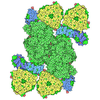
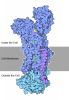
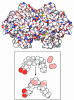
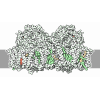
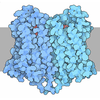
- Assembly
| Deposited unit | 
|
|---|---|
| 1 |
|
-Components
-Protein / Protein/peptide , 2 types, 2 molecules AB
| #1: Protein | Mass: 81404.992 Da / Num. of mol.: 1 Source method: isolated from a genetically manipulated source Source: (gene. exp.) Homo sapiens (human) / Gene: GGCX, GC / Production host: Homo sapiens (human)References: UniProt: P38435, peptidyl-glutamate 4-carboxylase |
|---|---|
| #2: Protein/peptide | Mass: 3382.779 Da / Num. of mol.: 1 Source method: isolated from a genetically manipulated source Source: (gene. exp.) Homo sapiens (human) / Gene: F9 / Production host: Homo sapiens (human) / References: UniProt: P00740, coagulation factor IXa |
-Sugars , 2 types, 3 molecules 
| #3: Polysaccharide | Source method: isolated from a genetically manipulated source #4: Sugar | ChemComp-NAG / | 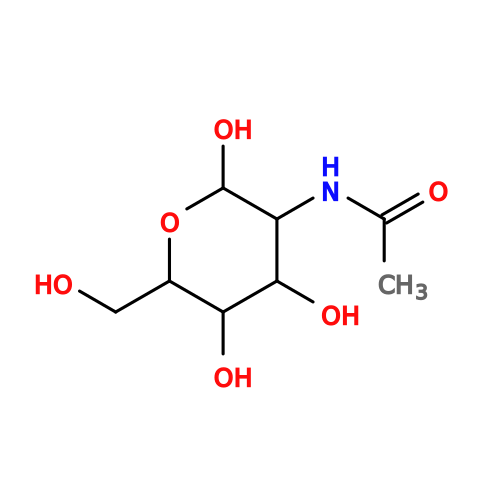 Type: D-saccharide, beta linking / Mass: 221.208 Da / Num. of mol.: 1 / Source method: obtained synthetically / Formula: C8H15NO6 Type: D-saccharide, beta linking / Mass: 221.208 Da / Num. of mol.: 1 / Source method: obtained synthetically / Formula: C8H15NO6 |
|---|
-Non-polymers , 7 types, 51 molecules 
| #5: Chemical | ChemComp-A1AVC / Mass: 452.712 Da / Num. of mol.: 1 / Source method: obtained synthetically / Formula: C31H48O2 / Feature type: SUBJECT OF INVESTIGATION | ||||||||
|---|---|---|---|---|---|---|---|---|---|
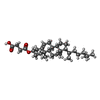
| #6: Chemical | ChemComp-CLR / 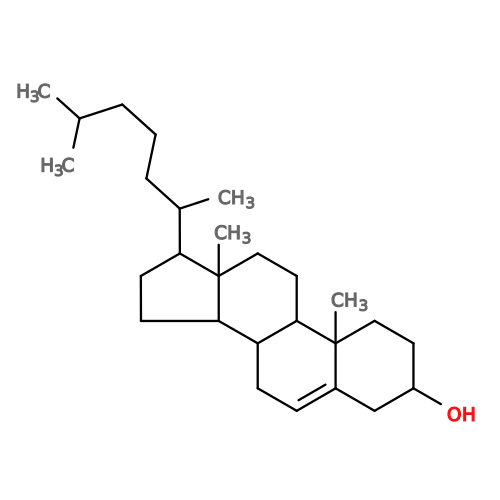 Mass: 386.654 Da / Num. of mol.: 1 / Source method: obtained synthetically / Formula: C27H46O Mass: 386.654 Da / Num. of mol.: 1 / Source method: obtained synthetically / Formula: C27H46O | ||||||||
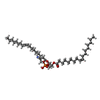
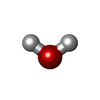
| #7: Chemical | 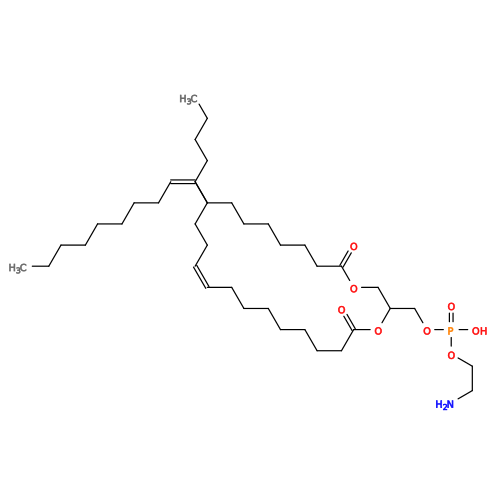 Mass: 744.034 Da / Num. of mol.: 3 / Source method: obtained synthetically / Formula: C41H78NO8P / Comment: DOPE, phospholipid*YM Mass: 744.034 Da / Num. of mol.: 3 / Source method: obtained synthetically / Formula: C41H78NO8P / Comment: DOPE, phospholipid*YM#8: Chemical | ChemComp-Y01 / | 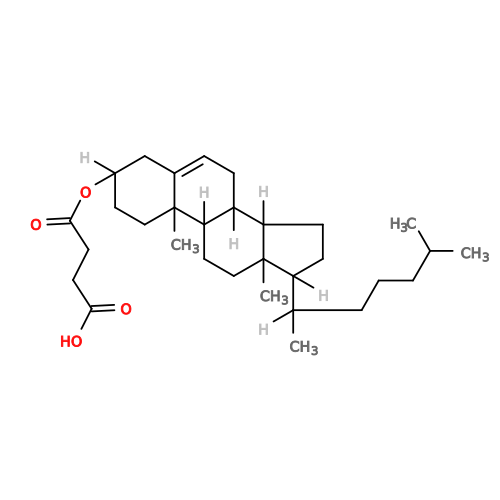 Mass: 486.726 Da / Num. of mol.: 1 / Source method: obtained synthetically / Formula: C31H50O4 Mass: 486.726 Da / Num. of mol.: 1 / Source method: obtained synthetically / Formula: C31H50O4#9: Chemical | ChemComp-CO2 / | 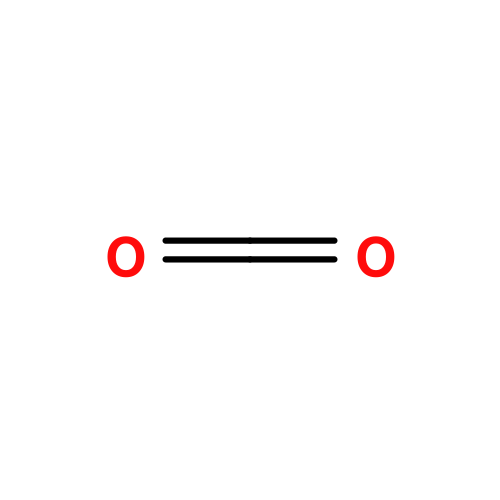 Mass: 44.010 Da / Num. of mol.: 1 / Source method: obtained synthetically / Formula: CO2 Mass: 44.010 Da / Num. of mol.: 1 / Source method: obtained synthetically / Formula: CO2#10: Chemical | ChemComp-BCT / | 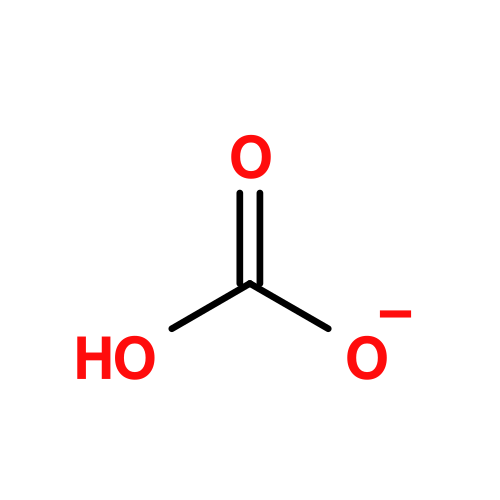 Mass: 61.017 Da / Num. of mol.: 1 / Source method: obtained synthetically / Formula: CHO3 / Comment: pH buffer*YM Mass: 61.017 Da / Num. of mol.: 1 / Source method: obtained synthetically / Formula: CHO3 / Comment: pH buffer*YM#11: Water | ChemComp-HOH / | Mass: 18.015 Da / Num. of mol.: 43 / Source method: isolated from a natural source / Formula: H2O |
-Details
| Has ligand of interest | Y |
|---|---|
| Has protein modification | Y |
-Experimental details
-Experiment
| Experiment | Method: ELECTRON MICROSCOPY |
|---|---|
| EM experiment | Aggregation state: PARTICLE / 3D reconstruction method: single particle reconstruction |
- Sample preparation
| Component | Name: Vitamin K-dependent gamma-carboxylase complexed with factor IX(Gla) Type: COMPLEX / Entity ID: #1-#2 / Source: RECOMBINANT |
|---|---|
| Source (natural) | Organism: Homo sapiens (human) |
| Source (recombinant) | Organism: Homo sapiens (human) |
| Buffer solution | pH: 7.5 |
| Specimen | Embedding applied: NO / Shadowing applied: NO / Staining applied: NO / Vitrification applied: YES |
| Vitrification | Cryogen name: ETHANE |
- Electron microscopy imaging
| Microscopy | Model: FEI/PHILIPS CM300FEG/T |
|---|---|
| Electron gun | Electron source:  FIELD EMISSION GUN / Accelerating voltage: 300 kV / Illumination mode: FLOOD BEAM FIELD EMISSION GUN / Accelerating voltage: 300 kV / Illumination mode: FLOOD BEAM |
| Electron lens | Mode: BRIGHT FIELD / Nominal defocus max: 1700 nm / Nominal defocus min: 900 nm |
| Image recording | Electron dose: 50 e/Å2 / Film or detector model: GATAN K3 (6k x 4k) |
- Processing
| EM software | Name: PHENIX / Version: 1.20.1_4487 / Category: model refinement |
|---|---|
| CTF correction | Type: PHASE FLIPPING AND AMPLITUDE CORRECTION |
| 3D reconstruction | Resolution: 2.41 Å / Resolution method: FSC 0.143 CUT-OFF / Num. of particles: 1267104 / Symmetry type: POINT |
| Refinement | Highest resolution: 2.41 Å Stereochemistry target values: REAL-SPACE (WEIGHTED MAP SUM AT ATOM CENTERS) |
