Journal: Nat Plants / Year: 2026 Title: Bottom-up reconstruction of synthetic pyrenoids provides insights into the mechanisms and evolution of carbon concentration by EPYC1 proteins. Authors: A M Küffner / B Pommerenke / L Kley / J Z Y Ng / S Prinz / M Tinzl-Zechner / L Schulz / P Claus / N Paczia / T Chotel / M Klose / J Zarzycki / G K A Hochberg / T J Erb / Abstract: Membraneless organelles play essential roles in many cellular processes. In various photosynthetic organisms, they are a crucial part of CO/carbon-concentrating mechanisms (CCMs) that increase ...Membraneless organelles play essential roles in many cellular processes. In various photosynthetic organisms, they are a crucial part of CO/carbon-concentrating mechanisms (CCMs) that increase photosynthetic productivity. One example is the pyrenoid in Chlamydomonas reinhardtii, a liquid-phase-separated organelle that localizes and improves CO fixation via the intrinsically disordered protein essential pyrenoid component 1 (EPYC1). Modern-day pyrenoids are complex structures with an elaborate cellular architecture and dozens of components, raising the question of how they could have developed from simpler condensates. Here we develop a bottom-up approach to study the function of EPYC1s and explore their sequence-function space across phylogenetic diversity and evolution. We demonstrate that extant and ancestral EPYC1 sequences induce phase separation of Rubisco into synthetic pyrenoids with functional CCMs. Surprisingly, these CCMs are mainly based on enhanced carboxylation rates (rather than increased specificity), offering new insights into the construction, function and evolution of natural and synthetic pyrenoids.
Mass: 18.015 Da / Num. of mol.: 415 / Source method: isolated from a natural source / Formula: H2O
Has ligand of interest
Y
Has protein modification
Y
-
Experimental details
-
Experiment
Experiment
Method: X-RAY DIFFRACTION / Number of used crystals: 1
-
Sample preparation
Crystal
Density Matthews: 3.87 Å3/Da / Density % sol: 68.23 %
Crystal grow
Temperature: 289 K / Method: vapor diffusion, sitting drop / pH: 7.3 Details: Crystallization of activated CbbM in buffer containing 20 mM Tris (pH 8.5), 100 mM NaCl, 0.2 mM CABP, and 10 mM sodium bicarbonate was mixed with a condition containing 200 mM Bis-Tris ...Details: Crystallization of activated CbbM in buffer containing 20 mM Tris (pH 8.5), 100 mM NaCl, 0.2 mM CABP, and 10 mM sodium bicarbonate was mixed with a condition containing 200 mM Bis-Tris propane (pH 7.3) and 20 % (w/v) PEG4000. Prior to plung freezing the crystals in liquid nitrogen the mother liquor was supplemented with 33 % (v/v) PEG200.
-
Data collection
Diffraction
Mean temperature: 100 K / Serial crystal experiment: N
Diffraction source
Source: SYNCHROTRON / Site: PETRA III, EMBL c/o DESY / Beamline: P13 (MX1) / Wavelength: 0.9762 Å
In the structure databanks used in Yorodumi, some data are registered as the other names, "COVID-19 virus" and "2019-nCoV". Here are the details of the virus and the list of structure data.
Jan 31, 2019. EMDB accession codes are about to change! (news from PDBe EMDB page)
EMDB accession codes are about to change! (news from PDBe EMDB page)
The allocation of 4 digits for EMDB accession codes will soon come to an end. Whilst these codes will remain in use, new EMDB accession codes will include an additional digit and will expand incrementally as the available range of codes is exhausted. The current 4-digit format prefixed with “EMD-” (i.e. EMD-XXXX) will advance to a 5-digit format (i.e. EMD-XXXXX), and so on. It is currently estimated that the 4-digit codes will be depleted around Spring 2019, at which point the 5-digit format will come into force.
The EM Navigator/Yorodumi systems omit the EMD- prefix.
Related info.:Q: What is EMD? / ID/Accession-code notation in Yorodumi/EM Navigator
Yorodumi is a browser for structure data from EMDB, PDB, SASBDB, etc.
This page is also the successor to EM Navigator detail page, and also detail information page/front-end page for Omokage search.
The word "yorodu" (or yorozu) is an old Japanese word meaning "ten thousand". "mi" (miru) is to see.
Related info.:EMDB / PDB / SASBDB / Comparison of 3 databanks / Yorodumi Search / Aug 31, 2016. New EM Navigator & Yorodumi / Yorodumi Papers / Jmol/JSmol / Function and homology information / Changes in new EM Navigator and Yorodumi
 Movie
Movie Controller

 Yorodumi
 Open data
 Basic information
 Components
 Keywords
 Function and homology information
 Rhodospirillum rubrum ATCC 11170 (bacteria)
 X-RAY DIFFRACTION /
  Authors
 Germany, 3items
  Citation
 Structure visualization
 Downloads & links
 Other downloads


 PDBj
PDBj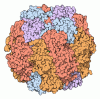
 Assembly
 Escherichia coli BL21(DE3) (bacteria)
 Mass: 24.305 Da / Num. of mol.: 2 / Source method: obtained synthetically / Formula: Mg / Feature type: SUBJECT OF INVESTIGATION
 Type: saccharide / Mass: 356.115 Da / Num. of mol.: 2 / Source method: obtained synthetically / Formula: C6H14O13P2 / Feature type: SUBJECT OF INVESTIGATION
 Mass: 18.015 Da / Num. of mol.: 415 / Source method: isolated from a natural source / Formula: H2O
 Sample preparation
 Processing