[English] 日本語
Yorodumi
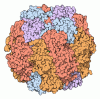
- PDB-9i26: inactive Form II Rubisco from Rhodospirillum rubrum -

+
Open data


ID or keywords:

Loading...

-
Basic information

Entry
Database: PDB / ID: 9i26
Titleinactive Form II Rubisco from Rhodospirillum rubrum
ComponentsRibulose bisphosphate carboxylase
KeywordsLYASE / ribulose-1 / 5-bisphosphate carboxylase/oxygenase / Rubisco
Function / homology
Function and homology information


ribulose-bisphosphate carboxylase / ribulose-bisphosphate carboxylase activity / reductive pentose-phosphate cycle / monooxygenase activity / magnesium ion binding
Similarity search - Function
Ribulose bisphosphate carboxylase large subunit, type II / Ribulose bisphosphate carboxylase, large chain, active site / Ribulose bisphosphate carboxylase large chain active site. / Ribulose bisphosphate carboxylase, large subunit, ferrodoxin-like N-terminal / Ribulose bisphosphate carboxylase large chain, N-terminal domain / Ribulose bisphosphate carboxylase, large subunit, C-terminal / RuBisCO / Ribulose bisphosphate carboxylase, large subunit, C-terminal domain superfamily / RuBisCO large subunit, N-terminal domain superfamily / Ribulose bisphosphate carboxylase large chain, catalytic domain
Similarity search - Domain/homology
Ribulose bisphosphate carboxylase
Similarity search - Component
Biological speciesRhodospirillum rubrum ATCC 11170 (bacteria)
MethodX-RAY DIFFRACTION / SYNCHROTRON / MOLECULAR REPLACEMENT / Resolution: 2.3 Å
AuthorsKueffner, A.M. / Zarzycki, J. / Erb, T.J.
Funding supportEuropean Union, Germany, 3items
OrganizationGrant numberCountry
European Molecular Biology Organization (EMBO)ALTF 684-2022European Union
Marie Sklodowska-Curie Actions, FragNET ITN101106795 - ECOFixEuropean Union
Max Planck Society Germany
CitationJournal: To Be Published
Title: Bottom-up reconstruction of minimal pyrenoids provides insights into the evolution and mechanisms of carbon concentration by EPYC1 proteins
Authors: Kueffner, A.M. / Pommerkenke, B. / Kley, L. / Ng, J.Z.Y. / Prinz, S. / Tinzl-Zechner, M. / Claus, P. / Paczia, N. / Zarzycki, J. / Hochberg, G.K.A. / Erb, T.J.
History
DepositionJan 20, 2025Deposition site: PDBE / Processing site: PDBE
Revision 1.0Feb 4, 2026Provider: repository / Type: Initial release

-
Structure visualization

Structure viewerMolecule:
MolmilJmol/JSmol

Downloads & links

-
Assembly

Deposited unit
A: Ribulose bisphosphate carboxylase
B: Ribulose bisphosphate carboxylase


Theoretical massNumber of molelcules
Total (without water)101,0782
Polymers101,0782
Non-polymers00
Water2,792155
1


  • Idetical with deposited unit
  • defined by author
  • Evidence: gel filtration
TypeNameSymmetry operationNumber
identity operation1_555x,y,z1
Buried area4320 Å2
ΔGint-21 kcal/mol
Surface area30240 Å2
Unit cell
Length a, b, c (Å)78.980, 78.980, 277.230
Angle α, β, γ (deg.)90.00, 90.00, 90.00
Int Tables number92
Space group name H-MP41212

-
Components

#1: Protein Ribulose bisphosphate carboxylase / RuBisCO


Mass: 50538.918 Da / Num. of mol.: 2
Source method: isolated from a genetically manipulated source
Source: (gene. exp.) Rhodospirillum rubrum ATCC 11170 (bacteria)
Gene: cbbM, Rru_A2400 / Production host: Escherichia coli BL21(DE3) (bacteria)
References: UniProt: Q2RRP5, ribulose-bisphosphate carboxylase
#2: Water ChemComp-HOH / water


Mass: 18.015 Da / Num. of mol.: 155 / Source method: isolated from a natural source / Formula: H2O
Has protein modificationN

-
Experimental details

-
Experiment

ExperimentMethod: X-RAY DIFFRACTION / Number of used crystals: 1

-
Sample preparation

CrystalDensity Matthews: 2.14 Å3/Da / Density % sol: 42.49 %
Crystal growTemperature: 289 K / Method: vapor diffusion, sitting drop / pH: 6
Details: Inactive CbbM in 20 mM Tris buffer (pH 8.5), containing 100 mM NaCl was mixed with condition comprised of 1.2 M ammonium chloride, 100 mM MES (pH 6), 20 %(w/v) PEG6000 in a 1:1 ratio with a ...Details: Inactive CbbM in 20 mM Tris buffer (pH 8.5), containing 100 mM NaCl was mixed with condition comprised of 1.2 M ammonium chloride, 100 mM MES (pH 6), 20 %(w/v) PEG6000 in a 1:1 ratio with a final drop volume of 1 micro liter. The mother liquor was supplemented with 30% (v/v) PEG200, before the crystals were plunge frozen in liquid nitrogen

-
Data collection

DiffractionMean temperature: 100 K / Serial crystal experiment: N
Diffraction sourceSource: SYNCHROTRON / Site: PETRA III, EMBL c/o DESY / Beamline: P13 (MX1) / Wavelength: 0.9762 Å
DetectorType: DECTRIS EIGER X 16M / Detector: PIXEL / Date: Jul 10, 2023
RadiationProtocol: SINGLE WAVELENGTH / Monochromatic (M) / Laue (L): M / Scattering type: x-ray
Radiation wavelengthWavelength: 0.9762 Å / Relative weight: 1
ReflectionResolution: 2.3→29.45 Å / Num. obs: 40094 / % possible obs: 99.8 % / Redundancy: 26.38 % / CC1/2: 1 / Rmerge(I) obs: 0.131 / Rrim(I) all: 0.134 / Net I/σ(I): 24.95
Reflection shell
Resolution (Å)Rmerge(I) obsNum. unique obsCC1/2Rrim(I) allDiffraction-ID
2.3-2.361.36428980.6561.3891
2.36-2.421.03128420.7931.051
2.42-2.490.84227470.8540.8571
2.49-2.570.68626930.9050.6991
2.57-2.660.58526080.9380.5961
2.66-2.750.49725150.9630.5061
2.75-2.850.39524610.9750.4031
2.85-2.970.33723420.9850.3431
2.97-3.10.30722760.9920.3121
3.1-3.250.27421350.9960.2791
3.25-3.430.18820720.9970.1911
3.43-3.640.13119440.9980.1331
3.64-3.890.09318600.9990.0941
3.89-4.20.06617460.9990.0681
4.2-4.60.05316050.9990.0541
4.6-5.140.047147610.0481
5.14-5.940.05113090.9990.0521
5.94-7.270.046113710.0471
7.27-10.290.03290210.0331
10.29-29.450.03152610.0311

-
Processing

Software
NameVersionClassification
PHENIX(1.21.2_5419: ???)refinement
XSCALEdata scaling
XDSdata reduction
PHENIXphasing
RefinementMethod to determine structure: MOLECULAR REPLACEMENT / Resolution: 2.3→29.45 Å / SU ML: 0.23 / Cross valid method: FREE R-VALUE / σ(F): 1.36 / Phase error: 20.84 / Stereochemistry target values: ML
RfactorNum. reflection% reflection
Rfree0.2263 2000 4.99 %
Rwork0.2036 --
obs0.2048 40091 99.88 %
Solvent computationShrinkage radii: 0.9 Å / VDW probe radii: 1.1 Å / Solvent model: FLAT BULK SOLVENT MODEL
Refinement stepCycle: LAST / Resolution: 2.3→29.45 Å
ProteinNucleic acidLigandSolventTotal
Num. atoms6369 0 0 155 6524
Refine LS restraints
Refine-IDTypeDev idealNumber
X-RAY DIFFRACTIONf_bond_d0.0026523
X-RAY DIFFRACTIONf_angle_d0.4428829
X-RAY DIFFRACTIONf_dihedral_angle_d10.4972325
X-RAY DIFFRACTIONf_chiral_restr0.039932
X-RAY DIFFRACTIONf_plane_restr0.0041162
LS refinement shell
Resolution (Å)Rfactor RfreeNum. reflection RfreeRfactor RworkNum. reflection RworkRefine-ID% reflection obs (%)
2.3-2.360.31131390.26762647X-RAY DIFFRACTION100
2.36-2.420.29311410.25692682X-RAY DIFFRACTION100
2.42-2.490.2661400.25112668X-RAY DIFFRACTION100
2.49-2.570.24851400.23582670X-RAY DIFFRACTION100
2.57-2.660.28041400.22482678X-RAY DIFFRACTION100
2.66-2.770.27121410.22332674X-RAY DIFFRACTION100
2.77-2.90.23221410.21682694X-RAY DIFFRACTION100
2.9-3.050.25841430.22352708X-RAY DIFFRACTION100
3.05-3.240.30231410.24862673X-RAY DIFFRACTION100
3.24-3.490.24391410.22882712X-RAY DIFFRACTION99
3.49-3.840.23141440.20152736X-RAY DIFFRACTION100
3.84-4.40.18691460.17092774X-RAY DIFFRACTION100
4.4-5.530.17091470.16112794X-RAY DIFFRACTION100
5.53-29.450.20141560.18862981X-RAY DIFFRACTION100
Refinement TLS params.Method: refined / Origin x: 47.6283 Å / Origin y: 36.4663 Å / Origin z: 111.2574 Å
111213212223313233
T0.2534 Å20.0018 Å20.0192 Å2-0.1981 Å2-0.0396 Å2--0.2652 Å2
L0.7142 °2-0.054 °2-0.2298 °2-0.6137 °20.0451 °2--1.0153 °2
S-0.0105 Å °0.054 Å °-0.1282 Å °-0.0506 Å °-0.0065 Å °0.0745 Å °0.0072 Å °-0.0142 Å °-0.0063 Å °
Refinement TLS groupSelection details: all

+
About Yorodumi

-
News

-
Feb 9, 2022. New format data for meta-information of EMDB entries

New format data for meta-information of EMDB entries

  • Version 3 of the EMDB header file is now the official format.
  • The previous official version 1.9 will be removed from the archive.

Related info.:EMDB header

External links:wwPDB to switch to version 3 of the EMDB data model

-
Aug 12, 2020. Covid-19 info

Covid-19 info

URL: https://pdbj.org/emnavi/covid19.php

New page: Covid-19 featured information page in EM Navigator.

Related info.:Covid-19 info / Mar 5, 2020. Novel coronavirus structure data

+
Mar 5, 2020. Novel coronavirus structure data

Novel coronavirus structure data

Related info.:Yorodumi Speices / Aug 12, 2020. Covid-19 info

External links:COVID-19 featured content - PDBj / Molecule of the Month (242):Coronavirus Proteases

+
Jan 31, 2019. EMDB accession codes are about to change! (news from PDBe EMDB page)

EMDB accession codes are about to change! (news from PDBe EMDB page)

  • The allocation of 4 digits for EMDB accession codes will soon come to an end. Whilst these codes will remain in use, new EMDB accession codes will include an additional digit and will expand incrementally as the available range of codes is exhausted. The current 4-digit format prefixed with “EMD-” (i.e. EMD-XXXX) will advance to a 5-digit format (i.e. EMD-XXXXX), and so on. It is currently estimated that the 4-digit codes will be depleted around Spring 2019, at which point the 5-digit format will come into force.
  • The EM Navigator/Yorodumi systems omit the EMD- prefix.

Related info.:Q: What is EMD? / ID/Accession-code notation in Yorodumi/EM Navigator

External links:EMDB Accession Codes are Changing Soon! / Contact to PDBj

+
Jul 12, 2017. Major update of PDB

Major update of PDB

  • wwPDB released updated PDB data conforming to the new PDBx/mmCIF dictionary.
  • This is a major update changing the version number from 4 to 5, and with Remediation, in which all the entries are updated.
  • In this update, many items about electron microscopy experimental information are reorganized (e.g. em_software).
  • Now, EM Navigator and Yorodumi are based on the updated data.

External links:wwPDB Remediation / Enriched Model Files Conforming to OneDep Data Standards Now Available in the PDB FTP Archive

-
Yorodumi

Thousand views of thousand structures

  • Yorodumi is a browser for structure data from EMDB, PDB, SASBDB, etc.
  • This page is also the successor to EM Navigator detail page, and also detail information page/front-end page for Omokage search.
  • The word "yorodu" (or yorozu) is an old Japanese word meaning "ten thousand". "mi" (miru) is to see.

Related info.:EMDB / PDB / SASBDB / Comparison of 3 databanks / Yorodumi Search / Aug 31, 2016. New EM Navigator & Yorodumi / Yorodumi Papers / Jmol/JSmol / Function and homology information / Changes in new EM Navigator and Yorodumi

Read more