 Movie
Movie Controller

[English] 日本語
 Yorodumi
- PDB-9hqp: Cryo-EM structure of mouse TMEM16F-YFP purified and plunged using... -
+ Open data

- Basic information
| Entry | Database: PDB / ID: 9hqp | |||||||||||||||||||||||||||
|---|---|---|---|---|---|---|---|---|---|---|---|---|---|---|---|---|---|---|---|---|---|---|---|---|---|---|---|---|
| Title | Cryo-EM structure of mouse TMEM16F-YFP purified and plunged using MISO (microfluidic isolation) | |||||||||||||||||||||||||||
 Components Components | Anoctamin-6,Yellow Fluorescent Protein | |||||||||||||||||||||||||||
 Keywords Keywords | MEMBRANE PROTEIN / lipid scramblase | |||||||||||||||||||||||||||
| Function / homology |  Function and homology information Function and homology informationcalcium activated galactosylceramide scrambling / phosphatidylserine exposure on blood platelet / calcium activated phosphatidylserine scrambling / calcium activated phosphatidylcholine scrambling / Amplification and propagation of coagulation cascade / Regulation of clotting cascade / positive regulation of potassium ion export across plasma membrane / positive regulation of monoatomic ion transmembrane transport / plasma membrane phospholipid scrambling / calcium activated phospholipid scrambling ...calcium activated galactosylceramide scrambling / phosphatidylserine exposure on blood platelet / calcium activated phosphatidylserine scrambling / calcium activated phosphatidylcholine scrambling / Amplification and propagation of coagulation cascade / Regulation of clotting cascade / positive regulation of potassium ion export across plasma membrane / positive regulation of monoatomic ion transmembrane transport / plasma membrane phospholipid scrambling / calcium activated phospholipid scrambling / activation of blood coagulation via clotting cascade / purinergic nucleotide receptor signaling pathway / bone mineralization involved in bone maturation / phospholipid scramblase activity / intracellularly calcium-gated chloride channel activity / bleb assembly / pore complex assembly / negative regulation of cell volume / voltage-gated monoatomic ion channel activity / cholinergic synapse / positive regulation of phagocytosis, engulfment / Stimuli-sensing channels / voltage-gated chloride channel activity / positive regulation of monocyte chemotaxis / calcium-activated cation channel activity / phospholipid translocation / chloride channel complex / dendritic cell chemotaxis / positive regulation of bone mineralization / chloride transport / regulation of postsynaptic membrane potential / positive regulation of endothelial cell apoptotic process / Neutrophil degranulation / chloride transmembrane transport / sodium ion transmembrane transport / synaptic membrane / blood coagulation / calcium ion transmembrane transport / positive regulation of apoptotic process / protein homodimerization activity / identical protein binding / plasma membrane / cytosol Similarity search - Function | |||||||||||||||||||||||||||
| Biological species |   Mus musculus (house mouse) Mus musculus (house mouse)  Aequorea victoria (jellyfish) Aequorea victoria (jellyfish) | |||||||||||||||||||||||||||
| Method | ELECTRON MICROSCOPY / single particle reconstruction / cryo EM / Resolution: 3.51 Å | |||||||||||||||||||||||||||
 Authors Authors | De Gieter, S. / Eluru, G. / Schenck, S. / Stroobants, A. / Efremov, R.G. / Brunner, J.D. | |||||||||||||||||||||||||||
| Funding support |  Belgium, European Union, 3items Belgium, European Union, 3items
| |||||||||||||||||||||||||||
 Citation Citation | Journal: Nat Methods / Year: 2025 Title: MISO: microfluidic protein isolation enables single-particle cryo-EM structure determination from a single cell colony. Authors: Gangadhar Eluru / Steven De Gieter / Stephan Schenck / Annelore Stroobants / Binesh Shrestha / Paul Erbel / Janine D Brunner / Rouslan G Efremov /  Abstract: Single-particle cryogenic electron microscopy (cryo-EM) enables reconstruction of atomic-resolution 3D maps of proteins by visualizing thousands to millions of purified protein particles embedded in ...Single-particle cryogenic electron microscopy (cryo-EM) enables reconstruction of atomic-resolution 3D maps of proteins by visualizing thousands to millions of purified protein particles embedded in vitreous ice. This corresponds to picograms of purified protein, which can potentially be isolated from a few thousand cells. Hence, cryo-EM holds the potential of a very sensitive analytical method for delivering high-resolution protein structure as a readout. In practice, millions of times more starting biological material is required to prepare cryo-EM grids. Here we show that using a micro isolation (MISO) method, which combines microfluidics-based protein purification with cryo-EM grid preparation, cryo-EM structures of soluble bacterial and eukaryotic membrane proteins can be solved starting from less than 1 µg of a target protein and progressing from cells to cryo-EM grids within a few hours. This scales down the amount of starting biological material hundreds to thousands of times, opening possibilities for the structural characterization of hitherto inaccessible proteins. | |||||||||||||||||||||||||||
| History |
|
- Structure visualization
| Structure viewer | Molecule: MolmilJmol/JSmol |
|---|
- Downloads & links
-Download
| PDBx/mmCIF format | 9hqp.cif.gz | 260.5 KB | Display | PDBx/mmCIF format |
|---|---|---|---|---|
| PDB format | pdb9hqp.ent.gz | 193.9 KB | Display | PDB format |
| PDBx/mmJSON format | 9hqp.json.gz | Tree view | PDBx/mmJSON format | |
| Others |  Other downloads Other downloads |
-Validation report
| Arichive directory | https://data.pdbj.org/pub/pdb/validation_reports/hq/9hqpftp://data.pdbj.org/pub/pdb/validation_reports/hq/9hqp | HTTPS FTP |
|---|
-Related structure data
| Related structure data |  52346MC  9hplC  9hpmC  9hqnC  9hqoC M: map data used to model this data C: citing same article ( |
|---|---|
| Similar structure data |


-Links
 PDBj
PDBj
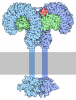
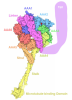
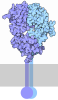
- Assembly
| Deposited unit | 
|
|---|---|
| 1 |
|
-Components
| #1: Protein | Mass: 140666.922 Da / Num. of mol.: 2 Source method: isolated from a genetically manipulated source Source: (gene. exp.) Mus musculus (house mouse), (gene. exp.) Aequorea victoria (jellyfish)Gene: Ano6, Tmem16f / Production host:  Homo sapiens (human) / References: UniProt: Q6P9J9 Homo sapiens (human) / References: UniProt: Q6P9J9#2: Chemical |   Mass: 40.078 Da / Num. of mol.: 2 / Source method: obtained synthetically / Formula: Ca Mass: 40.078 Da / Num. of mol.: 2 / Source method: obtained synthetically / Formula: CaHas ligand of interest | N | Has protein modification | Y | |
|---|
-Experimental details
-Experiment
| Experiment | Method: ELECTRON MICROSCOPY |
|---|---|
| EM experiment | Aggregation state: PARTICLE / 3D reconstruction method: single particle reconstruction |
- Sample preparation
| Component | Name: Scramblase 16F with c-terminal venus GFP / Type: CELL / Entity ID: #1 / Source: NATURAL |
|---|---|
| Source (natural) | Organism: Mus musculus (house mouse) |
| Buffer solution | pH: 7.6 Details: 150 mM NaCl, 30 mM HEPES-Na, pH 7.6, 0.0063% GDN, 10 mM D-(+)-biotin |
| Specimen | Embedding applied: NO / Shadowing applied: NO / Staining applied: NO / Vitrification applied: YES |
| Specimen support | Grid material: GOLD / Grid type: UltrAuFoil R1.2/1.3 |
| Vitrification | Cryogen name: ETHANE |
- Electron microscopy imaging
| Microscopy | Model: JEOL CRYO ARM 300 |
|---|---|
| Electron gun | Electron source:  FIELD EMISSION GUN / Accelerating voltage: 300 kV / Illumination mode: FLOOD BEAM FIELD EMISSION GUN / Accelerating voltage: 300 kV / Illumination mode: FLOOD BEAM |
| Electron lens | Mode: BRIGHT FIELD / Nominal defocus max: 1700 nm / Nominal defocus min: 1000 nm |
| Image recording | Electron dose: 60 e/Å2 / Film or detector model: GATAN K3 (6k x 4k) |
- Processing
| EM software |
| ||||||||||||||||||||||||
|---|---|---|---|---|---|---|---|---|---|---|---|---|---|---|---|---|---|---|---|---|---|---|---|---|---|
| CTF correction | Type: PHASE FLIPPING AND AMPLITUDE CORRECTION | ||||||||||||||||||||||||
| Symmetry | Point symmetry: C2 (2 fold cyclic) | ||||||||||||||||||||||||
| 3D reconstruction | Resolution: 3.51 Å / Resolution method: FSC 0.143 CUT-OFF / Num. of particles: 69117 / Symmetry type: POINT | ||||||||||||||||||||||||
| Refinement | Highest resolution: 3.51 Å Stereochemistry target values: REAL-SPACE (WEIGHTED MAP SUM AT ATOM CENTERS) | ||||||||||||||||||||||||
| Refine LS restraints |
|
