 Movie
Movie Controller


+ Open data

- Basic information
| Entry | Database: PDB / ID: 9eka | |||||||||||||||||||||
|---|---|---|---|---|---|---|---|---|---|---|---|---|---|---|---|---|---|---|---|---|---|---|
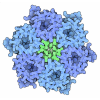
| Title | CRISPR-associated deaminase Cad1 in Apo form | |||||||||||||||||||||
 Components Components | CRISPR-associated ring nuclease and adenosine deaminase, subunit A | |||||||||||||||||||||
 Keywords Keywords | HYDROLASE / CRISPR-associated CARF ring nuclease / Cad1 / CRISPR-associated adenosine deaminase / S-adenosylmethionine / SIGNALING PROTEIN | |||||||||||||||||||||
| Function / homology |  Function and homology information Function and homology informationadenosine deaminase / inosine biosynthetic process / hypoxanthine salvage / adenosine deaminase activity / adenosine catabolic process / ATP binding / metal ion binding / cytosol Similarity search - Function | |||||||||||||||||||||
| Biological species |  Thermoanaerobaculum aquaticum (bacteria) Thermoanaerobaculum aquaticum (bacteria) | |||||||||||||||||||||
| Method | ELECTRON MICROSCOPY / single particle reconstruction / cryo EM / Resolution: 3.1 Å | |||||||||||||||||||||
 Authors Authors | Zhao, Y. / Whyms, C.T. / Li, H. | |||||||||||||||||||||
| Funding support |  United States, 1items United States, 1items
| |||||||||||||||||||||
 Citation Citation | Journal: EMBO J / Year: 2025 Title: The twist-and-squeeze activation of CARF-fused adenosine deaminase by cyclic oligoadenylates. Authors: Charlisa Whyms / Yu Zhao / Doreen Addo-Yobo / Huan He / Arthur Carl Whittington / Despoina Trasanidou / Carl Raymund P Salazar / Raymond H J Staals / Hong Li /  Abstract: The recently identified CARF (CRISPR-associated Rossman-fold) family of proteins play a critical role in prokaryotic defense, mediating cOA (cyclic oligoadenylate)-stimulated ancillary immune ...The recently identified CARF (CRISPR-associated Rossman-fold) family of proteins play a critical role in prokaryotic defense, mediating cOA (cyclic oligoadenylate)-stimulated ancillary immune responses in the type III CRISPR-Cas systems. Whereas most previously characterized CARF proteins contain nucleic acids or protein degradation effectors, a subset of the family, including the CARF-fused adenosine deaminase (ADA) (Cad1), has recently been shown to convert ATP to ITP. The enzymatic mechanism and the activation process of Cad1, however, remain incompletely understood. Here we present biochemical and structural analyses of a ring nuclease Cad1, revealing its substrate binding specificity and a sequential activation process by cOAs. Despite an overall structural similarity to canonical ADA enzymes, the ADA domain of Cad1 possesses unique structural features that confer a specificity for ATP. Supported by mutational analysis, our structural work demonstrates an allosteric link between the cOA-binding CARF and the ADA domain through a protein network within the hexameric enzyme assembly. Binding of a cA4 molecule to paired CARF domains induces a twisting of the linked ADA domains around one another, which remodels their active sites and alters interactions with neighboring ADA domains, thereby driving a sequential conformational activation mechanism. | |||||||||||||||||||||
| History |
|
- Structure visualization
| Structure viewer | Molecule: MolmilJmol/JSmol |
|---|
- Downloads & links
-Download
| PDBx/mmCIF format | 9eka.cif.gz | 861.3 KB | Display | PDBx/mmCIF format |
|---|---|---|---|---|
| PDB format | pdb9eka.ent.gz | 573.9 KB | Display | PDB format |
| PDBx/mmJSON format | 9eka.json.gz | Tree view | PDBx/mmJSON format | |
| Others |  Other downloads Other downloads |
-Validation report
| Arichive directory | https://data.pdbj.org/pub/pdb/validation_reports/ek/9ekaftp://data.pdbj.org/pub/pdb/validation_reports/ek/9eka | HTTPS FTP |
|---|
-Related structure data
| Related structure data |  48116MC  9ebtC  9mmwC  9of1C  9ofbC  9ofcC  9ofdC  9ofeC M: map data used to model this data C: citing same article ( |
|---|---|
| Similar structure data |


-Links
 PDBj
PDBj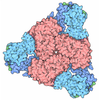
- Assembly
| Deposited unit | 
|
|---|---|
| 1 |
|
-Components
| #1: Protein | Mass: 69499.133 Da / Num. of mol.: 6 Source method: isolated from a genetically manipulated source Source: (gene. exp.) Thermoanaerobaculum aquaticum (bacteria)Gene: EG19_07865 / Production host:  Escherichia coli (E. coli) / References: UniProt: A0A062XY19, adenosine deaminase Escherichia coli (E. coli) / References: UniProt: A0A062XY19, adenosine deaminase#2: Chemical | ChemComp-ZN /   Mass: 65.409 Da / Num. of mol.: 6 / Source method: obtained synthetically / Formula: Zn / Feature type: SUBJECT OF INVESTIGATION Mass: 65.409 Da / Num. of mol.: 6 / Source method: obtained synthetically / Formula: Zn / Feature type: SUBJECT OF INVESTIGATIONHas ligand of interest | Y | Has protein modification | Y | |
|---|
-Experimental details
-Experiment
| Experiment | Method: ELECTRON MICROSCOPY |
|---|---|
| EM experiment | Aggregation state: PARTICLE / 3D reconstruction method: single particle reconstruction |
- Sample preparation
| Component | Name: protein-cA4 complex / Type: COMPLEX / Entity ID: #1 / Source: RECOMBINANT |
|---|---|
| Source (natural) | Organism: Thermoanaerobaculum aquaticum (bacteria) |
| Source (recombinant) | Organism: Escherichia coli (E. coli) |
| Buffer solution | pH: 7.5 |
| Specimen | Embedding applied: NO / Shadowing applied: NO / Staining applied: NO / Vitrification applied: YES |
| Vitrification | Cryogen name: ETHANE |
- Electron microscopy imaging
| Experimental equipment |  Model: Titan Krios / Image courtesy: FEI Company |
|---|---|
| Microscopy | Model: TFS KRIOS |
| Electron gun | Electron source:  FIELD EMISSION GUN / Accelerating voltage: 300 kV / Illumination mode: FLOOD BEAM FIELD EMISSION GUN / Accelerating voltage: 300 kV / Illumination mode: FLOOD BEAM |
| Electron lens | Mode: BRIGHT FIELD / Nominal magnification: 81000 X / Nominal defocus max: 2500 nm / Nominal defocus min: 800 nm |
| Image recording | Electron dose: 60 e/Å2 / Film or detector model: GATAN K3 BIOQUANTUM (6k x 4k) |
- Processing
| EM software | Name: PHENIX / Version: 1.21.2_5419 / Category: model refinement | ||||||||||||||||||||||||
|---|---|---|---|---|---|---|---|---|---|---|---|---|---|---|---|---|---|---|---|---|---|---|---|---|---|
| CTF correction | Type: PHASE FLIPPING AND AMPLITUDE CORRECTION | ||||||||||||||||||||||||
| 3D reconstruction | Resolution: 3.1 Å / Resolution method: FSC 0.143 CUT-OFF / Num. of particles: 15816 / Symmetry type: POINT | ||||||||||||||||||||||||
| Refinement | Cross valid method: NONE Stereochemistry target values: GeoStd + Monomer Library + CDL v1.2 | ||||||||||||||||||||||||
| Displacement parameters | Biso mean: 201.01 Å2 | ||||||||||||||||||||||||
| Refine LS restraints |
|
