 Movie
Movie Controller


+ Open data

- Basic information
| Entry | Database: PDB / ID: 9edt | |||||||||||||||
|---|---|---|---|---|---|---|---|---|---|---|---|---|---|---|---|---|
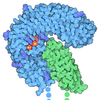
| Title | Tubulin cofactors D,E,G bound to tubulin dimer | |||||||||||||||
 Components Components |
| |||||||||||||||
 Keywords Keywords | CYTOSOLIC PROTEIN / Tubulin / cofactors / Tubulin cofactors / Tubulin biogenesis / Tubulin degradation / microtubules | |||||||||||||||
| Function / homology |  Function and homology information Function and homology informationpost-chaperonin tubulin folding pathway / tubulin complex assembly / alpha-tubulin binding / beta-tubulin binding / GTPase activator activity / neuron migration / microtubule cytoskeleton organization / structural constituent of cytoskeleton / microtubule cytoskeleton / neuron differentiation ...post-chaperonin tubulin folding pathway / tubulin complex assembly / alpha-tubulin binding / beta-tubulin binding / GTPase activator activity / neuron migration / microtubule cytoskeleton organization / structural constituent of cytoskeleton / microtubule cytoskeleton / neuron differentiation / mitotic cell cycle / protein folding / microtubule / Hydrolases; Acting on acid anhydrides; Acting on GTP to facilitate cellular and subcellular movement / hydrolase activity / GTPase activity / GTP binding / metal ion binding / cytoplasm Similarity search - Function | |||||||||||||||
| Biological species |   Saccharomyces cerevisiae (brewer's yeast) Saccharomyces cerevisiae (brewer's yeast)  Sus scrofa (pig) Sus scrofa (pig)  Escherichia coli (E. coli) Escherichia coli (E. coli) | |||||||||||||||
| Method | ELECTRON MICROSCOPY / single particle reconstruction / cryo EM / Resolution: 3.7 Å | |||||||||||||||
 Authors Authors | Taheri, A. / Al-bassam, J. | |||||||||||||||
| Funding support |  United States, 1items United States, 1items
| |||||||||||||||
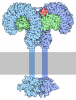
 Citation Citation | Journal: Nat Commun / Year: 2025 Title: Cryo-EM structures of the tubulin cofactors reveal the molecular basis of alpha/beta-tubulin biogenesis. Authors: Aryan Taheri / Zhoaqian Wang / Bharti Singal / Fei Guo / Jawdat Al-Bassam / Abstract: Microtubule polarity and dynamic polymerization arise from the self-association properties of the αβ-tubulin heterodimer. For decades, it has remained unclear how the tubulin cofactors TBCD, TBCE, ...Microtubule polarity and dynamic polymerization arise from the self-association properties of the αβ-tubulin heterodimer. For decades, it has remained unclear how the tubulin cofactors TBCD, TBCE, TBCC, and the Arl2 GTPase mediate the biogenesis of αβ-tubulin from individual α- and β-tubulins. Here, we use cryo-electron microscopy to determine structures of tubulin cofactors bound to αβ-tubulin. TBCD, TBCE, and Arl2 form a heterotrimeric cage-like assembly, we term TBC-DEG, around the αβ-tubulin heterodimer. The TBC-DEG-αβ-tubulin structures show that TBC-DEG wraps around β-tubulin while TBCE extends along α-tubulin. The TBC-DEG/TBCC-αβ-tubulin structures reveal that TBCC forms multi-domain interactions with Arl2 and TBCD to engage the αβ-tubulin intradimer-interface, promoting TBCE rotation while TBCD holds β-tubulin. TBCC engages the GTP-bound Arl2, multiple sites of TBCD, and the native αβ-tubulin intradimer interface near the α-tubulin N-site GTP. Together, these structures uncover transition states for αβ-tubulin biogenesis and degradation, suggesting a vise-like, GTP-hydrolysis-dependent mechanism in which TBCC binding to TBC-DEG modulates αβ-tubulin interfaces. Our studies provide structural evidence that tubulin cofactors act as enzymatic regulators that assemble the invariant αβ-tubulin architecture. By catalyzing α- and β-tubulin biogenesis and degradation, the TBC-DEG and TBCC assemblies regulate the polymerization competency of αβ-tubulin for microtubule formation. | |||||||||||||||
| History |
|
- Structure visualization
| Structure viewer | Molecule: MolmilJmol/JSmol |
|---|
- Downloads & links
-Download
| PDBx/mmCIF format | 9edt.cif.gz | 371.5 KB | Display | PDBx/mmCIF format |
|---|---|---|---|---|
| PDB format | pdb9edt.ent.gz | 255.5 KB | Display | PDB format |
| PDBx/mmJSON format | 9edt.json.gz | Tree view | PDBx/mmJSON format | |
| Others |  Other downloads Other downloads |
-Validation report
| Arichive directory | https://data.pdbj.org/pub/pdb/validation_reports/ed/9edtftp://data.pdbj.org/pub/pdb/validation_reports/ed/9edt | HTTPS FTP |
|---|
-Related structure data
| Related structure data |  47949MC  9edrC  9edsC  9eebC M: map data used to model this data C: citing same article ( |
|---|---|
| Similar structure data |


-Links
 PDBj
PDBj
- Assembly
| Deposited unit | 
|
|---|---|
| 1 |
|
-Components
-Protein , 6 types, 6 molecules DGABFE
| #1: Protein | Mass: 117608.211 Da / Num. of mol.: 1 Source method: isolated from a genetically manipulated source Source: (gene. exp.) Saccharomyces cerevisiae (brewer's yeast)Gene: CIN1, YOR349W, O6350 / Production host: Escherichia coli (E. coli) / References: UniProt: P40987 |
|---|---|
| #2: Protein | Mass: 22096.717 Da / Num. of mol.: 1 Source method: isolated from a genetically manipulated source Source: (gene. exp.) Saccharomyces cerevisiae (brewer's yeast)Gene: CIN4, GTP1, UGX1, YMR138W, YM9375.07 / Production host: Escherichia coli (E. coli) / References: UniProt: P39110 |
| #3: Protein | Mass: 50121.266 Da / Num. of mol.: 1 / Source method: isolated from a natural source / Source: (natural) Sus scrofa (pig) / References: UniProt: P02550 |
| #4: Protein | Mass: 49907.770 Da / Num. of mol.: 1 / Source method: isolated from a natural source / Source: (natural) Sus scrofa (pig) / References: UniProt: P02554 |
| #5: Protein | Mass: 17955.262 Da / Num. of mol.: 1 / Source method: obtained synthetically / Source: (synth.) Escherichia coli (E. coli) |
| #6: Protein | Mass: 41916.664 Da / Num. of mol.: 1 Source method: isolated from a genetically manipulated source Details: Chain E contains a well-resolved C-terminal region that was modeled with full side-chain identities. Density for the LRR and CAP-Gly domains is weaker and discontinuous, consistent with ...Details: Chain E contains a well-resolved C-terminal region that was modeled with full side-chain identities. Density for the LRR and CAP-Gly domains is weaker and discontinuous, consistent with flexibility of this portion of the protein in the complex. Therefore, residues in these regions are modeled as poly-alanine to represent the backbone trace and overall topology only (listed as UNK in the entry). Side-chain identities are not asserted in these low-density regions. The sequence register is anchored by the well-resolved C-terminal domain and supported by the AlphaFold prediction. Source: (gene. exp.) Saccharomyces cerevisiae (brewer's yeast)Gene: PAC2, YER007W / Production host: Escherichia coli (E. coli) / References: UniProt: P39937 |
-Non-polymers , 2 types, 3 molecules 
| #7: Chemical | 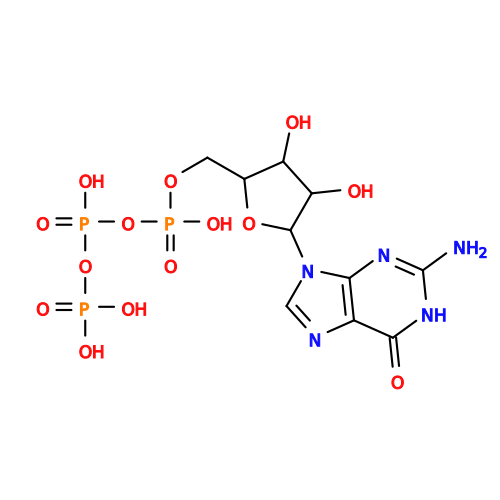 Mass: 523.180 Da / Num. of mol.: 2 / Source method: obtained synthetically / Formula: C10H16N5O14P3 / Feature type: SUBJECT OF INVESTIGATION / Comment: GTP, energy-carrying molecule*YM Mass: 523.180 Da / Num. of mol.: 2 / Source method: obtained synthetically / Formula: C10H16N5O14P3 / Feature type: SUBJECT OF INVESTIGATION / Comment: GTP, energy-carrying molecule*YM#8: Chemical | ChemComp-GDP / | 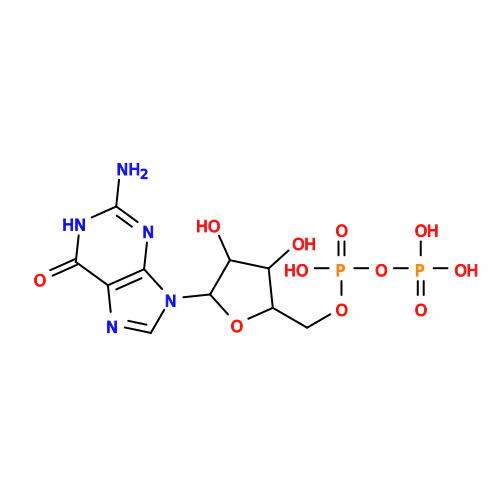 Type: RNA linking / Mass: 443.201 Da / Num. of mol.: 1 / Source method: obtained synthetically / Formula: C10H15N5O11P2 / Feature type: SUBJECT OF INVESTIGATION / Comment: GDP, energy-carrying molecule*YM Type: RNA linking / Mass: 443.201 Da / Num. of mol.: 1 / Source method: obtained synthetically / Formula: C10H15N5O11P2 / Feature type: SUBJECT OF INVESTIGATION / Comment: GDP, energy-carrying molecule*YM |
|---|
-Details
| Has ligand of interest | Y |
|---|---|
| Has protein modification | N |
-Experimental details
-Experiment
| Experiment | Method: ELECTRON MICROSCOPY |
|---|---|
| EM experiment | Aggregation state: PARTICLE / 3D reconstruction method: single particle reconstruction |
- Sample preparation
| Component | Name: Tubulin cofactors D,E,G bound to tubulin dimer / Type: COMPLEX / Entity ID: #1-#6 / Source: MULTIPLE SOURCES |
|---|---|
| Source (natural) | Organism: Saccharomyces cerevisiae (brewer's yeast) |
| Source (recombinant) | Organism: Escherichia coli (E. coli) |
| Buffer solution | pH: 7 |
| Specimen | Embedding applied: NO / Shadowing applied: NO / Staining applied: NO / Vitrification applied: YES |
| Vitrification | Cryogen name: ETHANE |
- Electron microscopy imaging
| Experimental equipment |  Model: Titan Krios / Image courtesy: FEI Company |
|---|---|
| Microscopy | Model: TFS KRIOS |
| Electron gun | Electron source:  FIELD EMISSION GUN / Accelerating voltage: 300 kV / Illumination mode: FLOOD BEAM FIELD EMISSION GUN / Accelerating voltage: 300 kV / Illumination mode: FLOOD BEAM |
| Electron lens | Mode: BRIGHT FIELD / Nominal defocus max: 2100 nm / Nominal defocus min: 900 nm |
| Image recording | Electron dose: 50 e/Å2 / Film or detector model: GATAN K2 BASE (4k x 4k) |
- Processing
| EM software |
| ||||||||||||||||
|---|---|---|---|---|---|---|---|---|---|---|---|---|---|---|---|---|---|
| CTF correction | Type: PHASE FLIPPING AND AMPLITUDE CORRECTION | ||||||||||||||||
| 3D reconstruction | Resolution: 3.7 Å / Resolution method: FSC 0.143 CUT-OFF / Num. of particles: 275487 / Symmetry type: POINT |
