 Movie
Movie Controller


+ Open data

- Basic information
| Entry | Database: PDB / ID: 9e4i | |||||||||||||||||||||||||||
|---|---|---|---|---|---|---|---|---|---|---|---|---|---|---|---|---|---|---|---|---|---|---|---|---|---|---|---|---|
| Title | Human ASIC1a at pH 7.5 in complex with MitTx | |||||||||||||||||||||||||||
 Components Components |
| |||||||||||||||||||||||||||
 Keywords Keywords | MEMBRANE PROTEIN / Ion channel / Trimer / Toxin | |||||||||||||||||||||||||||
| Function / homology |  Function and homology information Function and homology informationmonoatomic ion-gated channel activity / sensory perception of sour taste / pH-gated monoatomic ion channel activity / ion channel regulator activity / cellular response to pH / A2-type glycerophospholipase activity / arachidonate secretion / sodium ion transport / ligand-gated sodium channel activity / phospholipid metabolic process ...monoatomic ion-gated channel activity / sensory perception of sour taste / pH-gated monoatomic ion channel activity / ion channel regulator activity / cellular response to pH / A2-type glycerophospholipase activity / arachidonate secretion / sodium ion transport / ligand-gated sodium channel activity / phospholipid metabolic process / lipid catabolic process / regulation of postsynapse assembly / toxin activity / serine-type endopeptidase inhibitor activity / sodium ion transmembrane transport / phospholipid binding / postsynaptic density membrane / Stimuli-sensing channels / postsynaptic membrane / calcium ion binding / dendrite / glutamatergic synapse / cell surface / extracellular region / plasma membrane Similarity search - Function | |||||||||||||||||||||||||||
| Biological species |  Homo sapiens (human) Homo sapiens (human) Micrurus tener tener (cobra) Micrurus tener tener (cobra) | |||||||||||||||||||||||||||
| Method | ELECTRON MICROSCOPY / single particle reconstruction / cryo EM / Resolution: 2.33 Å | |||||||||||||||||||||||||||
 Authors Authors | Hartfield, K.A. / Yoshioka, C. / Cahill, J. / Baconguis, I. | |||||||||||||||||||||||||||
| Funding support |  United States, 1items United States, 1items
| |||||||||||||||||||||||||||
 Citation Citation | Journal: Nat Struct Mol Biol / Year: 2026 Title: Conformational plasticity of human acid-sensing ion channel 1a. Authors: James Cahill / Kimberly A Hartfield / Stephanie Andrea Heusser / Nadine Ritter / Mette Homann Poulsen / Craig Yoshioka / Stephan Alexander Pless / Isabelle Baconguis /   Abstract: Acid-sensing ion channels (ASICs) are typically activated by acidic environments and contribute to nociception and synaptic plasticity. ASIC1a is the most abundant subunit in the central nervous ...Acid-sensing ion channels (ASICs) are typically activated by acidic environments and contribute to nociception and synaptic plasticity. ASIC1a is the most abundant subunit in the central nervous system and forms homomeric channels permeable to Na and Ca, making it a compelling therapeutic target for acidotic pathologies including stroke and traumatic brain injury. However, a complete conformational library of human ASIC1a has yet to be described. Here we show that human ASIC1a adopts six major conformations, resolved by cryo-electron microscopy across a pH range between 8.5 and 5.7 and in the presence of a toxin agonist and a gating-modifying amino acid substitution. These major conformations establish linear transmembrane helices to be associated with an open state, delineate mechanistic differences between proton and toxin activation and demonstrate that desensitization involves unexpected conformational diversity in the transmembrane domain. Together, they provide a three-dimensional framework to integrate previous structure-function studies on ASIC. | |||||||||||||||||||||||||||
| History |
|
- Structure visualization
| Structure viewer | Molecule: MolmilJmol/JSmol |
|---|
- Downloads & links
-Download
| PDBx/mmCIF format | 9e4i.cif.gz | 358.8 KB | Display | PDBx/mmCIF format |
|---|---|---|---|---|
| PDB format | pdb9e4i.ent.gz | 290.4 KB | Display | PDB format |
| PDBx/mmJSON format | 9e4i.json.gz | Tree view | PDBx/mmJSON format | |
| Others |  Other downloads Other downloads |
-Validation report
| Arichive directory | https://data.pdbj.org/pub/pdb/validation_reports/e4/9e4iftp://data.pdbj.org/pub/pdb/validation_reports/e4/9e4i | HTTPS FTP |
|---|
-Related structure data
| Related structure data |  47511MC  9e4aC  9e4bC  9e4cC  9e4dC  9e4eC  9e4fC  9e4gC  9e4hC  9e4jC  9e4kC M: map data used to model this data C: citing same article ( |
|---|---|
| Similar structure data |


-Links
 PDBj
PDBj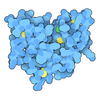

- Assembly
| Deposited unit | 
|
|---|---|
| 1 |
|
-Components
| #1: Protein | Mass: 60252.625 Da / Num. of mol.: 3 Source method: isolated from a genetically manipulated source Details: Thrombin cleavage product of construct with N-terminal fusion of 8xHis-EGFP-Thrombin site Source: (gene. exp.) Homo sapiens (human) / Gene: ASIC1, ACCN2, BNAC2 / Cell line (production host): HEK293S GnTI- / Production host: Homo sapiens (human) / References: UniProt: P78348#2: Protein | Mass: 7117.976 Da / Num. of mol.: 3 / Source method: isolated from a natural source / Source: (natural) Micrurus tener tener (cobra) / References: UniProt: G9I929#3: Protein | Mass: 13767.645 Da / Num. of mol.: 3 / Source method: isolated from a natural source / Source: (natural) Micrurus tener tener (cobra) / References: UniProt: G9I930Has ligand of interest | N | Has protein modification | Y | |
|---|
-Experimental details
-Experiment
| Experiment | Method: ELECTRON MICROSCOPY |
|---|---|
| EM experiment | Aggregation state: PARTICLE / 3D reconstruction method: single particle reconstruction |
- Sample preparation
| Component |
| |||||||||||||||||||||||||
|---|---|---|---|---|---|---|---|---|---|---|---|---|---|---|---|---|---|---|---|---|---|---|---|---|---|---|
| Molecular weight |
| |||||||||||||||||||||||||
| Source (natural) |
| |||||||||||||||||||||||||
| Source (recombinant) |
| |||||||||||||||||||||||||
| Buffer solution | pH: 7.5 | |||||||||||||||||||||||||
| Buffer component |
| |||||||||||||||||||||||||
| Specimen | Conc.: 4 mg/ml / Embedding applied: NO / Shadowing applied: NO / Staining applied: NO / Vitrification applied: YES Details: Monodisperse sample of homotrimeric ASIC1a mixed with MitTx alpha-beta complex | |||||||||||||||||||||||||
| Specimen support | Grid material: GOLD / Grid mesh size: 200 divisions/in. / Grid type: Quantifoil R2/1 | |||||||||||||||||||||||||
| Vitrification | Instrument: FEI VITROBOT MARK IV / Cryogen name: ETHANE / Humidity: 100 % / Chamber temperature: 285.15 K |
- Electron microscopy imaging
| Experimental equipment |  Model: Titan Krios / Image courtesy: FEI Company |
|---|---|
| Microscopy | Model: TFS KRIOS |
| Electron gun | Electron source:  FIELD EMISSION GUN / Accelerating voltage: 300 kV / Illumination mode: FLOOD BEAM FIELD EMISSION GUN / Accelerating voltage: 300 kV / Illumination mode: FLOOD BEAM |
| Electron lens | Mode: BRIGHT FIELD / Nominal defocus max: 2500 nm / Nominal defocus min: 800 nm / Cs: 2.7 mm |
| Image recording | Electron dose: 50 e/Å2 / Film or detector model: GATAN K3 (6k x 4k) |
- Processing
| EM software |
| ||||||||||||||||||||||||||||||
|---|---|---|---|---|---|---|---|---|---|---|---|---|---|---|---|---|---|---|---|---|---|---|---|---|---|---|---|---|---|---|---|
| CTF correction | Type: PHASE FLIPPING AND AMPLITUDE CORRECTION | ||||||||||||||||||||||||||||||
| 3D reconstruction | Resolution: 2.33 Å / Resolution method: FSC 0.143 CUT-OFF / Num. of particles: 541317 / Symmetry type: POINT | ||||||||||||||||||||||||||||||
| Refine LS restraints |
|
