 Movie
Movie Controller

[English] 日本語
 Yorodumi
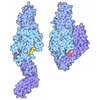
- PDB-9d74: CryoEM structure of anti-MHC-I Fab B1.23.2 complex with HLA-B44:05 -
+ Open data

- Basic information
| Entry | Database: PDB / ID: 9d74 | |||||||||||||||||||||||||||
|---|---|---|---|---|---|---|---|---|---|---|---|---|---|---|---|---|---|---|---|---|---|---|---|---|---|---|---|---|
| Title | CryoEM structure of anti-MHC-I Fab B1.23.2 complex with HLA-B44:05 | |||||||||||||||||||||||||||
 Components Components |
| |||||||||||||||||||||||||||
 Keywords Keywords | IMMUNE SYSTEM / MHC-I / anti-human-mAb / H2-Dd / B1.23.2 / Fab / anti-MHC-I antibody / anti-tumor / cancer immunotherapy | |||||||||||||||||||||||||||
| Function / homology |  Function and homology information Function and homology informationantigen processing and presentation of peptide or polysaccharide antigen via MHC class II / antigen processing and presentation of peptide antigen via MHC class I / regulation of natural killer cell mediated immunity / early endosome lumen / Nef mediated downregulation of MHC class I complex cell surface expression / DAP12 interactions / Endosomal/Vacuolar pathway / Antigen Presentation: Folding, assembly and peptide loading of class I MHC / lumenal side of endoplasmic reticulum membrane / regulation of iron ion transport ...antigen processing and presentation of peptide or polysaccharide antigen via MHC class II / antigen processing and presentation of peptide antigen via MHC class I / regulation of natural killer cell mediated immunity / early endosome lumen / Nef mediated downregulation of MHC class I complex cell surface expression / DAP12 interactions / Endosomal/Vacuolar pathway / Antigen Presentation: Folding, assembly and peptide loading of class I MHC / lumenal side of endoplasmic reticulum membrane / regulation of iron ion transport / negative regulation of iron ion transport / negative regulation of forebrain neuron differentiation / antigen processing and presentation of exogenous peptide antigen via MHC class Ib / peptide antigen assembly with MHC class I protein complex / ER to Golgi transport vesicle membrane / HFE-transferrin receptor complex / MHC class I peptide loading complex / transferrin transport / negative regulation of receptor-mediated endocytosis / cellular response to iron ion / positive regulation of T cell cytokine production / antigen processing and presentation of endogenous peptide antigen via MHC class I / MHC class I protein complex / peptide antigen assembly with MHC class II protein complex / negative regulation of epithelial cell proliferation / cellular response to nicotine / negative regulation of neurogenesis / MHC class II protein complex / positive regulation of receptor-mediated endocytosis / positive regulation of immune response / specific granule lumen / antigen processing and presentation of exogenous peptide antigen via MHC class II / peptide antigen binding / recycling endosome membrane / phagocytic vesicle membrane / positive regulation of T cell activation / Interferon gamma signaling / Immunoregulatory interactions between a Lymphoid and a non-Lymphoid cell / sensory perception of smell / Modulation by Mtb of host immune system / tertiary granule lumen / positive regulation of cellular senescence / MHC class II protein complex binding / DAP12 signaling / late endosome membrane / ER-Phagosome pathway / early endosome membrane / amyloid fibril formation / protein homotetramerization / adaptive immune response / intracellular iron ion homeostasis / learning or memory / immune response / endoplasmic reticulum lumen / Amyloid fiber formation / external side of plasma membrane / Golgi membrane / lysosomal membrane / focal adhesion / Neutrophil degranulation / SARS-CoV-2 activates/modulates innate and adaptive immune responses / structural molecule activity / Golgi apparatus / endoplasmic reticulum / protein homodimerization activity / : / extracellular exosome / extracellular region / membrane / identical protein binding / plasma membrane Similarity search - Function | |||||||||||||||||||||||||||
| Biological species |  Homo sapiens (human) Homo sapiens (human)synthetic construct (others) | |||||||||||||||||||||||||||
| Method | ELECTRON MICROSCOPY / single particle reconstruction / cryo EM / Resolution: 3.31 Å | |||||||||||||||||||||||||||
 Authors Authors | Jiang, J. / Natarajan, K. / Margulies, D.H. / Lei, H. / Huang, R. | |||||||||||||||||||||||||||
| Funding support |  United States, 1items United States, 1items
| |||||||||||||||||||||||||||
 Citation Citation | Journal: Commun Biol / Year: 2026 Title: Structural mechanism of anti-MHC-I antibody blocking of inhibitory NK cell receptors in tumor immunity. Authors: Jiansheng Jiang / Abir K Panda / Kannan Natarajan / Haotian Lei / Shikha Sharma / Lisa F Boyd / Reanne R Towler / Sruthi Chempati / Javeed Ahmad / Abraham J Morton / Zabrina C Lang / Yi Sun ...Authors: Jiansheng Jiang / Abir K Panda / Kannan Natarajan / Haotian Lei / Shikha Sharma / Lisa F Boyd / Reanne R Towler / Sruthi Chempati / Javeed Ahmad / Abraham J Morton / Zabrina C Lang / Yi Sun / Nikolaos Sgourakis / Martin Meier-Schellersheim / Rick K Huang / Ethan M Shevach / David H Margulies / Abstract: Anti-major histocompatibility complex class I (MHC-I) mAbs can stimulate immune responses to tumors and infections by blocking suppressive signals delivered via various immune inhibitory receptors. ...Anti-major histocompatibility complex class I (MHC-I) mAbs can stimulate immune responses to tumors and infections by blocking suppressive signals delivered via various immune inhibitory receptors. To understand such functions, we determined the structure of a highly cross-reactive anti-human MHC-I mAb, B1.23.2, in complex with the MHC-I molecule HLA-B*44:05 by both cryo-electron microscopy (cryo-EM) and X-ray crystallography. Structural models determined by the two methods were essentially identical revealing that B1.23.2 binds a conserved region on the α2 helix that overlaps the killer immunoglobulin-like receptor (KIR) binding site. Structural comparison to KIR/HLA complexes reveals a mechanism by which B1.23.2 blocks inhibitory receptor interactions, leading to natural killer (NK) cell activation. B1.23.2 treatment of the human KLM-1 pancreatic cancer model in humanized (NSG-IL15) mice provides evidence of suppression of tumor growth. Such anti-MHC-I mAb that block inhibitory KIR/HLA interactions may prove useful for tumor immunotherapy. | |||||||||||||||||||||||||||
| History |
|
- Structure visualization
| Structure viewer | Molecule: MolmilJmol/JSmol |
|---|
- Downloads & links
-Download
| PDBx/mmCIF format | 9d74.cif.gz | 165.5 KB | Display | PDBx/mmCIF format |
|---|---|---|---|---|
| PDB format | pdb9d74.ent.gz | 125.4 KB | Display | PDB format |
| PDBx/mmJSON format | 9d74.json.gz | Tree view | PDBx/mmJSON format | |
| Others |  Other downloads Other downloads |
-Validation report
| Arichive directory | https://data.pdbj.org/pub/pdb/validation_reports/d7/9d74ftp://data.pdbj.org/pub/pdb/validation_reports/d7/9d74 | HTTPS FTP |
|---|
-Related structure data
| Related structure data |  46602MC  8tq6C  9d73C  9oa9C C: citing same article ( M: map data used to model this data |
|---|---|
| Similar structure data |


-Links
 PDBj
PDBj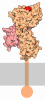
- Assembly
| Deposited unit | 
|
|---|---|
| 1 |
|
-Components
| #1: Protein | Mass: 31802.119 Da / Num. of mol.: 1 Source method: isolated from a genetically manipulated source Source: (gene. exp.) Homo sapiens (human) / Gene: HLA-B / Plasmid: pET21b / Production host:   Escherichia coli BL21(DE3) (bacteria) / References: UniProt: Q860B7 Escherichia coli BL21(DE3) (bacteria) / References: UniProt: Q860B7 |
|---|---|
| #2: Protein | Mass: 11879.356 Da / Num. of mol.: 1 / Fragment: UNP residues 21-119 Source method: isolated from a genetically manipulated source Source: (gene. exp.) Homo sapiens (human) / Gene: B2M, CDABP0092, HDCMA22P / Plasmid: pET3a / Production host: Escherichia coli BL21(DE3) (bacteria) / References: UniProt: P61769 |
| #3: Antibody | Mass: 22845.555 Da / Num. of mol.: 1 Source method: isolated from a genetically manipulated source Source: (gene. exp.) Homo sapiens (human) / Plasmid: pCDNA3.1 / Cell (production host): EXpi293F / Production host: Homo sapiens (human) |
| #4: Antibody | Mass: 23846.432 Da / Num. of mol.: 1 Source method: isolated from a genetically manipulated source Source: (gene. exp.) Homo sapiens (human) / Plasmid: pCDNA3.1 / Cell (production host): Expi293F / Production host: Homo sapiens (human) |
| #5: Protein/peptide | Mass: 1090.165 Da / Num. of mol.: 1 Fragment: HLA-DPA1*02:01 derived peptide 77-85 (UNP residues 36-44) Source method: obtained synthetically / Source: (synth.) synthetic construct (others) / References: UniProt: Q9TQB0 |
| Has protein modification | Y |
-Experimental details
-Experiment
| Experiment | Method: ELECTRON MICROSCOPY |
|---|---|
| EM experiment | Aggregation state: PARTICLE / 3D reconstruction method: single particle reconstruction |
- Sample preparation
| Component | Name: Complex of Anti-human-mAb B1.23.2 Fab and MHC-I HLA-B44:05 Type: COMPLEX Details: The sample was mixed 1:1 mole ratio of B1.23.2 Fab and HLA-B44 and purified. with concentration of 1.0 mg/ml Entity ID: all / Source: RECOMBINANT |
|---|---|
| Molecular weight | Value: 0.088943 MDa / Experimental value: NO |
| Source (natural) | Organism: Homo sapiens (human) |
| Source (recombinant) | Organism: Homo sapiens (human) / Cell: Expi293F / Plasmid: pCDNA3.1 |
| Buffer solution | pH: 8 |
| Buffer component | Conc.: 0.25 mg/ml / Name: TBS |
| Specimen | Conc.: 1 mg/ml / Embedding applied: NO / Shadowing applied: NO / Staining applied: NO / Vitrification applied: YES |
| Specimen support | Grid material: GOLD / Grid mesh size: 300 divisions/in. / Grid type: EMS Lacey Carbon |
| Vitrification | Instrument: FEI VITROBOT MARK IV / Cryogen name: ETHANE / Humidity: 95 % / Chamber temperature: 277 K |
- Electron microscopy imaging
| Experimental equipment |  Model: Titan Krios / Image courtesy: FEI Company |
|---|---|
| Microscopy | Model: TFS KRIOS |
| Electron gun | Electron source:  FIELD EMISSION GUN / Accelerating voltage: 300 kV / Illumination mode: FLOOD BEAM FIELD EMISSION GUN / Accelerating voltage: 300 kV / Illumination mode: FLOOD BEAM |
| Electron lens | Mode: BRIGHT FIELD / Nominal magnification: 105000 X / Calibrated magnification: 60096 X / Nominal defocus max: 2000 nm / Nominal defocus min: 700 nm / Cs: 2.7 mm / C2 aperture diameter: 100 µm / Alignment procedure: BASIC |
| Specimen holder | Cryogen: NITROGEN / Specimen holder model: FEI TITAN KRIOS AUTOGRID HOLDER / Temperature (max): 80 K / Temperature (min): 78 K |
| Image recording | Average exposure time: 8 sec. / Electron dose: 54.2 e/Å2 / Detector mode: SUPER-RESOLUTION / Film or detector model: GATAN K3 BIOQUANTUM (6k x 4k) / Num. of grids imaged: 1 / Num. of real images: 3077 |
| Image scans | Sampling size: 5.001 µm / Movie frames/image: 40 |
- Processing
| EM software |
| ||||||||||||||||||||||||||||||||
|---|---|---|---|---|---|---|---|---|---|---|---|---|---|---|---|---|---|---|---|---|---|---|---|---|---|---|---|---|---|---|---|---|---|
| CTF correction | Details: PATCH CTF estimation / Type: NONE | ||||||||||||||||||||||||||||||||
| Particle selection | Num. of particles selected: 662994 | ||||||||||||||||||||||||||||||||
| Symmetry | Point symmetry: C1 (asymmetric) | ||||||||||||||||||||||||||||||||
| 3D reconstruction | Resolution: 3.31 Å / Resolution method: FSC 0.143 CUT-OFF / Num. of particles: 406992 / Algorithm: SIMULTANEOUS ITERATIVE (SIRT) / Num. of class averages: 48 / Symmetry type: POINT | ||||||||||||||||||||||||||||||||
| Atomic model building | B value: 128.8 / Protocol: RIGID BODY FIT / Space: REAL / Target criteria: CC | ||||||||||||||||||||||||||||||||
| Atomic model building | PDB-ID: 8TQ6 Accession code: 8TQ6 / Source name: PDB / Type: experimental model | ||||||||||||||||||||||||||||||||
| Refinement | Highest resolution: 3.31 Å Stereochemistry target values: REAL-SPACE (WEIGHTED MAP SUM AT ATOM CENTERS) | ||||||||||||||||||||||||||||||||
| Refine LS restraints |
|
