 Movie
Movie Controller


+ Open data

- Basic information
| Entry | Database: PDB / ID: 9c6n | ||||||||||||||||||
|---|---|---|---|---|---|---|---|---|---|---|---|---|---|---|---|---|---|---|---|
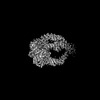
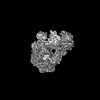
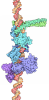
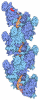
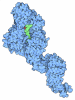
| Title | ARP module of the human TIP60 complex | ||||||||||||||||||
 Components Components |
| ||||||||||||||||||
 Keywords Keywords | GENE REGULATION / complex / chromatin regulator | ||||||||||||||||||
| Function / homology |  Function and homology information Function and homology informationpiccolo histone acetyltransferase complex / sperm DNA condensation / npBAF complex / positive regulation of norepinephrine uptake / positive regulation of telomere maintenance in response to DNA damage / regulation of DNA strand elongation / cellular response to cytochalasin B / neural retina development / Formation of the embryonic stem cell BAF (esBAF) complex / regulation of transepithelial transport ...piccolo histone acetyltransferase complex / sperm DNA condensation / npBAF complex / positive regulation of norepinephrine uptake / positive regulation of telomere maintenance in response to DNA damage / regulation of DNA strand elongation / cellular response to cytochalasin B / neural retina development / Formation of the embryonic stem cell BAF (esBAF) complex / regulation of transepithelial transport / Formation of the canonical BAF (cBAF) complex / protein antigen binding / morphogenesis of a polarized epithelium / Formation of annular gap junctions / Formation of the dystrophin-glycoprotein complex (DGC) / Swr1 complex / Formation of the polybromo-BAF (pBAF) complex / structural constituent of postsynaptic actin cytoskeleton / Gap junction degradation / GBP-mediated host defense / Formation of neuronal progenitor and neuronal BAF (npBAF and nBAF) / protein localization to adherens junction / Formation of the non-canonical BAF (ncBAF) complex / Cell-extracellular matrix interactions / regulation of G0 to G1 transition / dense body / Tat protein binding / Folding of actin by CCT/TriC / Ino80 complex / postsynaptic actin cytoskeleton / Regulation of CDH1 Function / apical protein localization / Adherens junctions interactions / microtubule nucleation / Prefoldin mediated transfer of substrate to CCT/TriC / SWI/SNF complex / RHOF GTPase cycle / adherens junction assembly / regulation of double-strand break repair / chromatin-protein adaptor activity / Sensory processing of sound by outer hair cells of the cochlea / tight junction / Sensory processing of sound by inner hair cells of the cochlea / regulation of mitotic metaphase/anaphase transition / spermatid development / spinal cord development / Formation of Senescence-Associated Heterochromatin Foci (SAHF) / positive regulation of T cell differentiation / maintenance of blood-brain barrier / Interaction between L1 and Ankyrins / apical junction complex / regulation of nucleotide-excision repair / negative regulation of gene expression, epigenetic / positive regulation of stem cell population maintenance / regulation of chromosome organization / NuA4 histone acetyltransferase complex / regulation of norepinephrine uptake / Transcriptional Regulation by E2F6 / transporter regulator activity / Recycling pathway of L1 / positive regulation of double-strand break repair / cortical cytoskeleton / Regulation of MITF-M-dependent genes involved in pigmentation / negative regulation of cell differentiation / establishment or maintenance of cell polarity / regulation of DNA replication / nitric-oxide synthase binding / RUNX1 interacts with co-factors whose precise effect on RUNX1 targets is not known / brush border / EPH-ephrin mediated repulsion of cells / regulation of synaptic vesicle endocytosis / enzyme-substrate adaptor activity / RHO GTPases Activate WASPs and WAVEs / positive regulation of myoblast differentiation / kinesin binding / regulation of protein localization to plasma membrane / RHO GTPases activate IQGAPs / positive regulation of double-strand break repair via homologous recombination / regulation of G1/S transition of mitotic cell cycle / axonogenesis / cytoskeleton organization / EPHB-mediated forward signaling / substantia nigra development / replication fork / regulation of embryonic development / telomere maintenance / calyx of Held / cell motility / nitric-oxide synthase regulator activity / helicase activity / FCGR3A-mediated phagocytosis / actin filament / Translocation of SLC2A4 (GLUT4) to the plasma membrane / adherens junction / positive regulation of cell differentiation / positive regulation of protein import into nucleus / Regulation of endogenous retroelements by Piwi-interacting RNAs (piRNAs) / RHO GTPases Activate Formins / Signaling by high-kinase activity BRAF mutants / MAP2K and MAPK activation Similarity search - Function | ||||||||||||||||||
| Biological species |  Homo sapiens (human) Homo sapiens (human) | ||||||||||||||||||
| Method | ELECTRON MICROSCOPY / single particle reconstruction / cryo EM / Resolution: 3.29 Å | ||||||||||||||||||
 Authors Authors | Yang, Z. / Mameri, A. / Florez Ariza, A.J. / Cote, J. / Nogales, E. | ||||||||||||||||||
| Funding support |  United States, United States,  Canada, 5items Canada, 5items
| ||||||||||||||||||
 Citation Citation | Journal: Science / Year: 2024 Title: Structural insights into the human NuA4/TIP60 acetyltransferase and chromatin remodeling complex. Authors: Zhenlin Yang / Amel Mameri / Claudia Cattoglio / Catherine Lachance / Alfredo Jose Florez Ariza / Jie Luo / Jonathan Humbert / Deepthi Sudarshan / Arul Banerjea / Maxime Galloy / Amélie ...Authors: Zhenlin Yang / Amel Mameri / Claudia Cattoglio / Catherine Lachance / Alfredo Jose Florez Ariza / Jie Luo / Jonathan Humbert / Deepthi Sudarshan / Arul Banerjea / Maxime Galloy / Amélie Fradet-Turcotte / Jean-Philippe Lambert / Jeff A Ranish / Jacques Côté / Eva Nogales / Abstract: The human nucleosome acetyltransferase of histone H4 (NuA4)/Tat-interactive protein, 60 kilodalton (TIP60) coactivator complex, a fusion of the yeast switch/sucrose nonfermentable related 1 (SWR1) ...The human nucleosome acetyltransferase of histone H4 (NuA4)/Tat-interactive protein, 60 kilodalton (TIP60) coactivator complex, a fusion of the yeast switch/sucrose nonfermentable related 1 (SWR1) and NuA4 complexes, both incorporates the histone variant H2A.Z into nucleosomes and acetylates histones H4, H2A, and H2A.Z to regulate gene expression and maintain genome stability. Our cryo-electron microscopy studies show that, within the NuA4/TIP60 complex, the E1A binding protein P400 (EP400) subunit serves as a scaffold holding the different functional modules in specific positions, creating a distinct arrangement of the actin-related protein (ARP) module. EP400 interacts with the transformation/transcription domain-associated protein (TRRAP) subunit by using a footprint that overlaps with that of the Spt-Ada-Gcn5 acetyltransferase (SAGA) complex, preventing the formation of a hybrid complex. Loss of the TRRAP subunit leads to mislocalization of NuA4/TIP60, resulting in the redistribution of H2A.Z and its acetylation across the genome, emphasizing the dual functionality of NuA4/TIP60 as a single macromolecular assembly. | ||||||||||||||||||
| History |
|
- Structure visualization
| Structure viewer | Molecule: MolmilJmol/JSmol |
|---|
- Downloads & links
-Download
| PDBx/mmCIF format | 9c6n.cif.gz | 557.4 KB | Display | PDBx/mmCIF format |
|---|---|---|---|---|
| PDB format | pdb9c6n.ent.gz | 377.1 KB | Display | PDB format |
| PDBx/mmJSON format | 9c6n.json.gz | Tree view | PDBx/mmJSON format | |
| Others |  Other downloads Other downloads |
-Validation report
| Arichive directory | https://data.pdbj.org/pub/pdb/validation_reports/c6/9c6nftp://data.pdbj.org/pub/pdb/validation_reports/c6/9c6n | HTTPS FTP |
|---|
-Related structure data
| Related structure data |  45252MC  9c47C  9c4bC  9c57C  9c62C M: map data used to model this data C: citing same article ( |
|---|---|
| Similar structure data |
-Links
 PDBj
PDBj
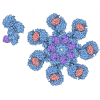
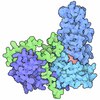
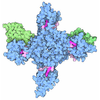





- Assembly
| Deposited unit | 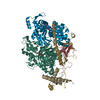
|
|---|---|
| 1 |
|
-Components
-Protein , 5 types, 5 molecules GHIJL
| #1: Protein | Mass: 343867.312 Da / Num. of mol.: 1 / Source method: isolated from a natural source / Source: (natural) Homo sapiens (human)References: UniProt: Q96L91, Hydrolases; Acting on acid anhydrides; Acting on acid anhydrides to facilitate cellular and subcellular movement |
|---|---|
| #2: Protein | Mass: 93589.172 Da / Num. of mol.: 1 / Source method: isolated from a natural source / Source: (natural) Homo sapiens (human) / References: UniProt: Q9H2F5 |
| #3: Protein | Mass: 53090.699 Da / Num. of mol.: 1 / Source method: isolated from a natural source / Source: (natural) Homo sapiens (human) / References: UniProt: Q9NPF5 |
| #4: Protein | Mass: 41782.660 Da / Num. of mol.: 1 / Source method: isolated from a natural source / Source: (natural) Homo sapiens (human) / References: UniProt: P60709 |
| #5: Protein | Mass: 47509.812 Da / Num. of mol.: 1 / Source method: isolated from a natural source / Source: (natural) Homo sapiens (human) / References: UniProt: O96019 |
-Non-polymers , 1 types, 2 molecules 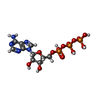
| #6: Chemical | 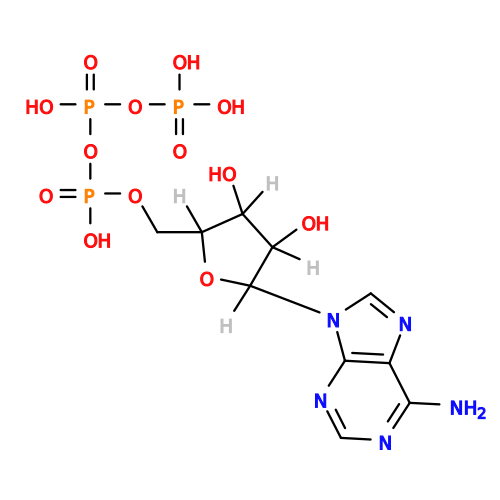 Mass: 507.181 Da / Num. of mol.: 2 / Source method: obtained synthetically / Formula: C10H16N5O13P3 / Feature type: SUBJECT OF INVESTIGATION / Comment: ATP, energy-carrying molecule*YM Mass: 507.181 Da / Num. of mol.: 2 / Source method: obtained synthetically / Formula: C10H16N5O13P3 / Feature type: SUBJECT OF INVESTIGATION / Comment: ATP, energy-carrying molecule*YM |
|---|
-Details
| Has ligand of interest | Y |
|---|
-Experimental details
-Experiment
| Experiment | Method: ELECTRON MICROSCOPY |
|---|---|
| EM experiment | Aggregation state: PARTICLE / 3D reconstruction method: single particle reconstruction |
- Sample preparation
| Component | Name: ARP module of the human TIP60 complex / Type: COMPLEX / Entity ID: #1-#5 / Source: NATURAL |
|---|---|
| Source (natural) | Organism: Homo sapiens (human) |
| Buffer solution | pH: 7.5 |
| Specimen | Embedding applied: NO / Shadowing applied: NO / Staining applied: NO / Vitrification applied: YES |
| Vitrification | Cryogen name: ETHANE |
- Electron microscopy imaging
| Experimental equipment |  Model: Titan Krios / Image courtesy: FEI Company |
|---|---|
| Microscopy | Model: FEI TITAN KRIOS |
| Electron gun | Electron source:  FIELD EMISSION GUN / Accelerating voltage: 300 kV / Illumination mode: SPOT SCAN FIELD EMISSION GUN / Accelerating voltage: 300 kV / Illumination mode: SPOT SCAN |
| Electron lens | Mode: 4D-STEM / Nominal defocus max: 2500 nm / Nominal defocus min: 1000 nm |
| Image recording | Electron dose: 50 e/Å2 / Film or detector model: GATAN K3 BIOQUANTUM (6k x 4k) |
- Processing
| EM software | Name: PHENIX / Version: 1.20.1_4487: / Category: model refinement |
|---|---|
| CTF correction | Type: PHASE FLIPPING AND AMPLITUDE CORRECTION |
| 3D reconstruction | Resolution: 3.29 Å / Resolution method: FSC 0.143 CUT-OFF / Num. of particles: 214481 / Symmetry type: POINT |
| Refinement | Cross valid method: NONE |
