[English] 日本語
Yorodumi
- PDB-8xo1: Human KCNQ2-CaM in complex with QO-83 -

+
Open data


ID or keywords:

Loading...

-
Basic information

Entry
Database: PDB / ID: 8xo1
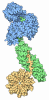
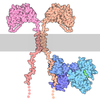
TitleHuman KCNQ2-CaM in complex with QO-83
Components
  • Calmodulin-1
  • Potassium voltage-gated channel subfamily KQT member 2
KeywordsMEMBRANE PROTEIN / KCNQ2 / human voltage-gated potassium channel
Function / homology
Function and homology information


axon initial segment / Voltage gated Potassium channels / node of Ranvier / Interaction between L1 and Ankyrins / voltage-gated monoatomic cation channel activity / CaM pathway / Cam-PDE 1 activation / ankyrin binding / Sodium/Calcium exchangers / Calmodulin induced events ...axon initial segment / Voltage gated Potassium channels / node of Ranvier / Interaction between L1 and Ankyrins / voltage-gated monoatomic cation channel activity / CaM pathway / Cam-PDE 1 activation / ankyrin binding / Sodium/Calcium exchangers / Calmodulin induced events / Reduction of cytosolic Ca++ levels / Activation of Ca-permeable Kainate Receptor / CREB1 phosphorylation through the activation of CaMKII/CaMKK/CaMKIV cascasde / Loss of phosphorylation of MECP2 at T308 / CREB1 phosphorylation through the activation of Adenylate Cyclase / negative regulation of high voltage-gated calcium channel activity / PKA activation / CaMK IV-mediated phosphorylation of CREB / Glycogen breakdown (glycogenolysis) / CLEC7A (Dectin-1) induces NFAT activation / Activation of RAC1 downstream of NMDARs / negative regulation of ryanodine-sensitive calcium-release channel activity / organelle localization by membrane tethering / mitochondrion-endoplasmic reticulum membrane tethering / autophagosome membrane docking / negative regulation of calcium ion export across plasma membrane / regulation of cardiac muscle cell action potential / presynaptic endocytosis / Synthesis of IP3 and IP4 in the cytosol / regulation of cell communication by electrical coupling involved in cardiac conduction / Phase 0 - rapid depolarisation / calcineurin-mediated signaling / Negative regulation of NMDA receptor-mediated neuronal transmission / Unblocking of NMDA receptors, glutamate binding and activation / RHO GTPases activate PAKs / Ion transport by P-type ATPases / Uptake and function of anthrax toxins / action potential / regulation of ryanodine-sensitive calcium-release channel activity / Long-term potentiation / protein phosphatase activator activity / voltage-gated potassium channel activity / Calcineurin activates NFAT / Regulation of MECP2 expression and activity / DARPP-32 events / Smooth Muscle Contraction / detection of calcium ion / regulation of cardiac muscle contraction / catalytic complex / RHO GTPases activate IQGAPs / regulation of cardiac muscle contraction by regulation of the release of sequestered calcium ion / calcium channel inhibitor activity / Activation of AMPK downstream of NMDARs / cellular response to interferon-beta / presynaptic cytosol / Protein methylation / regulation of release of sequestered calcium ion into cytosol by sarcoplasmic reticulum / eNOS activation / titin binding / Ion homeostasis / Tetrahydrobiopterin (BH4) synthesis, recycling, salvage and regulation / regulation of calcium-mediated signaling / sperm midpiece / voltage-gated potassium channel complex / potassium ion transmembrane transport / FCERI mediated Ca+2 mobilization / calcium channel complex / substantia nigra development / regulation of heart rate / Ras activation upon Ca2+ influx through NMDA receptor / FCGR3A-mediated IL10 synthesis / Antigen activates B Cell Receptor (BCR) leading to generation of second messengers / calyx of Held / adenylate cyclase activator activity / sarcomere / protein serine/threonine kinase activator activity / VEGFR2 mediated cell proliferation / VEGFR2 mediated vascular permeability / regulation of cytokinesis / spindle microtubule / positive regulation of receptor signaling pathway via JAK-STAT / Translocation of SLC2A4 (GLUT4) to the plasma membrane / calcium channel regulator activity / RAF activation / Transcriptional activation of mitochondrial biogenesis / response to calcium ion / cellular response to type II interferon / G2/M transition of mitotic cell cycle / Stimuli-sensing channels / long-term synaptic potentiation / spindle pole / Signaling by RAF1 mutants / calcium-dependent protein binding / Signaling by moderate kinase activity BRAF mutants / Paradoxical activation of RAF signaling by kinase inactive BRAF / RAS processing / Signaling downstream of RAS mutants / Signaling by BRAF and RAF1 fusions / Platelet degranulation / nervous system development
Similarity search - Function
Potassium channel, voltage dependent, KCNQ2 / Ankyrin-G binding site / Ankyrin-G binding motif of KCNQ2-3 / Unstructured region on Potassium channel subunit alpha KvLQT2 / Potassium channel, voltage dependent, KCNQ / Potassium channel, voltage dependent, KCNQ, C-terminal / KCNQ voltage-gated potassium channel / : / EF-hand domain pair / EF-hand, calcium binding motif ...Potassium channel, voltage dependent, KCNQ2 / Ankyrin-G binding site / Ankyrin-G binding motif of KCNQ2-3 / Unstructured region on Potassium channel subunit alpha KvLQT2 / Potassium channel, voltage dependent, KCNQ / Potassium channel, voltage dependent, KCNQ, C-terminal / KCNQ voltage-gated potassium channel / : / EF-hand domain pair / EF-hand, calcium binding motif / EF-Hand 1, calcium-binding site / EF-hand calcium-binding domain. / EF-hand calcium-binding domain profile. / EF-hand domain / Ion transport domain / Ion transport protein / EF-hand domain pair
Similarity search - Domain/homology
: / Potassium voltage-gated channel subfamily KQT member 2 / Calmodulin-1
Similarity search - Component
Biological speciesHomo sapiens (human)
MethodELECTRON MICROSCOPY / single particle reconstruction / cryo EM / Resolution: 3.8 Å
AuthorsZhao, Y.W. / Yang, Z.N. / Guo, J.T. / Du, X.N.
Funding support China, 1items
OrganizationGrant numberCountry
National Natural Science Foundation of China (NSFC)U21A20359 China
CitationJournal: Cell Rep / Year: 2025
Title: Structure basis for the activation of KCNQ2 by endogenous and exogenous ligands.
Authors: Yiwen Zhao / Zhenni Yang / Sai Shi / Han Hao / Xinmeng Li / Demin Ma / Nannan Su / Weixin Zhao / Jicheng Shao / Yating An / Ke Wang / Yinuo Liu / Lu Zou / Jinlong Qi / Hailin Zhang / Jiangtao Guo / Xiaona Du /
Abstract: The voltage-gated potassium channel KCNQ2 is crucial for stabilizing neuronal membrane potential, and its mutations can cause various epilepsies. KCNQ2 is activated by endogenous ligand ...The voltage-gated potassium channel KCNQ2 is crucial for stabilizing neuronal membrane potential, and its mutations can cause various epilepsies. KCNQ2 is activated by endogenous ligand phosphatidylinositol-4,5-bisphosphate (PIP) and exogenous ligands, yet the structural mechanisms underlying these activations remain unclear. Here, we report the cryo-electron microscopy structures of human KCNQ2 in complex with exogenous ligands QO-58 and QO-83 in the absence or presence of PIP in either closed or open conformation. While QO-83 binds in the classical fenestration pocket of the pore domain, QO-58 mainly binds at the flank of S4 in the voltage-sensing domain. These structures, along with electrophysiological assays and computational studies, provide mechanistic insights into the ligand activation of KCNQ2 and may guide the development of anti-epileptic drugs targeting KCNQ2.
History
DepositionDec 31, 2023Deposition site: PDBJ / Processing site: PDBJ
Revision 1.0Jan 1, 2025Provider: repository / Type: Initial release
Revision 1.0Jan 1, 2025Data content type: EM metadata / Data content type: EM metadata / Provider: repository / Type: Initial release
Revision 1.0Jan 1, 2025Data content type: Half map / Part number: 1 / Data content type: Half map / Provider: repository / Type: Initial release
Revision 1.0Jan 1, 2025Data content type: Half map / Part number: 2 / Data content type: Half map / Provider: repository / Type: Initial release
Revision 1.0Jan 1, 2025Data content type: Image / Data content type: Image / Provider: repository / Type: Initial release
Revision 1.0Jan 1, 2025Data content type: Primary map / Data content type: Primary map / Provider: repository / Type: Initial release
Revision 1.1Jun 18, 2025Group: Data collection / Category: em_admin / em_software / Item: _em_admin.last_update / _em_software.name
Revision 1.1Jun 18, 2025Data content type: EM metadata / Data content type: EM metadata / EM metadata / Group: Data processing / Experimental summary / Data content type: EM metadata / EM metadata / Category: em_admin / em_software / Data content type: EM metadata / EM metadata / Item: _em_admin.last_update / _em_software.name
Revision 2.0Jan 21, 2026Group: Advisory / Atomic model ...Advisory / Atomic model / Data collection / Database references / Derived calculations / Polymer sequence / Refinement description / Structure summary
Category: atom_site / atom_site_anisotrop ...atom_site / atom_site_anisotrop / citation / citation_author / em_admin / em_imaging / em_software / entity_poly / pdbx_contact_author / pdbx_nonpoly_scheme / pdbx_poly_seq_scheme / pdbx_struct_sheet_hbond / pdbx_unobs_or_zero_occ_atoms / pdbx_unobs_or_zero_occ_residues / pdbx_validate_close_contact / pdbx_validate_rmsd_angle / pdbx_validate_torsion / refine_ls_restr / struct_asym / struct_conf / struct_ref_seq / struct_sheet_range
Item: _atom_site_anisotrop.U[1][1] / _atom_site_anisotrop.U[2][2] ..._atom_site_anisotrop.U[1][1] / _atom_site_anisotrop.U[2][2] / _atom_site_anisotrop.U[3][3] / _atom_site_anisotrop.id / _atom_site_anisotrop.pdbx_auth_asym_id / _atom_site_anisotrop.pdbx_auth_atom_id / _atom_site_anisotrop.pdbx_auth_comp_id / _atom_site_anisotrop.pdbx_auth_seq_id / _atom_site_anisotrop.pdbx_label_asym_id / _atom_site_anisotrop.pdbx_label_atom_id / _atom_site_anisotrop.pdbx_label_comp_id / _atom_site_anisotrop.pdbx_label_seq_id / _atom_site_anisotrop.type_symbol / _citation.country / _citation.journal_abbrev / _citation.journal_id_CSD / _citation.journal_id_ISSN / _citation.journal_volume / _citation.page_first / _citation.page_last / _citation.pdbx_database_id_DOI / _citation.pdbx_database_id_PubMed / _citation.title / _citation.year / _em_admin.last_update / _em_imaging.microscope_model / _em_software.name / _entity_poly.pdbx_strand_id / _pdbx_nonpoly_scheme.auth_seq_num / _pdbx_nonpoly_scheme.pdb_seq_num / _pdbx_nonpoly_scheme.pdb_strand_id / _pdbx_poly_seq_scheme.asym_id / _pdbx_poly_seq_scheme.auth_mon_id / _pdbx_poly_seq_scheme.auth_seq_num / _pdbx_poly_seq_scheme.entity_id / _pdbx_poly_seq_scheme.mon_id / _pdbx_poly_seq_scheme.ndb_seq_num / _pdbx_poly_seq_scheme.pdb_mon_id / _pdbx_poly_seq_scheme.pdb_seq_num / _pdbx_poly_seq_scheme.pdb_strand_id / _pdbx_poly_seq_scheme.seq_id / _pdbx_struct_sheet_hbond.range_1_auth_asym_id / _pdbx_struct_sheet_hbond.range_1_label_asym_id / _pdbx_struct_sheet_hbond.range_2_auth_asym_id / _pdbx_struct_sheet_hbond.range_2_label_asym_id / _pdbx_unobs_or_zero_occ_atoms.auth_asym_id / _pdbx_unobs_or_zero_occ_atoms.auth_atom_id / _pdbx_unobs_or_zero_occ_atoms.auth_comp_id / _pdbx_unobs_or_zero_occ_atoms.auth_seq_id / _pdbx_unobs_or_zero_occ_atoms.label_asym_id / _pdbx_unobs_or_zero_occ_atoms.label_atom_id / _pdbx_unobs_or_zero_occ_atoms.label_comp_id / _pdbx_unobs_or_zero_occ_atoms.label_seq_id / _pdbx_unobs_or_zero_occ_residues.auth_asym_id / _pdbx_unobs_or_zero_occ_residues.auth_comp_id / _pdbx_unobs_or_zero_occ_residues.auth_seq_id / _pdbx_unobs_or_zero_occ_residues.label_asym_id / _pdbx_unobs_or_zero_occ_residues.label_comp_id / _pdbx_unobs_or_zero_occ_residues.label_seq_id / _pdbx_validate_torsion.auth_asym_id / _pdbx_validate_torsion.auth_comp_id / _pdbx_validate_torsion.auth_seq_id / _pdbx_validate_torsion.phi / _pdbx_validate_torsion.psi / _struct_asym.entity_id / _struct_ref_seq.db_align_end / _struct_ref_seq.pdbx_auth_seq_align_end / _struct_ref_seq.pdbx_db_accession / _struct_ref_seq.pdbx_strand_id / _struct_ref_seq.ref_id / _struct_ref_seq.seq_align_end / _struct_sheet_range.beg_auth_asym_id / _struct_sheet_range.beg_label_asym_id / _struct_sheet_range.end_auth_asym_id / _struct_sheet_range.end_label_asym_id
Description: Atomic clashes / Provider: author / Type: Coordinate replacement
Revision 1.2Jan 21, 2026Data content type: EM metadata
Data content type: EM metadata / EM metadata ...EM metadata / EM metadata / EM metadata / EM metadata / EM metadata
Group: Data collection / Data processing ...Data collection / Data processing / Database references / Experimental summary / Other
Data content type: EM metadata / EM metadata ...EM metadata / EM metadata / EM metadata / EM metadata / EM metadata / EM metadata / EM metadata
Category: citation / citation_author ...citation / citation_author / em_admin / em_imaging / em_software / entity_poly / struct_ref_seq
Data content type: EM metadata / EM metadata ...EM metadata / EM metadata / EM metadata / EM metadata / EM metadata / EM metadata / EM metadata / EM metadata / EM metadata / EM metadata / EM metadata / EM metadata / EM metadata / EM metadata / EM metadata / EM metadata / EM metadata / EM metadata / EM metadata / EM metadata / EM metadata
Item: _citation.country / _citation.journal_abbrev ..._citation.country / _citation.journal_abbrev / _citation.journal_id_CSD / _citation.journal_id_ISSN / _citation.journal_volume / _citation.page_first / _citation.page_last / _citation.pdbx_database_id_DOI / _citation.pdbx_database_id_PubMed / _citation.title / _citation.year / _em_admin.last_update / _em_imaging.microscope_model / _em_software.name / _entity_poly.pdbx_strand_id / _struct_ref_seq.db_align_end / _struct_ref_seq.pdbx_auth_seq_align_end / _struct_ref_seq.pdbx_db_accession / _struct_ref_seq.pdbx_strand_id / _struct_ref_seq.ref_id / _struct_ref_seq.seq_align_end

-
Structure visualization

Structure viewerMolecule:
MolmilJmol/JSmol

Downloads & links

-
Assembly

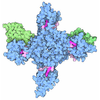
Deposited unit
A: Potassium voltage-gated channel subfamily KQT member 2
B: Potassium voltage-gated channel subfamily KQT member 2
C: Potassium voltage-gated channel subfamily KQT member 2
D: Potassium voltage-gated channel subfamily KQT member 2
E: Calmodulin-1
F: Calmodulin-1
G: Calmodulin-1
H: Calmodulin-1
hetero molecules


Theoretical massNumber of molelcules
Total (without water)453,01112
Polymers451,3178
Non-polymers1,6944
Water00
1


  • Idetical with deposited unit
  • defined by author
  • Evidence: electron microscopy, not applicable
TypeNameSymmetry operationNumber
identity operation1_5551

-
Components

#1: Protein
Potassium voltage-gated channel subfamily KQT member 2 / KQT-like 2 / Neuroblastoma-specific potassium channel subunit alpha KvLQT2 / Voltage-gated ...KQT-like 2 / Neuroblastoma-specific potassium channel subunit alpha KvLQT2 / Voltage-gated potassium channel subunit Kv7.2


Mass: 95976.742 Da / Num. of mol.: 4
Source method: isolated from a genetically manipulated source
Source: (gene. exp.) Homo sapiens (human) / Cell line: HEK293F / Gene: KCNQ2 / Cell line (production host): HEK293F / Production host: Homo sapiens (human) / References: UniProt: O43526
#2: Protein
Calmodulin-1


Mass: 16852.545 Da / Num. of mol.: 4
Source method: isolated from a genetically manipulated source
Source: (gene. exp.) Homo sapiens (human) / Gene: CALM1, CALM, CAM, CAM1 / Production host: Homo sapiens (human) / References: UniProt: P0DP23
#3: Chemical
ChemComp-A1LWZ / ~{N}-[2-azanyl-3-fluoranyl-4-[[4-(trifluoromethyl)phenyl]methylamino]phenyl]-3-cyclopentyl-propanamide


Mass: 423.447 Da / Num. of mol.: 4 / Source method: obtained synthetically / Formula: C22H25F4N3O / Feature type: SUBJECT OF INVESTIGATION
Has ligand of interestY
Has protein modificationN

-
Experimental details

-
Experiment

ExperimentMethod: ELECTRON MICROSCOPY
EM experimentAggregation state: PARTICLE / 3D reconstruction method: single particle reconstruction

-
Sample preparation

ComponentName: human KCNQ2-CaM in complex with QO-83 / Type: COMPLEX / Entity ID: #1-#2 / Source: RECOMBINANT
Source (natural)Organism: Homo sapiens (human)
Source (recombinant)Organism: Homo sapiens (human)
Buffer solutionpH: 8
SpecimenEmbedding applied: NO / Shadowing applied: NO / Staining applied: NO / Vitrification applied: YES
VitrificationCryogen name: ETHANE

-
Electron microscopy imaging

Experimental equipment
Model: Titan Krios / Image courtesy: FEI Company
MicroscopyModel: TFS KRIOS
Electron gunElectron source: FIELD EMISSION GUN / Accelerating voltage: 300 kV / Illumination mode: FLOOD BEAM
Electron lensMode: BRIGHT FIELD / Nominal defocus max: 1600 nm / Nominal defocus min: 800 nm
Image recordingElectron dose: 52 e/Å2 / Film or detector model: FEI FALCON IV (4k x 4k)

-
Processing

EM software
IDNameCategory
1RELIONparticle selection
8PHENIXmodel refinement
13RELION3D reconstruction
CTF correctionType: PHASE FLIPPING AND AMPLITUDE CORRECTION
3D reconstructionResolution: 3.8 Å / Resolution method: FSC 0.143 CUT-OFF / Num. of particles: 73879 / Symmetry type: POINT

+
About Yorodumi

-
News

-
Feb 9, 2022. New format data for meta-information of EMDB entries

New format data for meta-information of EMDB entries

  • Version 3 of the EMDB header file is now the official format.
  • The previous official version 1.9 will be removed from the archive.

Related info.:EMDB header

External links:wwPDB to switch to version 3 of the EMDB data model

-
Aug 12, 2020. Covid-19 info

Covid-19 info

URL: https://pdbj.org/emnavi/covid19.php

New page: Covid-19 featured information page in EM Navigator.

Related info.:Covid-19 info / Mar 5, 2020. Novel coronavirus structure data

+
Mar 5, 2020. Novel coronavirus structure data

Novel coronavirus structure data

Related info.:Yorodumi Speices / Aug 12, 2020. Covid-19 info

External links:COVID-19 featured content - PDBj / Molecule of the Month (242):Coronavirus Proteases

+
Jan 31, 2019. EMDB accession codes are about to change! (news from PDBe EMDB page)

EMDB accession codes are about to change! (news from PDBe EMDB page)

  • The allocation of 4 digits for EMDB accession codes will soon come to an end. Whilst these codes will remain in use, new EMDB accession codes will include an additional digit and will expand incrementally as the available range of codes is exhausted. The current 4-digit format prefixed with “EMD-” (i.e. EMD-XXXX) will advance to a 5-digit format (i.e. EMD-XXXXX), and so on. It is currently estimated that the 4-digit codes will be depleted around Spring 2019, at which point the 5-digit format will come into force.
  • The EM Navigator/Yorodumi systems omit the EMD- prefix.

Related info.:Q: What is EMD? / ID/Accession-code notation in Yorodumi/EM Navigator

External links:EMDB Accession Codes are Changing Soon! / Contact to PDBj

+
Jul 12, 2017. Major update of PDB

Major update of PDB

  • wwPDB released updated PDB data conforming to the new PDBx/mmCIF dictionary.
  • This is a major update changing the version number from 4 to 5, and with Remediation, in which all the entries are updated.
  • In this update, many items about electron microscopy experimental information are reorganized (e.g. em_software).
  • Now, EM Navigator and Yorodumi are based on the updated data.

External links:wwPDB Remediation / Enriched Model Files Conforming to OneDep Data Standards Now Available in the PDB FTP Archive

-
Yorodumi

Thousand views of thousand structures

  • Yorodumi is a browser for structure data from EMDB, PDB, SASBDB, etc.
  • This page is also the successor to EM Navigator detail page, and also detail information page/front-end page for Omokage search.
  • The word "yorodu" (or yorozu) is an old Japanese word meaning "ten thousand". "mi" (miru) is to see.

Related info.:EMDB / PDB / SASBDB / Comparison of 3 databanks / Yorodumi Search / Aug 31, 2016. New EM Navigator & Yorodumi / Yorodumi Papers / Jmol/JSmol / Function and homology information / Changes in new EM Navigator and Yorodumi

Read more