 Movie
Movie Controller


+ Open data

- Basic information
| Entry | Database: PDB / ID: 8vys | ||||||
|---|---|---|---|---|---|---|---|
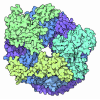
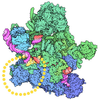
| Title | Cryo-EM Structure of the BRAF V600E monomer bound to PLX8394 | ||||||
 Components Components |
| ||||||
 Keywords Keywords | TRANSFERASE/INHIBITOR / BRAF Kinase Monomer Mutant Inhibitor / TRANSFERASE-INHIBITOR complex | ||||||
| Function / homology |  Function and homology information Function and homology informationsynaptic target recognition / Golgi reassembly / NOTCH4 Activation and Transmission of Signal to the Nucleus / respiratory system process / establishment of Golgi localization / tube formation / Signalling to p38 via RIT and RIN / ARMS-mediated activation / establishment of protein localization to membrane / SHOC2 M1731 mutant abolishes MRAS complex function ...synaptic target recognition / Golgi reassembly / NOTCH4 Activation and Transmission of Signal to the Nucleus / respiratory system process / establishment of Golgi localization / tube formation / Signalling to p38 via RIT and RIN / ARMS-mediated activation / establishment of protein localization to membrane / SHOC2 M1731 mutant abolishes MRAS complex function / Gain-of-function MRAS complexes activate RAF signaling / Rap1 signalling / regulation of synapse maturation / positive regulation of D-glucose transmembrane transport / negative regulation of protein localization to nucleus / KSRP (KHSRP) binds and destabilizes mRNA / Negative feedback regulation of MAPK pathway / GP1b-IX-V activation signalling / Frs2-mediated activation / lung development / MAP kinase kinase activity / Regulation of localization of FOXO transcription factors / Interleukin-3, Interleukin-5 and GM-CSF signaling / positive regulation of peptidyl-serine phosphorylation / phosphoserine residue binding / Activation of BAD and translocation to mitochondria / regulation of ERK1 and ERK2 cascade / MAP kinase kinase kinase activity / postsynaptic modulation of chemical synaptic transmission / cellular response to glucose starvation / SARS-CoV-2 targets host intracellular signalling and regulatory pathways / SARS-CoV-1 targets host intracellular signalling and regulatory pathways / RHO GTPases activate PKNs / Chk1/Chk2(Cds1) mediated inactivation of Cyclin B:Cdk1 complex / animal organ morphogenesis / Transcriptional and post-translational regulation of MITF-M expression and activity / cellular response to calcium ion / negative regulation of innate immune response / negative regulation of TORC1 signaling / hippocampal mossy fiber to CA3 synapse / TP53 Regulates Metabolic Genes / Translocation of SLC2A4 (GLUT4) to the plasma membrane / regulation of protein stability / RAF activation / Signaling by high-kinase activity BRAF mutants / Spry regulation of FGF signaling / MAP2K and MAPK activation / Deactivation of the beta-catenin transactivating complex / protein sequestering activity / Negative regulation of NOTCH4 signaling / epidermal growth factor receptor signaling pathway / intracellular protein localization / angiogenesis / Signaling by RAF1 mutants / Signaling by moderate kinase activity BRAF mutants / Paradoxical activation of RAF signaling by kinase inactive BRAF / Signaling downstream of RAS mutants / MAPK cascade / Negative regulation of MAPK pathway / melanosome / Signaling by BRAF and RAF1 fusions / cell body / scaffold protein binding / protein phosphatase binding / blood microparticle / DNA-binding transcription factor binding / vesicle / transmembrane transporter binding / positive regulation of ERK1 and ERK2 cascade / protein kinase activity / protein phosphorylation / non-specific serine/threonine protein kinase / neuron projection / postsynapse / cadherin binding / protein domain specific binding / protein serine kinase activity / focal adhesion / ubiquitin protein ligase binding / protein serine/threonine kinase activity / positive regulation of gene expression / calcium ion binding / negative regulation of apoptotic process / protein kinase binding / glutamatergic synapse / negative regulation of transcription by RNA polymerase II / signal transduction / mitochondrion / RNA binding / extracellular exosome / zinc ion binding / nucleoplasm / ATP binding / extracellular region / identical protein binding / nucleus / plasma membrane / cytosol / cytoplasm Similarity search - Function | ||||||
| Biological species |  Homo sapiens (human) Homo sapiens (human) | ||||||
| Method | ELECTRON MICROSCOPY / single particle reconstruction / cryo EM / Resolution: 3.06 Å | ||||||
 Authors Authors | Lavoie, H. / Lajoie, D. / Jin, T. / Decossas, M. / Maisonneuve, P. / Therrien, M. | ||||||
| Funding support |  Canada, 1items Canada, 1items
| ||||||
 Citation Citation | Journal: Science / Year: 2025 Title: BRAF oncogenic mutants evade autoinhibition through a common mechanism. Authors: Hugo Lavoie / Ting Jin / Driss Lajoie / Marion Decossas / Patrick Gendron / Bing Wang / Frantisek Filandr / Malha Sahmi / Chang Hwa Jo / Sandra Weber / Geneviève Arseneault / Sasmita ...Authors: Hugo Lavoie / Ting Jin / Driss Lajoie / Marion Decossas / Patrick Gendron / Bing Wang / Frantisek Filandr / Malha Sahmi / Chang Hwa Jo / Sandra Weber / Geneviève Arseneault / Sasmita Tripathy / Pierre Beaulieu / Doris A Schuetz / David C Schriemer / Anne Marinier / William J Rice / Pierre Maisonneuve / Marc Therrien /   Abstract: Uncontrolled activation of the rat sarcoma (RAS)-extracellular signal-regulated kinase (ERK) pathway drives tumor growth, often because of oncogenic BRAF mutations. BRAF regulation, involving ...Uncontrolled activation of the rat sarcoma (RAS)-extracellular signal-regulated kinase (ERK) pathway drives tumor growth, often because of oncogenic BRAF mutations. BRAF regulation, involving monomeric autoinhibition and activation by dimerization, has been intensely scrutinized, but mechanisms enabling oncogenic mutants to evade regulation remain unclear. By using cryo-electron microscopy, we solved the three-dimensional structures of the three oncogenic BRAF mutant classes, including the common V600E variant. These mutations disrupted wild-type BRAF's autoinhibited state, mediated by interactions between the cysteine-rich domain and kinase domain, thereby shifting the kinase domain into a preactivated conformation. This structural change likely results from helix αC displacement. PLX8394, a BRAF inhibitor that stabilizes helix αC in an inactive conformation, restored the autoinhibited conformation of oncogenic BRAF, explaining the properties of this class of compounds. | ||||||
| History |
|
- Structure visualization
| Structure viewer | Molecule: MolmilJmol/JSmol |
|---|
- Downloads & links
-Download
| PDBx/mmCIF format | 8vys.cif.gz | 275.4 KB | Display | PDBx/mmCIF format |
|---|---|---|---|---|
| PDB format | pdb8vys.ent.gz | Display | PDB format | |
| PDBx/mmJSON format | 8vys.json.gz | Tree view | PDBx/mmJSON format | |
| Others |  Other downloads Other downloads |
-Validation report
| Arichive directory | https://data.pdbj.org/pub/pdb/validation_reports/vy/8vysftp://data.pdbj.org/pub/pdb/validation_reports/vy/8vys | HTTPS FTP |
|---|
-Related structure data
| Related structure data |  43677MC  8vyoC  8vypC  8vyqC  8vyrC  8vyuC 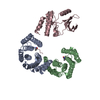 8vyvC  8vywC M: map data used to model this data C: citing same article ( |
|---|---|
| Similar structure data |





-Links
 PDBj
PDBj

- Assembly
| Deposited unit | 
|
|---|---|
| 1 |
|
-Components
| #1: Protein | Mass: 84800.750 Da / Num. of mol.: 1 / Mutation: V600E Source method: isolated from a genetically manipulated source Source: (gene. exp.) Homo sapiens (human) / Cell: FreeStyle 293-F cells / Gene: BRAF, BRAF1, RAFB1 / Plasmid: pCDNA3.1-FLAG-TEV-BRAF V600E / Cell (production host): FreeStyle 293-F cells / Production host: Homo sapiens (human)References: UniProt: P15056, non-specific serine/threonine protein kinase | ||||||
|---|---|---|---|---|---|---|---|
| #2: Protein | Mass: 27645.895 Da / Num. of mol.: 2 / Source method: isolated from a natural source / Source: (natural) Homo sapiens (human) / Cell line: FreeStyle 293-F cells / References: UniProt: P63104#3: Chemical | ChemComp-A1AEN / ( | Mass: 542.533 Da / Num. of mol.: 1 / Source method: obtained synthetically / Formula: C25H21F3N6O3S / Feature type: SUBJECT OF INVESTIGATION Has ligand of interest | Y | Has protein modification | Y | |
-Experimental details
-Experiment
| Experiment | Method: ELECTRON MICROSCOPY |
|---|---|
| EM experiment | Aggregation state: PARTICLE / 3D reconstruction method: single particle reconstruction |
- Sample preparation
| Component | Name: BRAF V600E - 14.3.3 complex bound to PLX8394 / Type: COMPLEX Details: BRAF complex purified by Flag affinity purification followed by TEV elution from FreeStyle 293F cells Entity ID: #1-#2 / Source: MULTIPLE SOURCES | ||||||||||||||||||||||||||||||
|---|---|---|---|---|---|---|---|---|---|---|---|---|---|---|---|---|---|---|---|---|---|---|---|---|---|---|---|---|---|---|---|
| Molecular weight | Value: 0.141 MDa / Experimental value: NO | ||||||||||||||||||||||||||||||
| Source (natural) | Organism: Homo sapiens (human) | ||||||||||||||||||||||||||||||
| Source (recombinant) | Organism: Homo sapiens (human) / Cell: FreeStyle 293-F cells / Plasmid: pCDNA3.1-FLAG-TEV-BRAF V600E | ||||||||||||||||||||||||||||||
| Buffer solution | pH: 7.5 | ||||||||||||||||||||||||||||||
| Buffer component |
| ||||||||||||||||||||||||||||||
| Specimen | Conc.: 1 mg/ml / Embedding applied: NO / Shadowing applied: NO / Staining applied: NO / Vitrification applied: YES | ||||||||||||||||||||||||||||||
| Vitrification | Cryogen name: ETHANE / Humidity: 80 % / Details: Chameleon system (SPT Labtech) |
- Electron microscopy imaging
| Experimental equipment |  Model: Titan Krios / Image courtesy: FEI Company |
|---|---|
| Microscopy | Model: TFS KRIOS |
| Electron gun | Electron source:  FIELD EMISSION GUN / Accelerating voltage: 300 kV / Illumination mode: FLOOD BEAM FIELD EMISSION GUN / Accelerating voltage: 300 kV / Illumination mode: FLOOD BEAM |
| Electron lens | Mode: BRIGHT FIELD / Nominal defocus max: 1500 nm / Nominal defocus min: 1300 nm |
| Image recording | Electron dose: 56.44 e/Å2 / Film or detector model: GATAN K3 BIOQUANTUM (6k x 4k) |
- Processing
| EM software |
| ||||||||||||||||||||||||
|---|---|---|---|---|---|---|---|---|---|---|---|---|---|---|---|---|---|---|---|---|---|---|---|---|---|
| CTF correction | Type: PHASE FLIPPING AND AMPLITUDE CORRECTION | ||||||||||||||||||||||||
| 3D reconstruction | Resolution: 3.06 Å / Resolution method: FSC 0.143 CUT-OFF / Num. of particles: 177000 Details: Resolution corresponds to the FSC 0.143 cut-off of the masked map. Symmetry type: POINT | ||||||||||||||||||||||||
| Refine LS restraints |
|
