 Movie
Movie Controller


+ Open data

- Basic information
| Entry | Database: PDB / ID: 8vyj | |||||||||||||||||||||||||||
|---|---|---|---|---|---|---|---|---|---|---|---|---|---|---|---|---|---|---|---|---|---|---|---|---|---|---|---|---|
| Title | Structure of full-length human cardiac sodium channel - Class-I. | |||||||||||||||||||||||||||
 Components Components | Sodium channel protein type 5 subunit alpha | |||||||||||||||||||||||||||
 Keywords Keywords | MEMBRANE PROTEIN / Voltage gated sodium channel / Nav1.5 / Ion Transporter | |||||||||||||||||||||||||||
| Function / homology |  Function and homology information Function and homology informationvoltage-gated sodium channel activity involved in AV node cell action potential / voltage-gated sodium channel activity involved in bundle of His cell action potential / voltage-gated sodium channel activity involved in Purkinje myocyte action potential / voltage-gated sodium channel activity involved in SA node cell action potential / bundle of His cell action potential / regulation of ventricular cardiac muscle cell membrane depolarization / AV node cell action potential / SA node cell action potential / AV node cell to bundle of His cell communication / membrane depolarization during SA node cell action potential ...voltage-gated sodium channel activity involved in AV node cell action potential / voltage-gated sodium channel activity involved in bundle of His cell action potential / voltage-gated sodium channel activity involved in Purkinje myocyte action potential / voltage-gated sodium channel activity involved in SA node cell action potential / bundle of His cell action potential / regulation of ventricular cardiac muscle cell membrane depolarization / AV node cell action potential / SA node cell action potential / AV node cell to bundle of His cell communication / membrane depolarization during SA node cell action potential / response to denervation involved in regulation of muscle adaptation / membrane depolarization during atrial cardiac muscle cell action potential / brainstem development / cardiac ventricle development / voltage-gated sodium channel activity involved in cardiac muscle cell action potential / regulation of atrial cardiac muscle cell membrane repolarization / cardiac conduction system development / atrial cardiac muscle cell action potential / regulation of atrial cardiac muscle cell membrane depolarization / positive regulation of action potential / telencephalon development / positive regulation of sodium ion transport / membrane depolarization during AV node cell action potential / membrane depolarization during bundle of His cell action potential / membrane depolarization during cardiac muscle cell action potential / membrane depolarization during Purkinje myocyte cell action potential / membrane depolarization during action potential / regulation of sodium ion transmembrane transport / ventricular cardiac muscle cell action potential / regulation of ventricular cardiac muscle cell membrane repolarization / odontogenesis of dentin-containing tooth / cardiac muscle cell action potential involved in contraction / voltage-gated sodium channel complex / regulation of cardiac muscle cell contraction / voltage-gated sodium channel activity / ankyrin binding / Interaction between L1 and Ankyrins / sodium ion transport / Phase 0 - rapid depolarisation / regulation of heart rate by cardiac conduction / nitric-oxide synthase binding / fibroblast growth factor binding / cerebellum development / intercalated disc / lateral plasma membrane / membrane depolarization / cardiac muscle contraction / regulation of heart rate / positive regulation of epithelial cell proliferation / cellular response to calcium ion / T-tubule / sodium ion transmembrane transport / sarcolemma / caveola / Z disc / scaffold protein binding / transmembrane transporter binding / calmodulin binding / protein domain specific binding / ubiquitin protein ligase binding / protein kinase binding / perinuclear region of cytoplasm / enzyme binding / cell surface / endoplasmic reticulum / membrane / plasma membrane Similarity search - Function | |||||||||||||||||||||||||||
| Biological species |  Homo sapiens (human) Homo sapiens (human) | |||||||||||||||||||||||||||
| Method | ELECTRON MICROSCOPY / single particle reconstruction / cryo EM / Resolution: 3.6 Å | |||||||||||||||||||||||||||
 Authors Authors | Biswas, R. / Chinthalapudi, K. | |||||||||||||||||||||||||||
| Funding support |  United States, 1items United States, 1items
| |||||||||||||||||||||||||||
 Citation Citation | Journal: Proc Natl Acad Sci U S A / Year: 2025 Title: Structural basis of human Na1.5 gating mechanisms. Authors: Rupam Biswas / Ana Laura López-Serrano / Apoorva Purohit / Angelina Ramirez-Navarro / Hsiang-Ling Huang / Giovanna Grandinetti / Xiaolin Cheng / Sarah M Heissler / Isabelle Deschênes / Krishna Chinthalapudi / Abstract: Voltage-gated Na1.5 channels are central to the generation and propagation of cardiac action potentials. Aberrations in their function are associated with a wide spectrum of cardiac diseases ...Voltage-gated Na1.5 channels are central to the generation and propagation of cardiac action potentials. Aberrations in their function are associated with a wide spectrum of cardiac diseases including arrhythmias and heart failure. Despite decades of progress in Na1.5 biology, the lack of structural insights into intracellular regions has hampered our understanding of its gating mechanisms. Here, we present two cryo-EM structures of human Na1.5 in open states, revealing sequential conformational changes in gating charges of the voltage-sensing domains (VSDs) and several intracellular regions. Despite the channel being in the open state, these structures show repositioning, but no dislodging of the IFM motif in the receptor site. Molecular dynamics analyses show our structures with CTD conduct Na ions. Notably, our structural findings highlight a dynamic C-terminal domain (CTD) and III-IV linker interaction, which regulates the conformation of VSDs and pore opening. Electrophysiological studies confirm that disrupting this interaction alters fast inactivation of Na1.5. Together, our structure-function studies establish a foundation for understanding the gating mechanisms of Na1.5 and the mechanisms underlying CTD-related channelopathies. | |||||||||||||||||||||||||||
| History |
|
- Structure visualization
| Structure viewer | Molecule: MolmilJmol/JSmol |
|---|
- Downloads & links
-Download
| PDBx/mmCIF format | 8vyj.cif.gz | 315.2 KB | Display | PDBx/mmCIF format |
|---|---|---|---|---|
| PDB format | pdb8vyj.ent.gz | 243.4 KB | Display | PDB format |
| PDBx/mmJSON format | 8vyj.json.gz | Tree view | PDBx/mmJSON format | |
| Others |  Other downloads Other downloads |
-Validation report
| Arichive directory | https://data.pdbj.org/pub/pdb/validation_reports/vy/8vyjftp://data.pdbj.org/pub/pdb/validation_reports/vy/8vyj | HTTPS FTP |
|---|
-Related structure data
| Related structure data |  43662MC  8vykC M: map data used to model this data C: citing same article ( |
|---|---|
| Similar structure data |

-Links
 PDBj
PDBj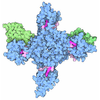
- Assembly
| Deposited unit | 
|
|---|---|
| 1 |
|
-Components
-Protein , 1 types, 1 molecules A
| #1: Protein | Mass: 227152.156 Da / Num. of mol.: 1 Source method: isolated from a genetically manipulated source Source: (gene. exp.) Homo sapiens (human) / Gene: SCN5A / Production host: Homo sapiens (human) / References: UniProt: Q14524 |
|---|
-Sugars , 3 types, 7 molecules 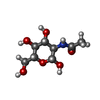
| #2: Polysaccharide | 2-acetamido-2-deoxy-beta-D-glucopyranose-(1-4)-2-acetamido-2-deoxy-beta-D-glucopyranose-(1-4)-2- ...2-acetamido-2-deoxy-beta-D-glucopyranose-(1-4)-2-acetamido-2-deoxy-beta-D-glucopyranose-(1-4)-2-acetamido-2-deoxy-beta-D-glucopyranose-(1-4)-2-acetamido-2-deoxy-beta-D-glucopyranose-(1-4)-2-acetamido-2-deoxy-beta-D-glucopyranose Source method: isolated from a genetically manipulated source | ||
|---|---|---|---|
| #3: Polysaccharide | Source method: isolated from a genetically manipulated source #6: Sugar | 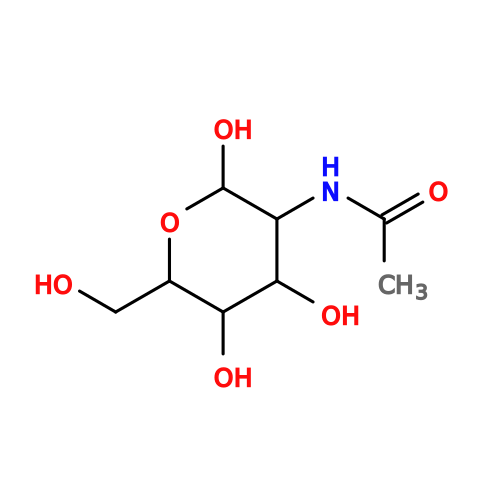 Type: D-saccharide, beta linking / Mass: 221.208 Da / Num. of mol.: 3 / Source method: obtained synthetically / Formula: C8H15NO6 / Feature type: SUBJECT OF INVESTIGATION Type: D-saccharide, beta linking / Mass: 221.208 Da / Num. of mol.: 3 / Source method: obtained synthetically / Formula: C8H15NO6 / Feature type: SUBJECT OF INVESTIGATION |
-Non-polymers , 2 types, 9 molecules 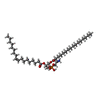
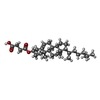
| #4: Chemical |  Mass: 717.996 Da / Num. of mol.: 2 / Source method: obtained synthetically / Formula: C39H76NO8P / Feature type: SUBJECT OF INVESTIGATION / Comment: phospholipid*YM Mass: 717.996 Da / Num. of mol.: 2 / Source method: obtained synthetically / Formula: C39H76NO8P / Feature type: SUBJECT OF INVESTIGATION / Comment: phospholipid*YM#5: Chemical | ChemComp-Y01 / 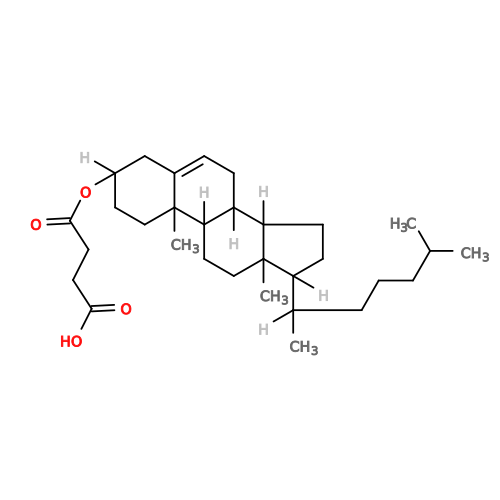 Mass: 486.726 Da / Num. of mol.: 7 / Source method: obtained synthetically / Formula: C31H50O4 / Feature type: SUBJECT OF INVESTIGATION Mass: 486.726 Da / Num. of mol.: 7 / Source method: obtained synthetically / Formula: C31H50O4 / Feature type: SUBJECT OF INVESTIGATION |
|---|
-Details
| Has ligand of interest | Y |
|---|---|
| Has protein modification | Y |
-Experimental details
-Experiment
| Experiment | Method: ELECTRON MICROSCOPY |
|---|---|
| EM experiment | Aggregation state: PARTICLE / 3D reconstruction method: single particle reconstruction |
- Sample preparation
| Component | Name: Sodium channel protein type 5 subunit alpha / Type: ORGANELLE OR CELLULAR COMPONENT / Details: Full-length protein / Entity ID: #1 / Source: RECOMBINANT |
|---|---|
| Molecular weight | Value: 0.2269 MDa / Experimental value: NO |
| Source (natural) | Organism: Mammalia (mammals) |
| Source (recombinant) | Organism: Mammalia (mammals) |
| Buffer solution | pH: 7.4 |
| Specimen | Embedding applied: NO / Shadowing applied: NO / Staining applied: NO / Vitrification applied: YES |
| Vitrification | Cryogen name: ETHANE |
- Electron microscopy imaging
| Experimental equipment |  Model: Titan Krios / Image courtesy: FEI Company |
|---|---|
| Microscopy | Model: TFS KRIOS |
| Electron gun | Electron source:  FIELD EMISSION GUN / Accelerating voltage: 300 kV / Illumination mode: FLOOD BEAM FIELD EMISSION GUN / Accelerating voltage: 300 kV / Illumination mode: FLOOD BEAM |
| Electron lens | Mode: BRIGHT FIELD / Nominal defocus max: 2500 nm / Nominal defocus min: 500 nm / Cs: 0.01 mm |
| Image recording | Electron dose: 60 e/Å2 / Film or detector model: GATAN K3 BIOQUANTUM (6k x 4k) |
| EM imaging optics | Energyfilter name: GIF Bioquantum |
- Processing
| EM software |
| ||||||||||||||||||||||||
|---|---|---|---|---|---|---|---|---|---|---|---|---|---|---|---|---|---|---|---|---|---|---|---|---|---|
| CTF correction | Type: PHASE FLIPPING AND AMPLITUDE CORRECTION | ||||||||||||||||||||||||
| 3D reconstruction | Resolution: 3.6 Å / Resolution method: FSC 0.143 CUT-OFF / Num. of particles: 75907 / Symmetry type: POINT | ||||||||||||||||||||||||
| Refinement | Highest resolution: 3.6 Å Stereochemistry target values: REAL-SPACE (WEIGHTED MAP SUM AT ATOM CENTERS) | ||||||||||||||||||||||||
| Refine LS restraints |
|
