 ムービー
ムービー コントローラー


+ データを開く

- 基本情報
基本情報
| 登録情報 | データベース: PDB / ID: 8usw | |||||||||||||||
|---|---|---|---|---|---|---|---|---|---|---|---|---|---|---|---|---|
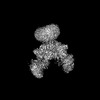
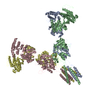
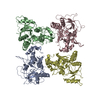
| タイトル | CNQX-bound GluN1a-3A NMDA receptor | |||||||||||||||
 要素 要素 |
| |||||||||||||||
 キーワード キーワード | MEMBRANE PROTEIN / Channel / receptor | |||||||||||||||
| 機能・相同性 |  機能・相同性情報 機能・相同性情報serine binding / negative regulation of dendritic spine development / glycine-gated cation channel activity / pons maturation / EPHB-mediated forward signaling / Assembly and cell surface presentation of NMDA receptors / regulation of cell communication / positive regulation of Schwann cell migration / olfactory learning / dendritic branch ...serine binding / negative regulation of dendritic spine development / glycine-gated cation channel activity / pons maturation / EPHB-mediated forward signaling / Assembly and cell surface presentation of NMDA receptors / regulation of cell communication / positive regulation of Schwann cell migration / olfactory learning / dendritic branch / conditioned taste aversion / protein localization to postsynaptic membrane / regulation of respiratory gaseous exchange / transmitter-gated monoatomic ion channel activity / suckling behavior / propylene metabolic process / response to glycine / RAF/MAP kinase cascade / response to amine / glutamate receptor activity / neurotransmitter receptor complex / Assembly and cell surface presentation of NMDA receptors / response to glycoside / Synaptic adhesion-like molecules / regulation of monoatomic cation transmembrane transport / NMDA glutamate receptor activity / voltage-gated monoatomic cation channel activity / NMDA selective glutamate receptor complex / glutamate binding / ligand-gated sodium channel activity / neuromuscular process / regulation of axonogenesis / calcium ion transmembrane import into cytosol / regulation of dendrite morphogenesis / male mating behavior / regulation of synapse assembly / protein heterotetramerization / response to morphine / glycine binding / startle response / positive regulation of reactive oxygen species biosynthetic process / dendrite development / parallel fiber to Purkinje cell synapse / monoatomic ion channel complex / monoatomic cation transmembrane transport / positive regulation of calcium ion transport into cytosol / cellular response to glycine / associative learning / positive regulation of dendritic spine maintenance / Unblocking of NMDA receptors, glutamate binding and activation / regulation of neuronal synaptic plasticity / monoatomic cation transport / prepulse inhibition / glutamate receptor binding / social behavior / ligand-gated monoatomic ion channel activity / phosphatase binding / long-term memory / monoatomic cation channel activity / synaptic cleft / response to fungicide / calcium ion homeostasis / positive regulation of synaptic transmission, glutamatergic / cellular response to manganese ion / glutamate-gated receptor activity / glutamate-gated calcium ion channel activity / presynaptic active zone membrane / sensory perception of pain / excitatory synapse / ionotropic glutamate receptor signaling pathway / dendrite membrane / presynaptic modulation of chemical synaptic transmission / regulation of neuron apoptotic process / protein phosphatase 2A binding / ligand-gated monoatomic ion channel activity involved in regulation of presynaptic membrane potential / positive regulation of excitatory postsynaptic potential / hippocampal mossy fiber to CA3 synapse / sodium ion transmembrane transport / response to amphetamine / learning / synaptic membrane / adult locomotory behavior / synaptic transmission, glutamatergic / excitatory postsynaptic potential / regulation of membrane potential / transmitter-gated monoatomic ion channel activity involved in regulation of postsynaptic membrane potential / neuron cellular homeostasis / cerebral cortex development / visual learning / response to calcium ion / regulation of synaptic plasticity / regulation of long-term neuronal synaptic plasticity / postsynaptic density membrane / modulation of chemical synaptic transmission / calcium ion transmembrane transport / calcium channel activity / memory / intracellular calcium ion homeostasis / terminal bouton / synaptic vesicle 類似検索 - 分子機能 | |||||||||||||||
| 生物種 |  Homo sapiens (ヒト) Homo sapiens (ヒト) | |||||||||||||||
| 手法 | 電子顕微鏡法 / 単粒子再構成法 / クライオ電子顕微鏡法 / 解像度: 4.23 Å | |||||||||||||||
 データ登録者 データ登録者 | Michalski, K. / Furukawa, H. | |||||||||||||||
| 資金援助 |  米国, 4件 米国, 4件
| |||||||||||||||
 引用 引用 | ジャーナル: Sci Adv / 年: 2024 タイトル: Structure and function of GluN1-3A NMDA receptor excitatory glycine receptor channel. 著者: Kevin Michalski / Hiro Furukawa / 要旨: -methyl-d-aspartate receptors (NMDARs) and other ionotropic glutamate receptors (iGluRs) mediate most of the excitatory signaling in the mammalian brains in response to the neurotransmitter glutamate. ...-methyl-d-aspartate receptors (NMDARs) and other ionotropic glutamate receptors (iGluRs) mediate most of the excitatory signaling in the mammalian brains in response to the neurotransmitter glutamate. Uniquely, NMDARs composed of GluN1 and GluN3 are activated exclusively by glycine, the neurotransmitter conventionally mediating inhibitory signaling when it binds to pentameric glycine receptors. The GluN1-3 NMDARs are vital for regulating neuronal excitability, circuit function, and specific behaviors, yet our understanding of their functional mechanism at the molecular level has remained limited. Here, we present cryo-electron microscopy structures of GluN1-3A NMDARs bound to an antagonist, CNQX, and an agonist, glycine. The structures show a 1-3-1-3 subunit heterotetrameric arrangement and an unprecedented pattern of GluN3A subunit orientation shift between the glycine-bound and CNQX-bound structures. Site-directed disruption of the unique subunit interface in the glycine-bound structure mitigated desensitization. Our study provides a foundation for understanding the distinct structural dynamics of GluN3 that are linked to the unique function of GluN1-3 NMDARs. | |||||||||||||||
| 履歴 |
|
- 構造の表示
構造の表示
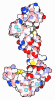
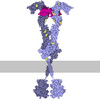
| 構造ビューア | 分子: MolmilJmol/JSmol |
|---|
- ダウンロードとリンク
-ダウンロード
| PDBx/mmCIF形式 | 8usw.cif.gz | 464.7 KB | 表示 | PDBx/mmCIF形式 |
|---|---|---|---|---|
| PDB形式 | pdb8usw.ent.gz | 342.5 KB | 表示 | PDB形式 |
| PDBx/mmJSON形式 | 8usw.json.gz | ツリー表示 | PDBx/mmJSON形式 | |
| その他 |  その他のダウンロード その他のダウンロード |
-検証レポート
| アーカイブディレクトリ | https://data.pdbj.org/pub/pdb/validation_reports/us/8uswftp://data.pdbj.org/pub/pdb/validation_reports/us/8usw | HTTPS FTP |
|---|
-関連構造データ


-リンク
 PDBj
PDBj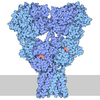
- 集合体
集合体
| 登録構造単位 | 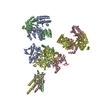
|
|---|---|
| 1 |
|
-要素
| #1: タンパク質 | 分子量: 95041.672 Da / 分子数: 2 / 由来タイプ: 組換発現 / 由来: (組換発現) Homo sapiens (ヒト) / 遺伝子: Grin1発現宿主:   Spodoptera frugiperda (ツマジロクサヨトウ) Spodoptera frugiperda (ツマジロクサヨトウ)参照: UniProt: P35439 #2: タンパク質 | 分子量: 104837.195 Da / 分子数: 2 / 由来タイプ: 組換発現 / 由来: (組換発現) Homo sapiens (ヒト) / 遺伝子: GRIN3A発現宿主: Spodoptera frugiperda (ツマジロクサヨトウ)参照: UniProt: Q8TCU5 #3: 化合物 | 分子量: 232.152 Da / 分子数: 2 / 由来タイプ: 合成 / 式: C9H4N4O4 / タイプ: SUBJECT OF INVESTIGATION 研究の焦点であるリガンドがあるか | Y | Has protein modification | Y | |
|---|
-実験情報
-実験
| 実験 | 手法: 電子顕微鏡法 |
|---|---|
| EM実験 | 試料の集合状態: PARTICLE / 3次元再構成法: 単粒子再構成法 |
- 試料調製
試料調製
| 構成要素 | 名称: CNQX-bound GluN1-3A NMDA receptor / タイプ: COMPLEX / Entity ID: #1-#2 / 由来: RECOMBINANT |
|---|---|
| 分子量 | 値: 0.4 MDa / 実験値: NO |
| 由来(天然) | 生物種: Homo sapiens (ヒト) |
| 由来(組換発現) | 生物種: Spodoptera frugiperda (ツマジロクサヨトウ) |
| 緩衝液 | pH: 7.5 |
| 試料 | 包埋: NO / シャドウイング: NO / 染色: NO / 凍結: YES |
| 急速凍結 | 凍結剤: ETHANE |
- 電子顕微鏡撮影
| 実験機器 |  モデル: Titan Krios / 画像提供: FEI Company |
|---|---|
| 顕微鏡 | モデル: FEI TITAN KRIOS |
| 電子銃 | 電子線源:  FIELD EMISSION GUN / 加速電圧: 300 kV / 照射モード: OTHER FIELD EMISSION GUN / 加速電圧: 300 kV / 照射モード: OTHER |
| 電子レンズ | モード: OTHER / 最大 デフォーカス(公称値): 2200 nm / 最小 デフォーカス(公称値): 800 nm / Cs: 2.7 mm |
| 撮影 | 電子線照射量: 60 e/Å2 / フィルム・検出器のモデル: GATAN K3 (6k x 4k) |
- 解析
解析
| EMソフトウェア | 名称: cryoSPARC / カテゴリ: 3次元再構成 |
|---|---|
| CTF補正 | タイプ: NONE |
| 3次元再構成 | 解像度: 4.23 Å / 解像度の算出法: FSC 0.143 CUT-OFF / 粒子像の数: 264487 / 対称性のタイプ: POINT |
